Kód: 37188764
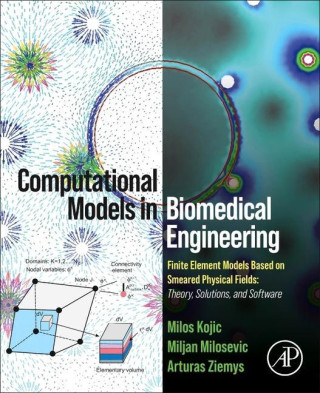
Computational Models in Biomedical Engineering
Autor Milos Kojic, Miljan Milosevic, Arturas Ziemys
Considerable efforts over the last several decades have been directed to the development of computational models and software to simulate biomedical problems, and various numerical and computational methods have been introduced. S ... celý popis


- Jazyk:
 Angličtina
 - Väzba: Brožovaná
- Počet strán: 400
Nakladateľ: Elsevier Books, 2022
- Viac informácií o knihe


Mohlo by sa vám tiež páčiť
-

Moonwalk
14.23 € -17 % -

The Score
13.72 € -12 % -

The Deal
11.40 € -27 % -

The Mistake
14.63 € -

Jujutsu Kaisen, Vol. 30
9.58 € -22 % -

Witch Hat Atelier: Grimoire Edition 1
34.52 € -29 % -

Berserk Deluxe Volume 1
35.63 € -25 % -

Invincible Compendium Volume 2
42.20 € -30 % -

Invincible Compendium Volume 1
45.73 € -24 % -

The Goal
14.63 € -

Berserk Deluxe Volume 2
33.21 € -30 % -

Witch Hat Atelier Manga Box Set 1
56.03 € -25 % -

Heated Rivalry
12.71 € -6 % -

Lord of Mysteries, Vol. 3: The Clown, Part III
14.93 € -29 % -

Moonwalk: A Memoir
21.70 € -24 % -

Murdoku
17.05 € -24 % -

Jujutsu Kaisen, Vol. 25
9.88 € -20 % -

Jujutsu Kaisen, Vol. 26
9.88 € -20 % -

Berserk Deluxe Volume 3
55.12 € -

Jujutsu Kaisen, Vol. 29
9.88 € -20 % -

Veil Volume 1
12.01 € -25 %
Darčekový poukaz: Radosť zaručená
- Darujte poukaz v ľubovoľnej hodnote, a my sa postaráme o zvyšok.
- Poukaz sa vzťahuje na všetky produkty v našej ponuke.
- Elektronický poukaz si vytlačíte z e-mailu a môžete ho ihneď darovať.
- Platnosť poukazu je 12 mesiacov od dátumu vystavenia.
Viac informácií o knihe Computational Models in Biomedical Engineering
Nákupom získate 479 bodov
 Anotácia knihy
Considerable efforts over the last several decades have been directed to the development of computational models and software to simulate biomedical problems, and various numerical and computational methods have been introduced. Some of these represent extensions of concepts already used in engineering, while others have been formulated to treat specifics in biomedicine. The range of approaches in computational methodology spans from pure mathematics to applied mechanics with a strong coupling to laboratory and clinical investigations. The results of computational methods helped to elucidate many biochemical and biomechanical processes, which ultimately improved both therapies and medical procedures. Computational methods and the corresponding software are becoming ever more prominent in medical research and practice. However, besides the mentioned advances, it can be stated that the extensive use of computer simulations in research and practice is still at an early stage. Thus, there is a need to have methodology and software suitable for everyday applications. The authors have developed novel computational methodology which addresses a variety of topics in biomedicine. Their original concept relies on the so-called smeared physical field built into the finite element method. A new and straightforward methodology is represented by the Kojic Transport Model (KTM). A composite smeared finite element (CSFE) as a FE formulation, contains different fields (eg. drug concentration, electrical potential) in a composite medium, such as tissue, which includes the capillary and lymphatic system, different cell groups and organelles. The continuum domains participate in the overall model according to their volumetric fractions. The governing laws and material parameters are assigned to each of the domains. Furthermore, the continuum fields are coupled at each FE node by connectivity elements which take into account biological barriers as vessel walls and cell/organelle membranes. This breakthrough concept opens a new avenue for practical applications since it is robust, effective, and simple to use. For example, instead of a detailed description of the capillary network or network of neural fibers, a continuum representation is employed (with the corresponding consistent transport tensors). The results of the smeared model are strikingly accurate, which is demonstrated in a number of publications related to drug delivery or electrophysiology. The same concept was further extended more broadly to tissue mechanics. Applicability of the new methodology was illustrated on a number of large-scale biomechanical problems: drug delivery within organs with tumors (eg. pancreas and liver) and including tumor growth modeling; lungs (still in the development phase); electrophysiology coupled with mechanics and drug delivery of the heart; eye models with implants; drug release from implants; immune cell transport, etc. The methodology presented in Computational Models in Biomedical Engineering: Finite Element Models Based on Smeared Physical Fields – Theory, Solutions, and Software will have a large and broad impact on computational methods, particularly with respect to biomedical applications and medical practice. It will also have a strong impact on education in computational methods, since the concept is straightforward and simple to follow. The book can also be used by researchers interested in modeling specific problems coupled to experimental or clinical research, as well as to extend the methodology by including additional effects and features. The book also offers a support by software designed for large number of examples, with interface, tutorial and guidance for exploring effects of parameters related to the computational models. The methodology based on the smeared concept within the finite element method is simple, straightforward and easy to use. It is robust and has a multi-scale and multi-domain character. This is shown in Chapter 3, which represents the central part of the book. The new methodology enables the modelling of complex physical field problems and the mechanics of biological systems. It relies on readily measurable geometric and material data, and is applicable to large systems, such as entire organs. These features are illustrated in chapters devoted to applications to tissue, heart, and lung The presented methodology can serve as a basis for further enhancements by including additional phenomena which can be described by relevant relationships, derived theoretically or experimentally observed in laboratories and clinics. It can also be used in the classroom, since the text is self-contained and straightforward , and easily understood even by students who do not have a strong background in natural sciences Lastly, the solved examples and accompanying software have user-friendly interfaces and instructions, making them easy to apply to a variety of problems
Parametre knihy
Zaradenie knihy Knihy po anglicky Medicine Nursing & ancillary services Biomedical engineering
197.69 €
- Celý názov: Computational Models in Biomedical Engineering
- Podnázov: Finite Element Models Based on Smeared Physical Fields: Theory, Solutions, and Software
- Autor: Milos Kojic, Miljan Milosevic, Arturas Ziemys
- Jazyk: Angličtina
- Väzba: Brožovaná
- Počet strán: 400
- EAN: 9780323884723
- ID: 37188764
- Nakladateľ: Elsevier Books
- Hmotnosť: 834 g
- Rozmery: 191 × 236 × 26 mm
- Dátum vydania: 15. September 2022
Osobný odber Bratislava a 12422 dalších
Copyright ©2008-26 najlacnejsie-knihy.sk Všetky práva vyhradenéSúkromieCookies

 24 miliónov titulov
 Vrátenie do mesiaca
 02/210 210 99 (8-15.30h)