Kód: 04535858
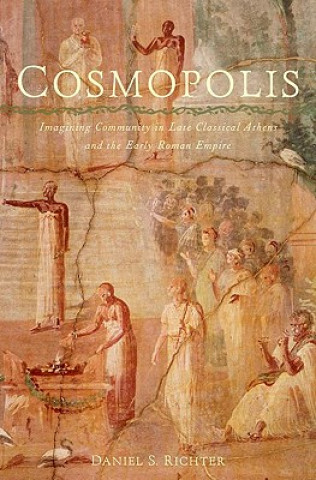
Cosmopolis
Autor Daniel S. Richter
This is a book about the ways in which various intellectuals in the post-classical Mediterranean imagined the human community as a unified, homogenous whole composed of a diversity of parts. More specifically, it explores how aut ... celý popis


- Jazyk:
 Angličtina
 - Väzba: Pevná
- Počet strán: 304
Nakladateľ: Oxford University Press Inc, 2011
- Viac informácií o knihe


Mohlo by sa vám tiež páčiť
-

Favorinos D'Arles, Oeuvres - Tome I: Introduction Generale - Temoignages - Discours Aux Corinthiens - Sur La Fortune
86.12 € -

Favorinos D'Arles, Oeuvres Tome III: Fragments
87.93 € -

Field, Flower, Vase
27.05 € -9 % -

Reaper Dark Verse Tom 2
8.27 € -30 % -

Making Men
45.43 € -

The Cambridge Companion to Classics and Race
43.61 € -

Plutarque Et Les Barbares La Rhetorique D'Une Image
58.05 €
Darčekový poukaz: Radosť zaručená
- Darujte poukaz v ľubovoľnej hodnote, a my sa postaráme o zvyšok.
- Poukaz sa vzťahuje na všetky produkty v našej ponuke.
- Elektronický poukaz si vytlačíte z e-mailu a môžete ho ihneď darovať.
- Platnosť poukazu je 12 mesiacov od dátumu vystavenia.
Viac informácií o knihe Cosmopolis
Nákupom získate 295 bodov
 Anotácia knihy
This is a book about the ways in which various intellectuals in the post-classical Mediterranean imagined the human community as a unified, homogenous whole composed of a diversity of parts. More specifically, it explores how authors of the second century CE adopted and adapted a particular ethnic and cultural discourse that had been elaborated by late fifth- and fourth-century BCE Athenian intellectuals. At the center of this book is a series of contests over the meaning of lineage and descent and the extent to which the political community is or ought to be coterminous with what we might call a biologically homogenous collectivity. The study suggests that early imperial intellectuals found in late classical and early Hellenistic thought a way of accommodating the claims of both ethnicity and culture in a single discourse of communal identity. The idea of the unity of humankind evolved in the fifth and fourth centuries as a response to and an engine for the creation of a rapidly shrinking and increasingly integrated oikoumene . The increased presence of outsiders in the classical city-state as well as the creation of sources of authority that lay outside of the polis destabilized the idea of the polis as a kin group (natio). Beginning in the early fourth century and gaining great momentum in the wake of Alexander's conquest of the East, traditional dichotomies such as Greek and barbarian lost much of their explanatory power. In the second-century CE, by contrast, the empire of the Romans imposed a political space that was imagined by many to be coterminous with the oikoumene itself. One of the central claims of this study is that the forms of cosmopolitan and ecumenical thought that emerged in both moments did so as responses to the idea that the natio - the kin group - is (or ought to be) the basis for any human collectivity.
Parametre knihy
Zaradenie knihy Knihy po anglicky Humanities History History: earliest times to present day
121.86 €
- Celý názov: Cosmopolis
- Podnázov: Imagining Community in Late Classical Athens and the Early Roman Empire
- Autor: Daniel S. Richter
- Jazyk: Angličtina
- Väzba: Pevná
- Počet strán: 304
- EAN: 9780199772681
- ISBN: 0199772681
- ID: 04535858
- Nakladateľ: Oxford University Press Inc
- Hmotnosť: 584 g
- Rozmery: 239 × 165 × 26 mm
- Dátum vydania: 15. April 2011
Obľúbené z iného súdka
-

Tuesdays With Morrie
9.88 € -33 % -

Guns, Germs, and Steel
10.89 € -10 % -

Medieval Costume and How to Make It
11.20 € -2 % -

On Tyranny
10.09 € -27 % -

Egyptian Book of the Dead: The Book of Going Forth by Day : The Complete Papyrus of Ani Featuring Integrated Text and Full-Color Images (History ... M
32.80 € -8 % -

The Art of Combat
26.44 € -24 % -

Distant Mirror
15.14 € -29 % -

1453
14.73 € -25 % -

Creation of Patriarchy
22.20 € -

Nixonland
20.89 € -

Victorian Lady's Guide to Fashion and Beauty
16.04 € -24 % -
Ancient Greece
22.71 € -10 % -

4th Fighter Wing in Korean War
32.10 € -26 % -

Crossfire
24.32 € -3 % -

Tuesdays With Morrie
12.31 € -21 % -

Henry III
12.81 € -25 % -

FN FAL Battle Rifle
17.15 € -26 % -

Woodstock
18.16 € -25 % -

Liberty & Order
25.43 € -11 % -

Inescapable Questions
15.44 € -25 % -

Revolution 1989
15.64 € -15 % -

Chronicles of the First Crusade
14.43 € -26 % -

Roman Auxiliary Forts 27 BC-AD 378
18.06 € -15 % -

Those Who Were There
25.74 € -25 % -

Epics of Sumerian Kings
24.32 € -6 % -

The Origins of Totalitarianism
13.12 € -34 % -

From Third World to First
19.88 € -

Illustrated Encyclopedia of Uniforms of World War I
21.19 € -25 % -

Learn to Read Ancient Sumerian
28.26 € -2 % -

History of the Decline and Fall of the Roman Empire
14.83 € -24 % -

Book of Margery Kempe
10.79 € -25 % -

Secret Team
18.27 € -24 % -

History of the Ancient World
26.14 € -21 % -

Gallic War
9.58 € -8 % -

Oxford Illustrated History of Prehistoric Europe
38.86 € -10 % -

Fall of Carthage
14.93 € -29 % -
24 Hours in Ancient Athens
9.08 € -30 % -

Oxford Handbook of Neolithic Europe
67.74 € -

Peloponnesian War
14.13 € -19 % -

Alexander the Great
14.13 € -23 % -

Swerve
14.23 € -

Complete Roman Army
21.19 € -25 % -

Caesar
19.17 € -20 % -

Life in a Medieval Castle
13.12 € -30 % -

Fear and Loathing on the Campaign Trail '72
13.01 € -29 % -

Streams of Gold, Rivers of Blood
30.18 € -12 % -

Safe Area Gorazde
20.18 € -24 % -

Electric Kool-Aid Acid Test
10.39 € -30 % -

Swords of the Viking Age
29.98 € -14 %
Osobný odber Bratislava a 12422 dalších
Copyright ©2008-26 najlacnejsie-knihy.sk Všetky práva vyhradenéSúkromieCookies

 24 miliónov titulov
 Vrátenie do mesiaca
 02/210 210 99 (8-15.30h)