Kód: 04616453
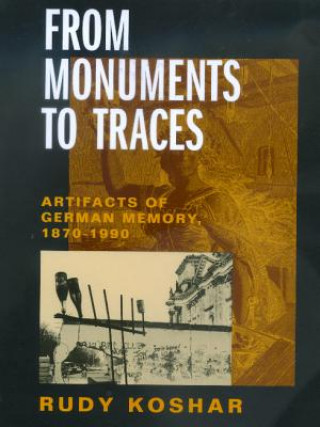
From Monuments to Traces
Autor Rudy Koshar
Rudy Koshar constructs a powerful framework in which to examine the subject of German collective memory, which for more than a half century has been shaped by the experience of Nazism, World War II, and the Holocaust. Finding the ... celý popis


- Jazyk:
 Angličtina
 - Väzba: Pevná
- Počet strán: 368
Nakladateľ: University of California Press, 2000
- Viac informácií o knihe


Mohlo by sa vám tiež páčiť
-

The history of the US and its influence on the world
9.08 € -15 % -

Smart Materials-Based Actuators at the Micro/Nano-Scale
154.07 € -7 % -

Geography Made Easy
18.06 € -24 % -

Jean Moulin
12.51 €
Darujte túto knihu ešte dnes
- Objednajte knihu a vyberte Zaslať ako darček.
- Obratom obdržíte darovací poukaz na knihu, ktorý môžete ihneď odovzdať obdarovanému.
- Knihu zašleme na adresu obdarovaného, o nič sa nestaráte.
Viac informácií o knihe From Monuments to Traces
Nákupom získate 169 bodov
 Anotácia knihy
Rudy Koshar constructs a powerful framework in which to examine the subject of German collective memory, which for more than a half century has been shaped by the experience of Nazism, World War II, and the Holocaust. Finding the assumptions of many writers and scholars shortsighted, Koshar surveys the evidence of postwar German memory in the context of previous traditions. "From Monuments to Traces" follows the evolution of German 'memory landscapes' all the way from national unification in 1870-71 through the world wars and political division to reunification in 1990. The memory landscapes of any society may incorporate monuments, historical buildings, memorials and cemeteries, battlefields, streets, or natural environments that foster shared memories of important events or personalities. They may also be designed to divert public attention from embarrassing or traumatic histories. Koshar argues that in Germany, memory landscapes have taken shape according to four separate paradigms - the national monument, the ruin, the reconstruction, and the trace - which he analyzes in relation to the changing political agendas that have guided them over time. Despite the massive ruptures of Germany's history, we see that significant continuities have served to counterbalance the traumas of the German past.
Parametre knihy
Zaradenie knihy Knihy po anglicky Humanities History Regional & national history
69.76 €
- Celý názov: From Monuments to Traces
- Podnázov: Artifacts of German Memory, 1870-1990
- Autor: Rudy Koshar
- Jazyk: Angličtina
- Väzba: Pevná
- Počet strán: 368
- EAN: 9780520217683
- ISBN: 0520217683
- ID: 04616453
- Nakladateľ: University of California Press
- Hmotnosť: 771 g
- Rozmery: 229 × 152 × 30 mm
- Dátum vydania: 18. July 2000
Obľúbené z iného súdka
-

Hundred Years' War on Palestine
13.22 € -19 % -

Rubicon
15.14 € -24 % -

Bury My Heart At Wounded Knee
11.40 € -34 % -

History of the Kings of Britain
17.66 € -5 % -

Cuneiform
10.79 € -25 % -

Alexander the Great
18.06 € -25 % -
Osman's Dream
16.85 € -24 % -

How to be a Victorian
13.01 € -29 % -

'Tis
11.80 € -25 % -

On China
16.95 € -34 % -

Empress Dowager Cixi
13.62 € -33 % -

Ecclesiastical History of the English People
10.59 € -25 % -

Voynich Manuscript
41.29 € -6 % -

We Were Soldiers Once...And Young
11.30 € -28 % -
Rise And Fall of Athens
17.36 € -22 % -

Colossus
11.80 € -25 % -

Austrian Commanders of the Napoleonic Wars
18.06 € -15 % -

Blood, Toil, Tears and Sweat
13.92 € -24 % -

Genghis Khan
18.77 € -16 % -

Origins of the Second World War
13.92 € -24 % -

Benjamin Franklin
18.87 € -11 % -

Children of Ash and Elm
19.98 € -20 % -

Campaigns of Alexander
13.72 € -26 % -

Diana: Her True Story - In Her Own Words
13.01 € -25 % -
Oxford History of Greece and the Hellenistic World
16.85 € -24 % -

Byzantium
16.04 € -24 % -

Florence
55.83 € -25 % -

History of the Byzantine State and Society
53.60 € -12 % -

Lords of the Horizons
13.12 € -29 % -

Annals & The Histories
15.44 € -25 % -

American Nations
13.42 € -24 % -

Badges and Uniforms of the Royal Air Force
16.04 € -24 % -

Spanish Civil War
13.92 € -24 % -

Berlin
12.81 € -26 % -
Winston Churchill
17.46 € -2 % -

Imagining the Balkans
37.75 € -

Inventing Eastern Europe
29.47 € -11 % -

Unfinished Empire
13.01 € -29 % -

German Fighter Ace Werner Molders:: An Illustrated Biography
35.43 € -26 % -
Two Lives of Charlemagne
12.71 € -25 % -

Secret History of the IRA
20.18 € -24 % -

Thracians 700BC-46AD
15.74 € -15 % -

Paston Letters
9.88 € -25 % -

Attila and the Nomad Hordes
18.06 € -15 % -

Middle Ground
32 € -24 % -

Promised You A Miracle
13.92 € -24 % -

Black Athena Writes Back
41.08 € -

Brief History of the Private Lives of the Roman Emperors
15.74 € -20 % -

Rising '44
21.19 € -25 %
Osobný odber Bratislava a 12422 dalších
Copyright ©2008-26 najlacnejsie-knihy.sk Všetky práva vyhradenéSúkromieCookies

 24 miliónov titulov
 Vrátenie do mesiaca
 02/210 210 99 (8-15.30h)