Kód: 06372184
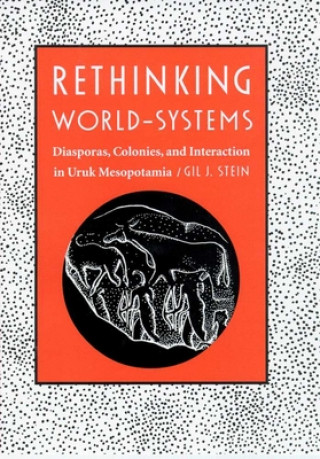
Rethinking World-Systems
Autor Gil J. Stein
The use of world-systems theory to explain the spread of social complexity has become accepted practice by both historians and archaeologists. Gil Stein now offers the first rigorous test of world systems as a model in archaeology ... celý popis


- Jazyk:
 Angličtina
 - Väzba: Pevná
- Počet strán: 206
Nakladateľ: University of Arizona Press, 1999
- Viac informácií o knihe

62.21 €
Dostupnosť:
50 % šanca Máme informáciu, že by titul mohol byť dostupný. Na základe vašej objednávky sa ho pokúsime do 6 týždňov zabezpečiť.
Prehľadáme celý svet
Mohlo by sa vám tiež páčiť
-

The Holographic Universe
11.81 € -24 % -

Jolly Phonics Puppets
64.54 € -27 % -

Shadow Work Journal
12.31 € -27 % -

Way of All Women
27.36 € -18 % -

The Carl Jung Psychology Test: Explore Your Inner Psychology: With 52 Cards & 128-Page Book
18.27 € -24 % -

Carl Jung: Wounded Healer of the Soul
26.35 € -25 % -

Superstart Violin
12.21 € -14 % -

Bez slov
6.96 € -37 % -

City And The Stars
11 € -30 % -

Zázračná rovnice
9.08 € -21 % -

Persona Q: Shadow Of The Labyrinth Side: P3 Volume 2
9.28 € -41 % -

A tutorial for making military DIORAMAS and MODELS
31.51 € -7 % -

How Shoes are Made
41.10 € -
Ústecko z nebe
20.29 € -21 % -

First, Know Your Self: A Guide to Discovering the Power of Your Personality. Based on the Work of Carl Jung
9.69 € -7 % -

The Call of the Wild and White Fang
8.68 € -14 % -

Queen Victoria's Matchmaking: The Royal Marriages That Shaped Europe
14.03 € -25 % -

Armathco
18.78 € -

History Of Labor In The United States V2 (1918)
45.34 € -1 % -

Convert
11.71 € -26 % -

Where Survivors Are Buried
14.03 € -7 % -

The Puzzle Piece Maker: Chosen To Win
14.03 € -7 % -

Le cahier d'Ella - Petits carreaux, 96p, A5 - Ballerine
10.50 € -

Windows Vista Par étapes
25.24 € -

Stuck
46.96 € -

Essays on the Doctrinal Study of Law
92.52 € -7 % -

World Jury Systems
275.55 € -

Chemistry of the Actinide Elements
615.65 € -7 % -
Marie Gerin-Lajoie
25.04 € -

Children Exposed To Violence
63.83 € -

Love Affair for Life
17.87 € -
HYMNE AU SOLEIL 4 VX M CHANT
8.48 € -

Sage of Sixteen, Etc
23.53 € -25 % -

Mathématiques pour l'économie - Algèbre - Licence
21.81 € -14 % -

Infections in Outpatient Practice
102.82 € -7 %
Darčekový poukaz: Radosť zaručená
- Darujte poukaz v ľubovoľnej hodnote, a my sa postaráme o zvyšok.
- Poukaz sa vzťahuje na všetky produkty v našej ponuke.
- Elektronický poukaz si vytlačíte z e-mailu a môžete ho ihneď darovať.
- Platnosť poukazu je 12 mesiacov od dátumu vystavenia.
Informovať o naskladnení knihy
Zadajte do formulára e-mailovú adresu a akonáhle knihu naskladníme, zašleme vám o tom správu. Postrážime všetko za vás.
Viac informácií o knihe Rethinking World-Systems
Nákupom získate 151 bodov
 Anotácia knihy
The use of world-systems theory to explain the spread of social complexity has become accepted practice by both historians and archaeologists. Gil Stein now offers the first rigorous test of world systems as a model in archaeology, arguing that the application of world-systems theory to noncapitalist, pre-fifteenth-century societies distorts our understanding of developmental change by overemphasizing the role of external over internal dynamics.In this new study, Stein proposes two complementary theoretical frameworks for the study of interregional interaction: a "distance-parity" model, which views world-systems as simply one factor in a broader range of intersocietal relations, and a "trade-diaspora" model, which explains variation in exchange systems from the perspective of participant groups. He tests his models against the archaeological record of Mesopotamian expansion into the Anatolian highlands during the fourth millennium B.C.Whereas some scholars have considered this "Uruk expansion" to be one of the earliest documented world-systems, Stein uses data from the site of Hacinebi in southeastern Turkey to support his alternate perspective. Comparing economic data from pre- and postcontact phases, Stein shows that the Mesopotamians did not dominate the people of this distant periphery.Such evidence, argues Stein, shows that we must look more closely at the local cultures of peripheries to develop realistic cross-cultural models of variation in colonialism, exchange, and secondary state formation in ancient societies. By demonstrating that a multitude of factors affect the nature and consequences of intersocietal contacts, his book advocates a much-needed balance betweenrecognizing that no society can be understood in complete isolation from its neighbors and assuming the primacy of outside contact in a society's development.
Parametre knihy
Zaradenie knihy Books in English Society & social sciences Sociology & anthropology Anthropology
62.21 €
- Celý názov: Rethinking World-Systems
- Podnázov: Diasporas, Colonies, and Interaction in Uruk Mesopotamia
- Autor: Gil J. Stein
- Jazyk: Angličtina
- Väzba: Pevná
- Počet strán: 206
- EAN: 9780816520091
- ISBN: 9780816520091
- ID: 06372184
- Nakladateľ: University of Arizona Press
- Hmotnosť: 500 g
- Rozmery: 160 × 235 × 24 mm
- Dátum vydania: 15. September 1999
Obľúbené z iného súdka
-

Revolt Against the Modern World
22.21 € -23 % -

Consider The Lobster
14.43 € -19 % -

Trickster Makes This World
13.93 € -24 % -

Crowd
9.28 € -24 % -

Cognition in the Wild
61.81 € -

On Saudi Arabia
14.64 € -28 % -

Up from Eden
18.78 € -21 % -

Combatting Cult Mind Control
18.37 € -1 % -

How Forests Think
31 € -9 % -

Incomplete Nature
34.94 € -18 % -

Utopia Of Rules
18.78 € -8 % -

Ritual
11.30 € -25 % -

Continuum Concept
16.25 € -6 % -

Secret of Our Success
22.41 € -11 % -

Designs for the Pluriverse
28.88 € -

Think Like an Anthropologist
13.12 € -29 % -

The Fate of Africa
27.57 € -

Kill All Normies - Online culture wars from 4chan and Tumblr to Trump and the alt-right
12.21 € -14 % -

Logic of Practice
27.87 € -10 % -

Silo Effect
14.43 € -19 % -

Human Devolution
31.20 € -8 % -

Stone Age Economics
30.39 € -

Modernity At Large
29.28 € -

Cultural Histories of the Material World
28.78 € -

Forms of Talk
31.10 € -6 % -

Landscapes of Fear
29.49 € -4 % -

Genesis of Symbolic Thought
33.53 € -

Sound and Sentiment
31.10 € -

Heritage
61.81 € -

Animal to Edible
28.78 € -

Stranger and Friend
19.89 € -18 % -

Dreamscapes of Modernity
40.90 € -

Swastika
23.22 € -

Cultural Evolution
42.01 € -

Crisis of the Modern World
18.37 € -1 % -

Exercised
15.44 € -11 % -

Catching Fire
12.21 € -30 % -

Gift
12.92 € -30 % -

Crisis of the Modern World
28.27 € -1 % -

Social Life of Things
34.43 € -

Protestant Ethic and Other Writings
15.95 € -25 % -

Continuum Concept
14.03 € -25 % -

Spirit Catches You and You Fall Down
14.03 € -25 % -

Purity and Danger
24.13 € -10 % -

Direct Action: An Ethnography
21.61 € -25 % -

Origin of Our Species
11 € -30 % -

Dance Ethnography and Global Perspectives
106.15 € -4 % -

Ruin of Kasch
13.02 € -29 % -

Fragments of an Anarchist Anthropology
9.89 € -25 %
Collection points Bratislava a 13253 dalších
Copyright ©2008-26 najlacnejsie-knihy.sk All rights reservedPrivacyCookies

 26510 collection points
 Delivery 2.99 €
 02/210 210 99 (8-15.30h)