Kód: 42363667
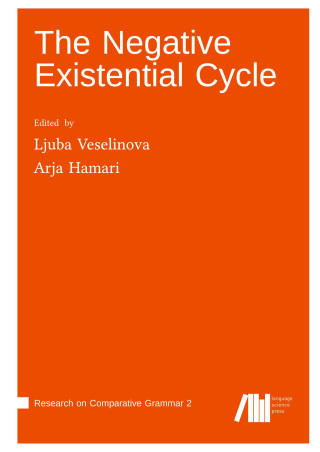
The Negative Existential Cycle
Autor Arja Hamari
In 1991, William Croft suggested that negative existentials (typically lexical expressions that mean 'not exist, not have') are one possible source for negation markers and gave his hypothesis the name Negative Existential Cycle ( ... celý popis


- Jazyk:
 Angličtina
 - Väzba: Pevná
- Počet strán: 668
Nakladateľ: Language Science Press, 2022
- Viac informácií o knihe

57.69 €
Bežne: 67.71 €
Ušetríte 10.03 €

Skladom u dodávateľa
Odosielame za 10 - 13 dní
Mohlo by sa vám tiež páčiť
-

Moonwalk
14.01 € -14 % -

The Score
13.71 € -

The Deal
12.30 € -21 % -

The Mistake
13.51 € -

Jujutsu Kaisen, Vol. 30
9.87 € -20 % -

The Goal
14.62 € -

Berserk Deluxe Volume 1
35.70 € -25 % -

Berserk Deluxe Volume 2
33.17 € -30 % -

Invincible Compendium Volume 2
45.68 € -24 % -

Legacy
11.89 € -22 % -

Lord of Mysteries, Vol. 3: The Clown, Part III
17.04 € -13 % -

Berserk Deluxe Volume 3
55.16 € -

Murdoku
14.01 € -25 % -

Witch Hat Atelier: Grimoire Edition 1
35.19 € -29 % -

Jujutsu Kaisen, Vol. 25
9.67 € -25 % -

JoJo's Bizarre Adventure: Part 7--Steel Ball Run, Vol. 7
18.15 € -25 % -

Chainsaw Man, Vol. 21
9.27 € -25 % -

White Nights
4.53 € -14 % -

Witch Hat Atelier Manga Box Set 1
53.85 € -28 % -

The Deal
14.62 € -22 % -

Jujutsu Kaisen, Vol. 29
9.67 € -25 %
Darujte túto knihu ešte dnes
- Objednajte knihu a vyberte Zaslať ako darček.
- Obratom obdržíte darovací poukaz na knihu, ktorý môžete ihneď odovzdať obdarovanému.
- Knihu zašleme na adresu obdarovaného, o nič sa nestaráte.
Viac informácií o knihe The Negative Existential Cycle
Nákupom získate 140 bodov
 Anotácia knihy
In 1991, William Croft suggested that negative existentials (typically lexical expressions that mean 'not exist, not have') are one possible source for negation markers and gave his hypothesis the name Negative Existential Cycle (NEC). It is a variationist model based on cross-linguistic data. For a good twenty years following its formulation, it was cited at face-value without ever having been tested by (historical)-comparative data. Over the last decade, Ljuba Veselinova has worked on testing the model in a comparative perspective, and this edited volume further expands on her work. The collection presented here features detailed studies of several language families such as Bantu, Chadic and Indo-European. A number of articles focus on the micro-variation and attested historical developments within smaller groups and clusters such as Arabic, Mandarin and Cantonese, and Nanaic. Finally, variation and historical developments in specific languages are discussed for Ancient Hebrew, Ancient Egyptian, Moksha-Mordvin (Uralic), Bashkir (Turkic), Kalmyk (Mongolic), three Pama-Nyungan languages, O'dam (Southern Uto-Aztecan) and Tacana (Takanan, Amazonian Bolivia). The book is concluded by two chapters devoted to modeling cyclical processes in language change from different theoretical perspectives. Key notions discussed throughout the book include affirmative and negative existential constructions, the expansion of the latter into verbal negation, and subsequently from more specific to more general markers of negation. Nominalizations as well as the uses of negative existentials as standalone negative answers figure among the most frequent pathways whereby negative existentials evolve as general negation markers. The operation of the Negative Existential Cycle appears partly genealogically conditioned, as the cycle is found to iterate regularly within some families but never starts in others, as is the case in Bantu. In addition, other special negation markers such as nomin
Parametre knihy
Zaradenie knihy Books in German Geisteswissenschaften, Kunst, Musik Sprach- und Literaturwissenschaft Sonstige Sprachen / Sonstige Literaturen
57.69 €
- Celý názov: The Negative Existential Cycle
- Autor: Arja Hamari
- Jazyk: Angličtina
- Väzba: Pevná
- Počet strán: 668
- EAN: 9783985540358
- ISBN: 3985540357
- ID: 42363667
- Nakladateľ: Language Science Press
- Hmotnosť: 1431 g
- Rozmery: 246 × 175 × 47 mm
- Dátum vydania: 02. December 2022
Collection points Bratislava a 12799 dalších
Copyright ©2008-26 najlacnejsie-knihy.sk All rights reservedPrivacyCookies

 25602 collection points
 Delivery 2.99 €
 02/210 210 99 (8-15.30h)