Code: 50069183
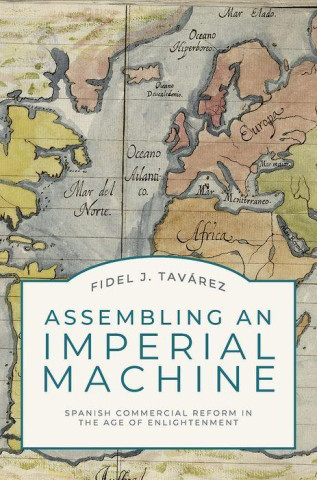
Assembling an Imperial Machine
by Tavarez, Fidel J. (Assistant Professor of History, Assistant Professor of History, Queens College, CUNY)
During the eighteenth century, Spanish statesmen pursued a set of ambitious imperial reforms that thoroughly remade conceptualizations of empire. They compared well-ordered empires to harmonious machines and devised a comprehensiv ... more


- Language:
 English
 - Binding: Hardback
- Number of pages: 344
Publisher: Oxford University Press, 2026
- More about this


You might also like
-

Sakamoto Days, Vol. 3
10.28 € -21 % -

Expecting Better
13.91 € -24 % -

Espanol en marcha - Nueva edicion (2021 ed.)
18.15 € -

Metody dramatické výchovy v mateřské škole
7.55 € -19 % -

Beste Freunde A1+A2
6.24 € -22 % -

Směju se, abych nebrečel
13 € -16 % -

Moderní analýza biologických dat 3
9.37 € -22 % -

Smrt boha smrti
5.64 € -30 % -

Samolepková zvířátka V noci
2.71 € -33 % -

BEST OF DARK ART
13.40 € -24 % -

100 Children's Crosswords: Travel
5.84 € -25 % -

Art of Indian Asia
104.28 € -

Assembly of God Evangelical Church
57.69 € -14 % -

Alice's Adventures in Wonderland
19.66 € -30 %
Give this book as a present today
- Order book and choose Gift Order.
- We will send you book gift voucher at once. You can give it out to anyone.
- Book will be send to donee, nothing more to care about.
More about Assembling an Imperial Machine
You get 129 loyalty points
 Book synopsis
During the eighteenth century, Spanish statesmen pursued a set of ambitious imperial reforms that thoroughly remade conceptualizations of empire. They compared well-ordered empires to harmonious machines and devised a comprehensive plan to liberalize and integrate the imperial economy. The main initiative to emerge from this economic plan was a commercial policy that contemporaries called comercio libre, which entailed replacing the traditional fleets and galleons with a new system of free trade within the empire. The men who designed this new imperial vision became convinced that the pursuit of markets, rather than military power alone, was the key to succeeding in a modern commercial society. Unlike their European counterparts, who remained keenly interested in international trade, Spanish ministers focused on integrating Spain's vast imperial economy. In their minds, the Hispanic world could become an integrated and self-sufficient microcosm of the global economy, which would enable the empire to partake in the world's trade without the rivalry and warfare that came from international commerce. Moving seamlessly between developments in Spain and Spanish America, Fidel J. Tavárez demonstrates how the imperial machine was projected to reap the benefits of economic growth by synergizing millions of people across Spain's dominions, including Indigenous and Afro-descendant colonial subjects. He traces the evolution of the empire's economy from extractive measures intended to drain colonial possessions of their resources for the metropole's gain to notions of a mutually beneficial and equal conglomeration of transoceanic territories. By bringing this effort to light, Tavárez shows that, rather than a mercantilist throwback, the Hispanic world's commercial reforms represented a genuine attempt to solve the dilemmas of early modern globalization, an endeavor that, in turn, inaugurated the enduring fascination with erecting trade blocs in Latin America. Combining economic, intellectual, and political history, Assembling an Imperial Machine provides an innovative interpretation of this momentous period in the history of the Hispanic world.
Book details
Book category Books in German Geisteswissenschaften, Kunst, Musik Geschichte Kulturgeschichte einzelne Themen und Gegenstände
53.35 €
- Full title: Assembling an Imperial Machine
- Author: Tavarez, Fidel J. (Assistant Professor of History, Assistant Professor of History, Queens College, CUNY)
- Language: English
- Binding: Hardback
- Number of pages: 344
- EAN: 9780197755051
- ISBN: 0197755054
- ID: 50069183
- Publisher: Oxford University Press
- Weight: 689 g
- Date of publishing: 22. April 2026
Trending among others
-

Junkers Ju 88c Day and Nightfighters
18.15 € -24 % -

Everything Is Tuberculosis
11.79 € -20 % -

King of Kings
12.19 € -25 % -

Cobalt Red: How the Blood of the Congo Powers Our Lives
11.19 € -29 % -

Spice
13.71 € -20 % -

A Little History of the World
12.50 € -17 % -

Cuba: An American History
15.42 € -25 % -

Imperial Japanese Navy 1932-1945 Warships and Colours: With Japanese Army Vessels and Three Special Bonus Pages
59.60 € -2 % -

Byzantine Cavalryman Vs Vandal Warrior: North Africa Ad 533-36
17.14 € -26 % -

Kyiv 2022
16.83 € -24 % -

Inventing the Renaissance
16.23 € -23 % -

200 Years Together I
28.23 € -2 % -

White Power
23.39 € -7 % -

200 Years Together II
28.23 € -2 % -

Women and Gender in Islam
21.37 € -10 % -

The Electric Kool-Aid Acid Test
14.82 € -24 % -

Israel on Trial
22.68 € -27 % -

Ungrounding
26.32 € -20 % -

Lavochkin La-7 In Profile & Scale
21.88 € -2 % -

The Pirates' Code
11.79 € -25 % -

1942
31.96 € -24 % -

The International Jew
25.11 € -6 % -

Sinai 1916-17
18.04 € -25 % -

Advanced Long Range Shooting
19.26 € -2 % -

Flieger-Kappmesser
41.75 € -17 % -

FW 190 Schlacht Units
18.04 € -25 % -

Guadalcanal's Longest Fight
25 € -25 % -

No. 311 (Czechoslovak) Squadron in RAF Bomber Command 1940 - 1942
25.41 € -6 % -

Simo Häyhä
14.82 € -1 % -

The White Pedestal
23.29 € -25 % -

Waging a Good War: How the Civil Rights Movement Really Worked
14.82 € -24 % -

A Killer by Design: Murderers, Mindhunters, and My Quest to Decipher the Criminal Mind
14.72 € -25 % -

A Little History of the United States
11.49 € -24 % -

The Frontiersmen; a Narrative of 1783
18.35 € -1 % -

The Identity Trap: What the New Groupthink Gets Right--And What It Gets Dangerously Wrong
36.10 € -11 % -

UFO: The Inside Story of the Us Government's Search for Alien Life Here--And Out There
23.29 € -25 % -

African Trade Beads
28.43 € -25 % -

War is a Racket
7.86 € -25 % -

The Petlyakov Pe-2 and Pe-3 In Profile & Scale Volume II
23.69 € -2 % -

South Africa's Border War 1966-89
44.47 € -22 % -

The D-Day Visitor's Handbook, 80th Anniversary Edition: Your Guide to the Normandy Battlefields and WWII Paris, Revised and Updated
11.79 € -25 % -

Pamphlets
37.21 € -2 % -

Luftwaffe Squadrons 1939-45
21.17 € -25 % -

Vietnam War Heroes
13.91 € -1 % -

History and Politics of Star Wars
58.79 € -

Trauma of Caste
14.01 € -25 % -

Ghosts of Honolulu
14.72 € -25 % -

La Guerra en Ucrania: Breve historia de la Invasión Rusa, la Caída de Mariupol, los Ataques de Bajmut, el Frente de Donetsk, la Resistencia
11.29 € -25 % -

A Burst of Light: and Other Essays
10.58 € -25 %
Collection points Bratislava a 12825 dalších
Copyright ©2008-26 najlacnejsie-knihy.sk All rights reservedPrivacyCookies

 25654 collection points
 Delivery 2.99 €
 02/210 210 99 (8-15.30h)