Code: 09200024
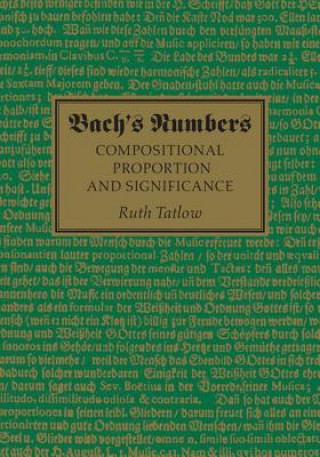
Bach's Numbers
by Ruth Tatlow
In eighteenth-century Germany the universal harmony of God's creation and the perfection of its proportions still held philosophical, moral and devotional significance. Reproducing proportions close to the unity (1:1) across compo ... more


- Language:
 English
- Binding: Hardback
- Number of pages: 427
Publisher: Cambridge University Press, 2015
- More about this


You might also like
-

Gödel, Escher, Bach
18.15 € -29 % -

Advaita Vedanta
22.07 € -25 % -

Natur-Memo Wald
14.14 € -

Treasury of Greek Mythology
21.06 € -25 % -

My First Big Book of Dinosaur Facts
14.24 € -9 % -

Sweet Anticipation
43.44 € -

Regency Guide to Romance
9.32 € -26 % -

Advaita Vedanta
14.64 € -5 % -

Essential Vedanta
21.06 € -17 % -

Her Forgotten Hours
12.33 € -2 % -

Five Arguments All Couples (Need To) Have
10.73 € -24 % -

Staré slovenské povesti II. (červené)
29.89 € -15 % -

Emmanuel Macron and the Two Years That Changed France
17.05 € -10 % -

Wall of Birds
41.23 € -9 % -

Les Particules elementaires
26.18 € -

Blue Labour
33.21 € -

Irak
16.05 € -10 % -

Mathematical Statistics
254.27 € -

Arab and Arab American Feminisms
34.71 € -

Nuwana Wedena Bosath Katha - 53
7.32 € -25 % -

Jérôme K. Jérôme Bloche - Tome 4 - Passé recomposé (nouvelle maquette)
17.05 € -

Oxford Handbook of Religious Conversion
245.04 € -

Bach's Numbers
43.84 € -

Cellat
15.04 € -4 % -

Progressive Revolution
131.95 € -

Medium als symbolische Macht
25.18 € -16 % -

Csi - Rechtsmedizin - Mitternachtsforensik
47.86 € -4 % -

Allgemeine Medizinische Zeichenlehre: Für Angehende Ärzte
25.38 € -29 % -

Kissen - Solo Leveling - Motiv 1
29.29 € -

Membrane Transporters as Drug Targets
204.10 € -7 % -

Wool and Wine
16.25 € -35 % -

Don't Ask the Dragon
13.84 € -24 % -

Arquitectura, Modernidad y Conocimiento
15.44 € -19 % -

DIY Welsh
12.53 € -22 % -

Gender Differences in Expectation, Self-Efficacy, and Attribution
49.36 € -3 % -

Gestion de conflits entre entreprise et usagers
35.31 € -14 % -

LOS FELICES DÍAS DEL VERANO
22.67 € -

Realities of Life
19.96 € -25 % -

Clubhouse
8.02 € -25 % -

Rhiannan's Quest
16.45 € -17 % -

Making Rights Real
118.90 € -
Fiche de lecture Ubu roi de Alfred Jarry (Analyse litteraire de reference et resume complet)
5.71 € -

India-America Relations (1942-62)
238.12 € -

Bad Vespers
11.53 € -25 % -

Maine Horse Doctor
16.05 € -6 % -

Bundle of Sticks; Or, Love and Hate
22.07 € -

What's My Name? Jenay
14.34 € -7 % -

Keeper of the Atlas
13.44 € -7 % -

Last Thing I Saw
11.23 € -10 %
Give this book as a present today
- Order book and choose Gift Order.
- We will send you book gift voucher at once. You can give it out to anyone.
- Book will be send to donee, nothing more to care about.
More about Bach's Numbers
You get 384 loyalty points
 Book synopsis

In eighteenth-century Germany the universal harmony of God's creation and the perfection of its proportions still held philosophical, moral and devotional significance. Reproducing proportions close to the unity (1:1) across compositions could render them beautiful, perfect and even eternal. Using the principles of her groundbreaking theory of proportional parallelism and the latest source study research, Ruth Tatlow reveals how Bach used the number of bars to create numerical perfection across his published collections, and explains why he did so. The first part of the book shows the wide-ranging application of belief in the unity, demonstrating how planning a perfect structure was a normal compositional procedure in Bach's time. In the second part Tatlow presents practical demonstrations of this in all Bach's publications and fair copies, showing that layers of proportion can appear within a movement, a work, between two works in a collection, across a collection or between collections themselves.
Book details
Book category Books in English The arts Music Music: styles & genres
157.64 €
- Full title: Bach's Numbers
- Subtitle: Compositional Proportion and Significance
- Author: Ruth Tatlow
- Language: English
- Binding: Hardback
- Number of pages: 427
- EAN: 9781107088603
- ISBN: 1107088607
- ID: 09200024
- Publisher: Cambridge University Press
- Weight: 1014 g
- Dimensions: 183 × 257 × 26 mm
- Date of publishing: 06. August 2015
Trending among others
-

Dancing The Dream
19.76 € -31 % -

Just Kids
11.23 € -31 % -

Moonwalk
11.93 € -29 % -

Michael Jackson
14.14 € -49 % -

The Long Hard Road Out Of Hell
13.64 € -29 % -

Jazz Piano Book
42.64 € -9 % -

Real Book
36.12 € -25 % -

My Friend Michael
18.45 € -30 % -

Please Kill Me
14.34 € -29 % -

A Perfect Union of Contrary Things
14.94 € -28 % -

The Dirt - Mötley Crüe
14.34 € -29 % -

Songwriters On Songwriting
18.55 € -25 % -

Punk, Post Punk, New Wave
30.60 € -30 % -

Early Flute
32.30 € -

Altered State
12.23 € -25 % -

John Coltrane
15.04 € -25 % -

Twelve Days of Christmas
7.32 € -25 % -

Sound Man
14.64 € -30 % -

Funk: Music, People and Rhythm of the One
20.66 € -25 % -

Next to Normal
13.64 € -24 % -

Pearl Jam Anthology - The Complete Scores
71.24 € -25 % -

Music in the Castle of Heaven
19.96 € -25 % -

Not Dead Yet: The Autobiography
14.84 € -29 % -

Perfect Union of Contrary Things
25.58 € -24 % -

Songs of Leonard Cohen
22.07 € -15 % -
Kurt Cobain
25.28 € -27 % -

Patti Smith
13.14 € -19 % -

Complete David Bowie (Revised and Updated 2016 Edition)
27.49 € -25 % -

Finishing the Hat
43.14 € -25 % -

Real Book - Volume 1
64.21 € -25 % -

Book of Salsa
37.82 € -

Murder In The Front Row
36.12 € -25 % -

What's Love Got to Do with It?
57.09 € -

Pink Noises
27.79 € -9 % -

To Be, or Not . . . to Bop
18.86 € -10 % -

Harmony Of Bill Evans
19.86 € -22 % -

Vocal warm-ups
18.55 € -25 % -
Oscar Peterson
15.64 € -18 % -

Words and Music of Frank Zappa
14.34 € -24 % -

Dire Straits Every Album, Every Song (On Track )
16.45 € -25 % -

M Train
12.13 € -30 % -

In the Studio with Michael Jackson
34.61 € -

Lords Of Chaos - 2nd Edition
18.55 € -24 % -

The Jazz Theory Book
56.29 € -10 % -
Scales and Finger Exercises
10.73 € -7 % -

Yann Tiersen - Piano Works
26.98 € -24 % -

Ocean of Sound
15.04 € -7 % -

Pink Floyd All The Songs
50.26 € -12 % -

Inside Out
17.05 € -27 %
Collection points Bratislava a 13624 dalších
Copyright ©2008-26 najlacnejsie-knihy.sk All rights reservedPrivacyCookies

 27252 collection points
 Delivery 2.99 €
 02/210 210 99 (8-15.30h)
