Code: 04706380
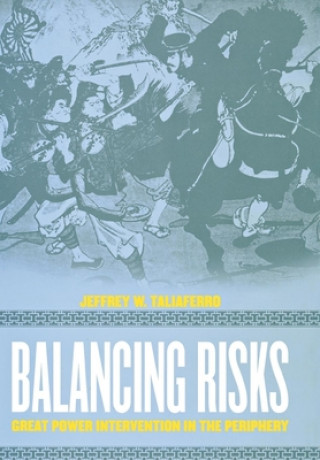
Balancing Risks
by Jeffrey W. Taliaferro
Great powers often initiate risky military and diplomatic inventions in far-off, peripheral regions that pose no direct threat to them, risking direct confrontation with rivals in strategically inconsequential places. Why do power ... more


- Language:
 English
 - Binding: Hardback
- Number of pages: 336
Publisher: Cornell University Press, 2004
- More about this


You might also like
-

List: Magnolia Tree (Foiled Pocket Journal)
8 € -25 % -

Learn 101 Danish Verbs in 1 Day
15.60 € -

Un amor antes de Portugal
21.37 € -10 % -

Волшебное Таро Руси
34.85 € -11 % -

Deterrence Now
51.57 € -

La laïcité française pour débutants
18.33 € -

The Sky Gods Book of Money Magick
14.08 € -7 % -

War in the Modern Great Power System
22.39 € -

To See Ourselves as Others See Us
32.32 € -5 % -

Beast Quest: Dolrus the Spiked Destroyer
7.69 € -15 % -

History, Topography and Antiquities of Framlingham and Saxsted ... with Biographical Sketches, Etc.Vol.I
25.83 € -9 % -

Morphology
205.92 € -

Explaining War and Peace
83.90 € -

American Leadership in World Affairs
51.17 €
Give this book as a present today
- Order book and choose Gift Order.
- We will send you book gift voucher at once. You can give it out to anyone.
- Book will be send to donee, nothing more to care about.
More about Balancing Risks
You get 193 loyalty points
 Book synopsis
Great powers often initiate risky military and diplomatic inventions in far-off, peripheral regions that pose no direct threat to them, risking direct confrontation with rivals in strategically inconsequential places. Why do powerful countries behave in a way that leads to entrapment in prolonged, expensive, and self-defeating conflicts? Jeffrey W. Taliaferro suggests that such interventions are driven by the refusal of senior officials to accept losses in their state's relative power, international status, or prestige. Instead of cutting their losses, leaders often continue to invest blood and money in failed excursions into the periphery. Their policies may seem to be driven by rational concerns about power and security, but Taliaferro deems them to be at odds with the master explanation of political realism. Taliaferro constructs a "balance-of-risk" theory of foreign policy that draws on defensive realism (in international relations) and prospects theory (in psychology). He illustrates the power of this new theory in several case narratives: Germany's initiation and escalation of the 1905 and 1911 Moroccan crises, the United States's involvement in the Korean War in 1950-52, and Japan's entanglement in the second Sino--Japanese war in 1937-40 and its decisions for war with the U.S. in 1940-41.
Book details
Book category Books in English Society & social sciences Politics & government International relations
79.75 €
- Full title: Balancing Risks
- Subtitle: Great Power Intervention in the Periphery
- Author: Jeffrey W. Taliaferro
- Language: English
- Binding: Hardback
- Number of pages: 336
- EAN: 9780801442216
- ISBN: 0801442214
- ID: 04706380
- Publisher: Cornell University Press
- Weight: 674 g
- Dimensions: 167 × 243 × 30 mm
- Date of publishing: 18. March 2004
Trending among others
-
Diplomacy
20.77 € -8 % -

Grand Chessboard
20.36 € -

How Spies Think
14.18 € -17 % -

PEACE TO END ALL PEACE
20.66 € -23 % -

Going to Tehran
23.81 € -24 % -

Strategic Vision
14.48 € -29 % -

Deception
126.67 € -

Understanding Modern Warfare
51.37 € -

Target-Centric Network Modeling
123.53 € -5 % -

Peace and War
41.95 € -

International Relations: A Very Short Introduction
10.43 € -24 % -

The Spy and the Traitor
13.47 € -18 % -

Planetary Cycles Mundane Astrology
17.52 € -2 % -

People, States and Fear
50.05 € -1 % -

Righteous Victims
18.94 € -25 % -

Tragedy of Great Power Politics
16.81 € -23 % -

World Order
14.18 € -19 % -

Israel Lobby and US Foreign Policy
16 € -25 % -

Political Order and Political Decay
18.13 € -12 % -

Adults In The Room
16 € -8 % -

Countdown to Zero Day
15.29 € -22 % -

Cold War
19.35 € -23 % -

Deterrence
19.95 € -9 % -

Opening NATO's Door
45.09 € -

Search for the "Manchurian Candidate"
14.18 € -24 % -

Structured Analytic Techniques for Intelligence Analysis
203.69 € -

Revenge of Geography
16.21 € -26 % -

Legacy of Ashes
16.51 € -25 % -

Hundred-Year Marathon
14.79 € -25 % -

Secret World
20.56 € -18 % -

Evolution of Co-Operation
13.87 € -25 % -

Man Without A Face
19.95 € -18 % -

Against Our Better Judgment
10.12 € -6 % -

See No Evil
11.04 € -30 % -

What Every Young Person Should Know
11.64 € -18 % -

The Economic Consequences of the Peace
14.68 € -18 % -

What Terrorists Want
19.25 € -18 % -

Dawn of Eurasia
12.96 € -30 % -

Mossad
12.86 € -25 % -

Key Concepts in Politics and International Relations
36.17 € -5 % -

Shadow Factory
16.21 € -18 % -

Die Macht der Geographie im 21. Jahrhundert
13.98 € -8 % -

Grand Strategy of the Habsburg Empire
43.26 € -

End of American World Order
24.21 € -5 % -

Head Hunters
11.85 € -24 % -

Falcon and the Snowman
20.77 € -17 % -

The Main Enemy
7.29 € -24 % -

International Relations, Global Edition
82.89 € -14 % -
Operation Caesar
15.19 € -26 %
Collection points Bratislava a 13292 dalších
Copyright ©2008-26 najlacnejsie-knihy.sk All rights reservedPrivacyCookies

 26588 collection points
 Delivery 2.99 €
 02/210 210 99 (8-15.30h)