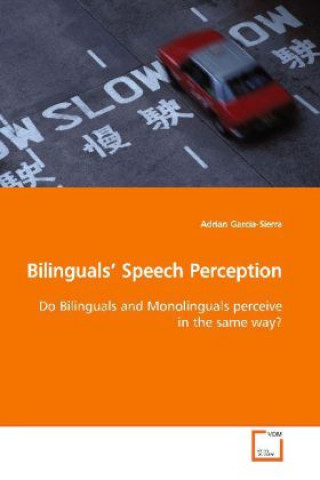
Code: 06823934
Bilinguals Speech Perception
by Adrian Garcia-Sierra
One s native language influences how speech sounds§are perceived. For example, the English d is§perceived as t by native Spanish speakers. This§fact suggests that bilinguals speakers may develop§double phonemic boundaries for ... more


- Language:
 English
 - Binding: Paperback
- Number of pages: 88
Publisher: VDM Verlag Dr. Müller, 2009
- More about this


You might also like
-

Naturalist's Guide to the Birds of Thailand
13.87 € -25 % -
PRIMUS SAILING SEAS CHEESE GTR TAB
21.78 € -22 % -

Mississippi Manhunt / Last Mission
15.29 € -20 % -

Grasslands
29.48 € -9 % -

Die ungarndeutsche Kultur und Tradition
49.85 € -

Skill-Management
37.89 € -6 % -

Students' Perceptions of the Hybrid Learning Structure
49.04 € -2 % -
La nova cuina de Balaguer : Receptes de cal xirricló
16.51 € -

Perfection
21.07 € -24 % -

Estudio de la variabilidad genetica de la coleccion de germoplasma de canahua
64.14 € -14 % -

Mental Leaps
50.97 € -

International Relations Theory and the Politics of European Integration
85.93 € -

American Medical Intelligencer
28.37 € -1 % -

Keats's Boyish Imagination
234 € -

Influencia del taller creciendo para equilibrar tu vida
52.69 € -14 % -

Les Arbitrages Simplifies, Ou Recueil Des Arbitrages de Changes de la France, l'Europe
15.90 € -10 % -

Deutsche Rechtsprechung in Volkerrechtlichen Fragen / Decisions of German Courts Relating to Public International Law / Decisions des Cours Allemandes
67.59 € -7 % -

Sensors
154.64 € -7 % -

Eye Single
22.39 € -25 % -

Regresso a casa
5.97 € -

Imagination Master
27.05 € -1 % -

La percezione del pubblico dell'immagine della Nigeria nei film di Nollywood
75.70 € -14 % -

How to Love a Kitten
14.89 € -

Un chemin sans trace
23.81 € -

Life and Letters in the Ancient Greek World
234 € -

Risk-Management fur versicherte Kraftfahrzeugflotten
26.85 € -11 % -

Popular Radical Press in Britain, 1811-1821 Vol 3
141.57 € -

A Wheel Within a Wheel
12.66 € -14 % -

C is for Cocoa: An alphabet book about Ghana, West Africa, and the food, plants, and animals found in its environment
22.69 € -6 % -

UMA PROPOSTA INESPERADA; SEDUÇÇO MALEVOLA
7.89 € -

Northwest Bones
12.15 € -2 % -

Bandstands of Britain
25.33 € -9 % -

Rise and Decline of the Free Trade Movement
38.50 € -
Evaluacion del duo Comunicacion Participacion en Politicas Publicas
61.61 € -14 % -

From Synagogue to Church: The Traditional Design
83.90 € -

Le Genie Industriel
44.58 € -11 % -

Optimus Princeps
49.04 € -2 % -

David Goldblatt
53.60 € -14 % -

Nagorno - Karabakh conflict and its implications for citizens
19.75 € -14 % -

Quality of Citizenship Education in Harare
53.50 € -14 % -

Our Lost Border
18.64 € -9 % -

Text and Intertext in Medieval Arthurian Literature
78.53 €
Give this book as a present today
- Order book and choose Gift Order.
- We will send you book gift voucher at once. You can give it out to anyone.
- Book will be send to donee, nothing more to care about.
More about Bilinguals Speech Perception
You get 120 loyalty points
 Book synopsis
One s native language influences how speech sounds§are perceived. For example, the English d is§perceived as t by native Spanish speakers. This§fact suggests that bilinguals speakers may develop§double phonemic boundaries for speech sounds that§have equal acoustic information but different meaning§in each of the languages they speak. The goal of the§present book was to test the double phonemic boundary§in bilingual speakers of Spanish and English.§Bilinguals participated in two language contexts one§was in English and one was in. In each language§context two measures were done: One measure involved§pressing a response button when a repetitive§background d sound changed to t . The second§measure involved assessing the brain activity§associated to the sound change. The results showed§that the underlying neural mechanisms associated§between stimulus and response did change between§language contexts even though the behavioral§responses did not change dramatically. This book§sheds some light in how language contexts affect§phonetic judgments in bilinguals and monolinguals,§and how language contexts affects the underlying§neural mechanism associated with speech discrimination. One s native language influences how speech sounds§are perceived. For example, the English d is§perceived as t by native Spanish speakers. This§fact suggests that bilinguals speakers may develop§double phonemic boundaries for speech sounds that§have equal acoustic information but different meaning§in each of the languages they speak. The goal of the§present book was to test the double phonemic boundary§in bilingual speakers of Spanish and English.§Bilinguals participated in two language contexts one§was in English and one was in. In each language§context two measures were done: One measure involved§pressing a response button when a repetitive§background d sound changed to t . The second§measure involved assessing the brain activity§associated to the sound change. The results showed§that the underlying neural mechanisms associated§between stimulus and response did change between§language contexts even though the behavioral§responses did not change dramatically. This book§sheds some light in how language contexts affect§phonetic judgments in bilinguals and monolinguals,§and how language contexts affects the underlying§neural mechanism associated with speech discrimination.
Book details
49.85 €
- Full title: Bilinguals Speech Perception
- Subtitle: Do Bilinguals and Monolinguals perceive in the same way?
- Author: Adrian Garcia-Sierra
- Language: English
- Binding: Paperback
- Number of pages: 88
- EAN: 9783639154306
- ID: 06823934
- Publisher: VDM Verlag Dr. Müller
- Weight: 132 g
- Dimensions: 220 × 150 × 5 mm
- Published: 2009
Trending among others
-

Murdoku
10.53 € -31 % -

Threshing Day (Wing and Claw Collection)
17.83 € -29 % -

Berserk Deluxe Volume 1
39.01 € -26 % -

Threshing Day (Limited Deluxe Edition)
21.07 € -29 % -
White Nights
4.55 € -14 % -

Berserk Deluxe Volume 2
36.37 € -31 % -
The Odyssey
14.99 € -20 % -

What Happened Yesterday
15.70 € -27 % -
Kid's Box New Generation Level 2 Activity Book with Digital Pack British English
10.83 € -9 % -

Onyx Storm (Deluxe Limited Edition) (The Empyrean, 3)
24.21 € -25 % -

Berserk Deluxe Volume 3
55.53 € -

Dancing The Dream
21.58 € -25 % -

The Count of Monte Cristo
13.87 € -
Kid's Box New Generation Level 1 Activity Book with Digital Pack British English
11.24 € -5 % -

Jojo's Bizarre Adventure: Part 7--Steel Ball Run, Vol. 8
18.13 € -26 % -

Kid's Box New Generation Level 2 Pupil's Book with eBook British English
20.36 € -

Iron Flame
24.82 € -23 % -

Fourth Wing
23.81 € -26 % -

The Score
12.35 € -9 % -

Yesteryear
16.10 € -13 % -
Kid's Box New Generation Level 3 Activity Book with Digital Pack British English
11.24 € -5 % -

Murdoku Volume 2: Back in Time
13.77 € -29 % -

Jujutsu Kaisen, Vol. 26
9.72 € -25 % -

The Mistake
11.24 € -28 % -

Lord of Mysteries, Vol. 1: The Clown, Part I
15.39 € -22 % -

Berserk Deluxe Volume 4
43.67 € -17 % -

Throne of Glass Box Set
78.03 € -25 % -

Moonwalk
13.77 € -19 % -

Lord of Mysteries, Vol. 3: The Clown, Part III
17.12 € -19 % -

The Courage To Be Disliked
10.73 € -13 % -

Court of Thorns and Roses 6
15.50 € -31 % -

Berserk Deluxe Volume 5
55.02 € -

The Iliad
15.19 € -26 % -

East of Eden
12.76 € -27 % -

Kid's Box New Generation Level 1 Pupil's Book with eBook British English
16.91 € -13 % -

Murdoku
16.91 € -29 % -

I Who Have Never Known Men
10.33 € -16 % -

Jojo's Bizarre Adventure: Part 7--Steel Ball Run, Vol. 2
18.94 € -22 % -
Kid's Box New Generation Level 3 Pupil's Book with eBook British English
16.91 € -13 % -

Veil Volume 1
11.54 € -29 % -

JoJo's Bizarre Adventure: Part 7--Steel Ball Run, Vol. 7
18.03 € -26 % -
Kid's Box New Generation Level 4 Activity Book with Digital Pack British English
12.05 € -

Berserk Deluxe Volume 7
55.43 € -

Atomic Habits
16.51 € -34 % -

How Lucky Am I?
19.45 € -31 % -

Jujutsu Kaisen, Vol. 30
9.92 € -23 % -

Witch Hat Atelier: Grimoire Edition 1
34.65 € -29 % -

Insatiable
11.34 € -16 % -

The Goal
12.96 € -4 %
Collection points Bratislava a 13299 dalších
Copyright ©2008-26 najlacnejsie-knihy.sk All rights reservedPrivacyCookies

 26602 collection points
 Delivery 2.99 €
 02/210 210 99 (8-15.30h)