
Code: 02645743
Branching Processes Applied to Cell Surface Aggregation Phenomena, 1
by Catherine Macken, Alan S. Perelson
Aggregation processes are studied within a number of different fields--c- loid chemistry, atmospheric physics, astrophysics, polymer science, and biology, to name only a few. Aggregation pro ces ses involve monomer units (e. g. , ... more


- Language:
 English
 - Binding: Paperback
- Number of pages: 124
Publisher: Springer, Berlin, 1985
- More about this

51.66 €
RRP: 55.94 €
You save 4.28 €

In stock at our supplier
Shipping in 8 - 11 days
You might also like
-

Blackout
16.27 € -20 % -

LA MAGIA DE LAS CASUALIDADES IMPOSIBLES
19.81 € -9 % -

Competency-Based Recruitment & Selection
4.34 € -92 % -

Coffret Porsche 911 2e ed
87.35 € -

Bible d’étude, version Semeur
62.18 € -

Over Tumbled Graves
14.05 € -25 % -

Profiles of the Mannequin
40.64 € -

Deseo y representación : convergencias de psicoanálisis y teoría feminista
44.08 € -

RON DESANTIS
22.84 € -

SECRETS OF THE NATL BOARD CERT
64.10 € -9 % -

5S - Die Erfolgsmethode zur Arbeitsplatzorganisation
26.79 € -11 % -

Lone Wolf's Reclaimed Mate
12.73 € -25 % -

Im freien Fall
10.20 € -10 % -

Excursionsflora Fur Die Schweiz: Nach Der Analytischen Methode Bearbeitet...
25.57 € -2 % -

Issak T08
11.32 € -

Authentische Polizei- Und Kriminalgeschichten
11.82 € -10 % -

Creativity to Reinvent Your Life
18.60 € -9 % -

Vacation Hiro
12.12 € -2 % -

Gesunde Abgrenzung
12.63 € -10 % -

America's God
37.81 € -

School Public Relations for Student Success
32.25 € -10 %
Give this book as a present today
- Order book and choose Gift Order.
- We will send you book gift voucher at once. You can give it out to anyone.
- Book will be send to donee, nothing more to care about.
More about Branching Processes Applied to Cell Surface Aggregation Phenomena, 1
You get 125 loyalty points
 Book synopsis
Aggregation processes are studied within a number of different fields--c- loid chemistry, atmospheric physics, astrophysics, polymer science, and biology, to name only a few. Aggregation pro ces ses involve monomer units (e. g. , biological cells, liquid or colloidal droplets, latex beads, molecules, or even stars) that join together to form polymers or aggregates. A quantitative theory of aggre- tion was first formulated in 1916 by Smoluchowski who proposed that the time e- lution of the aggregate size distribution is governed by the infinite system of differential equations: (1) K . . c. c. - c k = 1, 2, . . . k 1. J 1. J L ~ i+j=k j=l where c is the concentration of k-mers, and aggregates are assumed to form by ir k reversible condensation reactions [i-mer + j-mer -+ (i+j)-mer]. When the kernel K . . can be represented by A + B(i+j) + Cij, with A, B, and C constant; and the in- 1. J itial condition is chosen to correspond to a monodisperse solution (i. e. , c (0) = 1 0, k 1), then the Smoluchowski equation can be co' a constant; and ck(O) solved exactly (Trubnikov, 1971; Drake, 1972; Ernst, Hendriks, and Ziff, 1982; Dongen and Ernst, 1983; Spouge, 1983; Ziff, 1984). For arbitrary K , the solution ij is not known and in some ca ses may not even exist.
Book details
Book category Books in English Mathematics & science Science: general issues Maths for scientists
51.66 €
- Full title: Branching Processes Applied to Cell Surface Aggregation Phenomena, 1
- Author: Catherine Macken, Alan S. Perelson
- Language: English
- Binding: Paperback
- Number of pages: 124
- EAN: 9783540156567
- ISBN: 3540156569
- ID: 02645743
- Publisher: Springer, Berlin
- Weight: 374 g
- Dimensions: 297 × 210 × 7 mm
- Date of publishing: 01. July 1985
Trending among others
-

New Kind of Science
31.94 € -25 % -

Topics In Contemporary Mathematical Physics
78.76 € -

Essential Pre-University Mathematics for Sciences
8.99 € -

Mathematical Methods for Physics and Engineering
63.39 € -10 % -

What Is Mathematics?
21.73 € -24 % -
Introductory Discrete Mathematics
14.85 € -24 % -

Principles of Quantum Mechanics
99.59 € -

General Theory of Relativity
39.12 € -1 % -

Mathematical Methods for Physics and Engineering Third Edition Paperback Set
83.21 € -15 % -
Mathematical Methods for Physicists
127.40 € -

1089 and All That
12.12 € -19 % -

Fundamental Math and Physics for Scientists and Engineers
64.20 € -2 % -

Mathematics for Civil Engineers
71.98 € -

Student Solution Manual for Mathematical Methods for Physics and Engineering
38.41 € -

Schaum's Outline of Advanced Mathematics for Engineers and Scientists
26.68 € -18 % -

Mathematics for Physics
81.08 € -
Schaum's Outline of Basic Mathematics with Applications to Science and Technology, 2ed
34.27 € -17 % -
Tensor Analysis for Physicists, Seco
14.75 € -25 % -

Student's Guide to Infinite Series and Sequences
29.82 € -

Mathematics for Physicists
21.02 € -27 % -
Geometric Algebra for Physicists
115.56 € -

Mathematical Techniques
79.26 € -

Classical Mathematical Physics
44.18 € -39 % -

Advanced Mathematical Methods for Scientists and Engineers I
98.58 € -

Mathematics Handbook for Science and Engineering
146.91 € -

Primer on Scientific Programming with Python
69.15 € -

Mathematics for Physical Chemistry: Opening Doors
64.70 € -

Brownian Motion Calculus
52.97 € -

Difference Equations For Scientists And Engineering: Interdisciplinary Difference Equations
118.40 € -

Robust Regression and Outlier Detection
160.56 € -1 % -

Symbolic Mathematics for Chemists - A Guide for Maxima Users
120.72 € -

Mathematical Methods for Physics and Engineering
160.06 € -
Course in Modern Mathematical Physics
127.19 € -

Mathematics for Physical Chemistry
53.99 € -

Qspr/Qsar Studies By Molecular Descriptors
166.83 € -10 % -
Geometrical Methods of Mathematical Physics
56.41 € -

Mathematical Biology
109.30 € -

Topology and Geometry for Physics
82.70 € -

Chemistry Maths Book
66.42 € -
Nature of Time: Geometry, Physics and Perception
226.19 € -7 % -

Schaum's Outline of Mathematics for Physics Students
16.78 € -53 % -
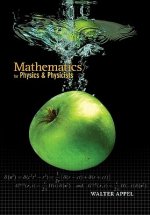
Mathematics for Physics and Physicists
138.52 € -

Computable Structures and the Hyperarithmetical Hierarchy
147.11 € -
Entropy and the Time Evolution of Macroscopic Systems
147.52 € -
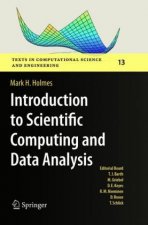
Introduction to Scientific Computing and Data Analysis
60.66 € -

Essential Mathematical Methods for Physicists, ISE
103.73 € -10 % -

Mathematical Methods for Scientists and Engineers
115.56 € -

Handbook of Computational Chemistry
1461.51 € -
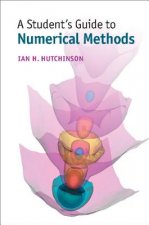
Student's Guide to Numerical Methods
37.10 €
Collection points Bratislava a 12833 dalších
Copyright ©2008-26 najlacnejsie-knihy.sk All rights reservedPrivacyCookies

 25670 collection points
 Delivery 2.99 €
 02/210 210 99 (8-15.30h)