Code: 04522363
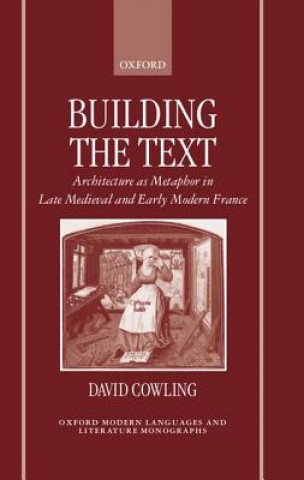
Building the Text
by David Cowling
Descriptions of imaginary buildings abound in late medieval and early modern texts in France as in other European countries. The vogue for allegorical buildings was, however, more than a literary fashion: by deploying familiar met ... more


- Language:
 English
 - Binding: Hardback
- Number of pages: 256
Publisher: Oxford University Press, 1998
- More about this


You might also like
-

Nuovissimo Progetto italiano: Quaderno degli esercizi (+ audio)
13.11 € -23 % -
Dune: House Corrino
8.26 € -29 % -

Learn Spanish With Stories (B1)
11.49 € -7 % -

T'Ai Chi Classics
18.15 € -25 % -
Grade 9-1 GCSE Maths Edexcel Student Book - Foundation (with Online Edition)
31.97 € -10 % -

GSM Global System for Mobile Communication
51.74 € -6 % -

Amerika vor Kolumbus
28.54 € -16 % -

Martin Eden
9.78 € -6 % -
Romero (Rosmarinus officinalis)
35.60 € -14 % -

Forgotten Soldiers of a Lost Cause
52.85 € -18 % -

Wittgenstein and William James
55.17 € -

Arcaboucos de quitosana
44.38 € -14 % -

Beweisprogramme F r Die Pr dikatenlogik Und Der Vollst ndigkeitssatz Von Beth
52.96 € -7 % -

Britain, Spain and the Treaty of Utrecht 1713-2013
215.48 €
Give this book as a present today
- Order book and choose Gift Order.
- We will send you book gift voucher at once. You can give it out to anyone.
- Book will be send to donee, nothing more to care about.
More about Building the Text
You get 580 loyalty points
 Book synopsis
Descriptions of imaginary buildings abound in late medieval and early modern texts in France as in other European countries. The vogue for allegorical buildings was, however, more than a literary fashion: by deploying familiar metaphors of the building in new contexts, writers gained a powerful tool of persuasion. This book explores the complex relationship between metaphor and allegory in the largely neglected but extremely rich corpus of writing that spans the late fifteenth and early sixteenth century in France, and concentrates on the output of Jean Lemaire (c.1473-after 1515), whose fascination with architecture played a crucial role in defining his self-image as a writer. By exploiting the semantic richness of the image of the temple, Lemaire was able to combine panegyric of his patrons with advertisement of his own talents and to promote an ideology of the self-conscious and self-confident writer that was to characterize the stance of Ronsard and the Pleiade in the poet-architect debate of the later sixteenth century.
Book details
Book category Books in English Literature & literary studies Literature: history & criticism Literary studies: general
238.99 €
- Full title: Building the Text
- Subtitle: Architecture as Metaphor in Late Medieval and Early Modern France
- Author: David Cowling
- Language: English
- Binding: Hardback
- Number of pages: 256
- EAN: 9780198159599
- ISBN: 0198159595
- ID: 04522363
- Publisher: Oxford University Press
- Weight: 464 g
- Dimensions: 149 × 223 × 28 mm
- Date of publishing: 12. February 1998
Trending among others
-

How to Read a Book
14.62 € -7 % -
Dubliners
8.97 € -29 % -
Zofloya or The Moor
10.38 € -24 % -
Art of Rhetoric
4.53 € -24 % -

Karamazov Brothers
9.78 € -31 % -

Saga of Tanya the Evil, Vol. 3
12.20 € -14 % -
Count of Monte Cristo
10.18 € -29 % -
If Not, Winter: Fragments Of Sappho
18.05 € -25 % -

Annotated Alice
10.48 € -29 % -

Tempest
8.57 € -25 % -

Daphne Du Maurier
10.99 € -30 % -
Birth of Tragedy
9.98 € -24 % -
Complete Poems
16.13 € -27 % -
Complete Poems of Philip Larkin
26.32 € -25 % -

Outsider
12.60 € -20 % -

Les Liaisons dangereuses
8.57 € -24 % -

Cambridge Companion to Edgar Allan Poe
31.57 € -

Selected Journals of L. M. Montgomery: Volume I: 1889-1910
31.37 € -
Complete Plays of Sophocles
6.95 € -26 % -

Riverside Chaucer
31.37 € -26 % -

Woman in Her Garden
14.01 € -19 % -
Donne's Augustine
135.88 € -

Pere Goriot
9.78 € -24 % -
Le Morte Darthur
22.08 € -

Silent Catastrophes
12.20 € -30 % -
English Literature: A Very Short Introduction
9.98 € -24 % -

Weird Realism - Lovecraft and Philosophy
18.96 € -10 % -
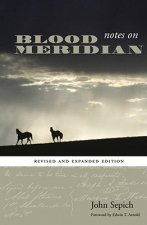
Notes on Blood Meridian
24.91 € -5 % -

Grand Strategies
21.98 € -20 % -
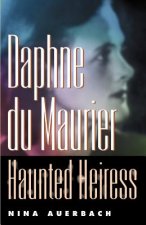
Daphne du Maurier, Haunted Heiress
26.83 € -6 % -

Alienation and Freedom
48.11 € -22 % -

On the Wilder Shores of Love
11.79 € -25 % -

Under My Skin
16.43 € -19 % -

Weird and the Eerie
11.39 € -12 % -

The Picture of Dorian Gray
7.15 € -29 % -
Great God Pan and Other Horror Stories
16.74 € -25 % -

SEOUL University Korean 1B Workbook (QR), m. 1 Audio
33.99 € -
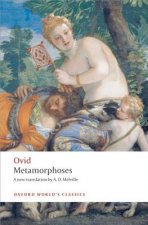
Metamorphoses
7.15 € -25 % -

Edda
7.86 € -24 % -

Simple Passion
7.86 € -29 % -
Odyssey
10.18 € -23 % -

Moveable Feast
8.57 € -30 % -

SEOUL University Korean 1B Student's Book (QR), m. 1 Audio
49.93 € -
Two Treatises of Government
7.86 € -24 % -
Complete Short Stories of Ambrose Bierce
21.58 € -25 % -

Captain is Out to Lunch
13.71 € -30 % -

Selected Poems
9.88 € -25 % -
Rumi: The Big Red Book
12.80 € -25 % -

Memoirs of a Dutiful Daughter
14.11 € -23 %
Collection points Bratislava a 12730 dalších
Copyright ©2008-26 najlacnejsie-knihy.sk All rights reservedPrivacyCookies

 25464 collection points
 Delivery 2.99 €
 02/210 210 99 (8-15.30h)