Code: 04826024
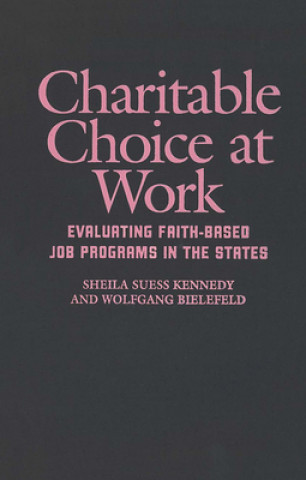
Charitable Choice at Work
by Sheila Kennedy, Wolfgang Bielefeld
Too often, say its critics, U.S. domestic policy is founded on ideology rather than evidence. Take "Charitable Choice": legislation enacted with the assumption that faith-based organizations can offer the best assistance to the ne ... more


- Language:
 English
 - Binding: Hardback
- Number of pages: 234
Publisher: Georgetown University Press, 2006
- More about this

183.87 €

Low in stock at our supplier
Shipping in 11 - 15 days
Potřebujete více kusů?Máte-li zájem o více kusů, prověřte, prosím, nejprve dostupnost titulu na naši zákaznické podpoře.
Add to wishlist
You might also like
-

Elantris
25.96 € -28 % -

Robotics for Babies
7.87 € -25 % -

Raiders
15.04 € -26 % -

Neu Klang
14.03 € -19 % -

Knowledge Encyclopedia Ocean!
24.64 € -30 % -

Mermaid
9.69 € -29 % -

PRIMERA MEMORIA
12.42 € -

Buddhist Scriptures
9.29 € -25 % -

Manga-Zeichenstudio: Hände & Füße
16.86 € -16 % -

Piano Adventures
6.66 € -22 % -

London: City of the Dead
20.20 € -24 % -

Kengan Omega
11.31 € -

THE STRANGER'S CHILD
19.89 € -

Le Petit-Maître corrigé
9.08 € -7 % -

Labour Party and British Society, 1880-2005
56.16 € -

Das grosse Netz
31.92 € -16 % -

DEAD BEFORE MIDNIGHT PAGE TURN
321.68 € -

Development Strategies in East Asia and Latin America
167.50 € -

Nachbarschaftsgedanke Und Die Nachbarliche Wirklichkeit in Der Grossstadt
53.03 € -7 % -

Around the World in 80 Days
10.80 € -1 % -

Tranquil Star
11.81 € -25 % -

Computer Assisted Learning
165.68 € -

Ingmar Bergman
32.02 € -

Apocrypha
14.74 € -25 % -

Just 'Cause I Feel It!
8.38 € -6 % -

Wiley International Handbook of Mentoring - Paradigms, Practices, Programs, and Possibilities
202.66 € -10 % -

La sophrologie face à l'actuel malaise dans la civilisation
16.36 € -12 % -

Community Organizing
21.61 € -4 % -

Mémoires. Traduction française avec notes et explications par Paul Magnette
30.91 € -2 % -

Last Mile
26.46 € -1 % -

Catholic Social Teaching
23.73 € -9 % -

So wunderbar ist unsere Welt!
11 € -15 % -

Reproducible Bible Studies: For Individuals or Small Groups
9.69 € -6 % -
![Passages in the Life of Blue Beard. [In Verse.]](https://media.libris.to/jacket/07999667t.jpg "Passages in the Life of Blue Beard. [In Verse.]")
Passages in the Life of Blue Beard. [In Verse.]
17.27 € -2 % -

Titus Andronicus & Timon of Athens
11.31 € -25 %
Give this book as a present today
- Order book and choose Gift Order.
- We will send you book gift voucher at once. You can give it out to anyone.
- Book will be send to donee, nothing more to care about.
More about Charitable Choice at Work
You get 445 loyalty points
 Book synopsis
Too often, say its critics, U.S. domestic policy is founded on ideology rather than evidence. Take "Charitable Choice": legislation enacted with the assumption that faith-based organizations can offer the best assistance to the needy at the lowest cost. The Charitable Choice provision of the 1996 Welfare Reform Act - buttressed by President Bush's Faith-Based Initiative of 2000 - encouraged religious organizations, including congregations, to bid on government contracts to provide social services. But in neither year was data available to prove or disprove the effectiveness of such an approach. "Charitable Choice at Work" fills this gap with a comprehensive look at the evidence for and against faith-based initiatives. Sheila Suess Kennedy and Wolfgang Bielefeld review the movement's historical context along with legal analysis of constitutional concerns including privatization, federalism, and separation of church and state. Using both qualitative and, where possible, statistical data, the authors analyze the performance of job placement programs in three states with a representative range of religious, political, and demographic traits - Massachusetts, Indiana, and North Carolina. Throughout, they focus on measurable outcomes as they compare non-faith-based with faith-based organizations, nonprofits with for-profits, and the logistics of contracting before and after Charitable Choice. Among their findings: in states where such information is available, the composition of social service contractor pools has changed very little. Reflecting their varied political cultures, states have funded programs differently. Faith-based organizations have not been eager to seek government contracts, perhaps wary of additional legal restraints and reporting burdens. The authors conclude that faith-based organizations appear no more effective than secular organizations at government-funded social service provision, that there has been no dramatic change in the social welfare landscape since Charitable Choice, and that the constitutional concerns of its detractors may be valid. This empirical study penetrates the fog of the culture wars, moving past controversy over the role of religion in public life to offer pragmatic suggestions for policymakers and organizations who must decide how best to assist the needy.
Book details
Book category Books in English Humanities Religion & beliefs Aspects of religion (non-Christian)
183.87 €
- Full title: Charitable Choice at Work
- Subtitle: Evaluating Faith-Based Job Programs in the States
- Author: Sheila Kennedy, Wolfgang Bielefeld
- Language: English
- Binding: Hardback
- Number of pages: 234
- EAN: 9781589011311
- ISBN: 1589011317
- ID: 04826024
- Publisher: Georgetown University Press
- Weight: 399 g
- Dimensions: 218 × 161 × 22 mm
- Date of publishing: 31. October 2006
Trending among others
-

The Lesser Key of Solomon
17.47 € -2 % -

Secret Teachings of All Ages
43.03 € -

Sefer Yetzira/the Book of Creation
34.04 € -34 % -

Tao: The Watercourse Way
12.52 € -27 % -

Why Buddhism Is True
11.81 € -25 % -

The Way of the Shaman
12.82 € -24 % -

Upanisads
7.87 € -24 % -

Start Where You Are
10.80 € -25 % -

Dhammapada
9.99 € -24 % -

Major Trends in Jewish Mysticism
14.74 € -28 % -

Gurdjieff and the Women of the Rope
31.92 € -2 % -

Scriptural Commentaries of Yogiraj Sri Sri Shyama Charan Lahiri Mahasaya
12.01 € -24 % -

House of Darkness House of Light
25.75 € -25 % -

Kabbalah: A Very Short Introduction
9.99 € -24 % -

Knowing Heart
23.93 € -26 % -

Everyman's Talmud
16.86 € -24 % -

Al-Ghazali on the Ninety-Nine Beautiful Names of God
20.20 € -24 % -

Conferences
41.72 € -2 % -

Fire in the Head
15.45 € -25 % -

Reversing Hermon: Enoch, the Watchers, and the Forgotten Mission of Jesus Christ
14.74 € -25 % -

Wilder Mann
33.53 € -14 % -

Stillness Speaks
11 € -30 % -

Upanishads
10.60 € -25 % -

Mindfulness
16.16 € -25 % -

Bhagavad Gita
11.20 € -25 % -

Essential Kabbalah
13.43 € -24 % -

Bhagavad Gita as it is
17.17 € -

Holy Qur'an
6.15 € -30 % -

The Masnavi, Book One
9.29 € -24 % -

Qur'an
10.40 € -24 % -

Birthright
22.62 € -6 % -

God Talks with Arjuna
25.05 € -25 % -

To Bless the Space Between Us
20.70 € -28 % -

Pistis Sophia
14.74 € -25 % -

How To Love
7.06 € -18 % -

Synchronicity Key
18.07 € -25 % -

Essential Zohar
13.43 € -24 % -

Five Things We Cannot Change
13.73 € -26 % -

Presence of the Infinite
15.25 € -21 % -

Struggle of the Magicians
22.92 € -2 % -

Prayers That Shake Heaven and Earth, Volume 1
11 € -21 % -

Living Gita
13.33 € -25 % -

Dhammapada
9.89 € -25 % -

Masnavi, Book Two
11.81 € -25 % -

Health, Healing, and Beyond
14.84 € -24 % -

Demonologist
11.31 € -25 % -

Gospel Of Ramakrishna
8.88 € -7 % -

Koran
11.91 € -24 % -

Bodhicaryavatara
9.89 € -25 %
Collection points Bratislava a 12927 dalších
Copyright ©2008-26 najlacnejsie-knihy.sk All rights reservedPrivacyCookies

 25858 collection points
 Delivery 2.99 €
 02/210 210 99 (8-15.30h)