Code: 53747510
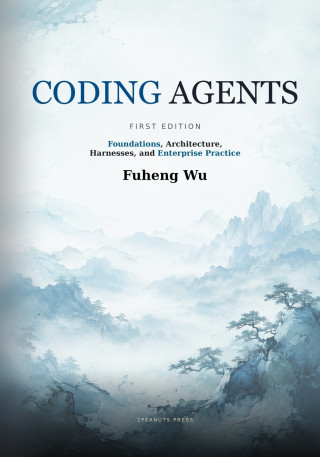
Coding Agents
by Fuheng Wu
A coding agent looks like a language model with a code prompt. It isn't. An LLM emits probabilistic tokens; an autonomous coding agent navigates unfamiliar codebases, formulates hypotheses, executes shell commands, inspects compil ... more


- Language:
 English
 - Binding: Paperback
- Number of pages: 278
Publisher: 2Peanuts.com, 2026
- More about this

49.34 €
RRP: 49.36 €
You save 0.02 €

You might also like
-

Threshing Day (Wing and Claw Collection)
17.75 € -29 % -

Murdoku
14.62 € -22 % -

Threshing Day (Limited Deluxe Edition)
20.98 € -29 % -

Berserk Deluxe Volume 1
38.85 € -26 % -

White Nights
4.53 € -14 % -

What Happened Yesterday
15.63 € -27 % -

Berserk Deluxe Volume 2
36.42 € -30 % -

Berserk Deluxe Volume 3
55.40 € -

Onyx Storm (Deluxe Limited Edition) (The Empyrean, 3)
24.21 € -25 % -
Kid's Box New Generation Level 2 Activity Book with Digital Pack British English
10.79 € -9 % -

Court of Thorns and Roses 6
15.53 € -31 % -

Dancing The Dream
21.59 € -25 % -

Jojo's Bizarre Adventure: Part 7--Steel Ball Run, Vol. 8
18.16 € -25 % -

Yesteryear
16.04 € -24 % -
Kid's Box New Generation Level 1 Activity Book with Digital Pack British English
11.19 € -5 % -
Kid's Box New Generation Level 3 Activity Book with Digital Pack British English
11.19 € -5 % -

The Courage To Be Disliked
10.69 € -13 % -

The Count of Monte Cristo
13.82 € -

Murdoku
17.05 € -29 % -

Iron Flame
24.82 € -23 % -

Fourth Wing
23.81 € -26 %
Give this book as a present today
- Order book and choose Gift Order.
- We will send you book gift voucher at once. You can give it out to anyone.
- Book will be send to donee, nothing more to care about.
Availability alert
Enter your e-mail address and once book will be available,
we will send you a message. It's that simple.
More about Coding Agents
You get 120 loyalty points
 Book synopsis
A coding agent looks like a language model with a code prompt. It isn't. An LLM emits probabilistic tokens; an autonomous coding agent navigates unfamiliar codebases, formulates hypotheses, executes shell commands, inspects compiler diagnostics, and repairs multi-file regressions under strict token, latency, and financial budgets. The moment a model interacts with a filesystem and a shell, the primary engineering challenge ceases to be prompt engineering. It becomes software systems engineering.
This book is an architectural and production guide to engineering systems in which humans and coding agents work reliably together on real codebases. It treats coding agents not as chatbots, but as composite software engineering systems built around foundation models. Every chapter bridges theoretical mechanics with concrete architectural blueprints: how context allocators manage active working sets, how tool dispatchers enforce secure capability boundaries, how isolated sandboxes execute mutations, and how closed-loop verification pipelines transform raw model proposals into verified pull requests.
The early chapters establish the foundational mechanics and core architecture: Code LLM token economics, KV cache utilization, deterministic execution theory, and prompt/harness boundary contracts. It then dissects the 7-component agent stack: tool calling protocols, structured orchestrator loops, memory layers, and multi-agent coordination topologies (hierarchical supervisors, peer pipelines, and collaborative swarms).
The later chapters focus on verification, harnesses, and production scale: why ungrounded agents hallucinate syntactically plausible regressions, how to build robust generate-verify-repair loops with AST linters and test runners, and how SWE-bench evaluation prevents contamination. The concluding chapters deliver enterprise engineering practices: microVM and gVisor container sandboxing, CI/CD integration gates, permission deny-lists, cost controls, and self-improving agents that distill lessons from repository execution traces.
For software engineers, ML system architects, developer tooling engineers, and engineering leaders building the next generation of AI-augmented software workflows. The code examples are standalone, all architectures verified against production benchmarks, and each chapter closes with technical exercises and architectural checklists.
Book details
49.34 €
- Full title: Coding Agents
- Author: Fuheng Wu
- Language: English
- Binding: Paperback
- Number of pages: 278
- EAN: 9798995152385
- ID: 53747510
- Publisher: 2Peanuts.com
- Weight: 489 g
- Dimensions: 254 × 178 × 15 mm
- Date of publishing: 11. September 2026
Collection points Bratislava a 13333 dalších
Copyright ©2008-26 najlacnejsie-knihy.sk All rights reservedPrivacyCookies

 26670 collection points
 Delivery 2.99 €
 02/210 210 99 (8-15.30h)