Code: 49316398
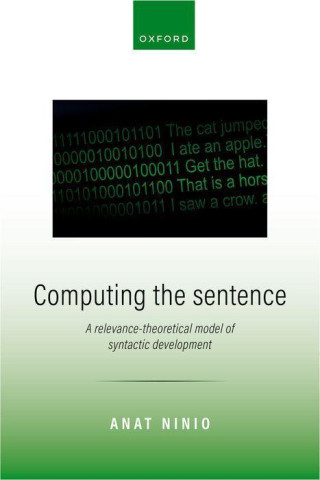
Computing the Sentence
by Ninio, Anat (Professor Emeritus, Department of Psychology, Professor Emeritus, Department of Psychology, The Hebrew University of Jerusalem)
Developmental research is abandoning formal syntax, probably because Chomskyan generative syntax lacks psychological reality. Some studies opt for pure statistics-based definitions of syntactic knowledge, as if humans were similar ... more


- Language:
 English
 - Binding: Hardback
- Number of pages: 256
Publisher: Oxford University Press, 2025
- More about this


You might also like
-

Murdoku
14.04 € -25 % -

Threshing Day (Wing and Claw Collection)
17.78 € -29 % -

Berserk Deluxe Volume 1
37.80 € -21 % -

Threshing Day (Limited Deluxe Edition)
21.02 € -29 % -

Berserk Deluxe Volume 2
35.37 € -32 % -

White Nights
4.54 € -14 % -

Moonwalk
13.84 € -

The Odyssey
14.04 € -25 % -

Berserk Deluxe Volume 3
55.39 € -

Kid's Box New Generation Level 2 Activity Book with Digital Pack British English
12.42 € -

Dancing The Dream
21.42 € -25 % -

Murdoku Volume 2: Back in Time
14.04 € -25 % -

Onyx Storm (Deluxe Limited Edition) (The Empyrean, 3)
24.15 € -25 % -

The Score
12.32 € -9 % -

Kid's Box New Generation Level 2 Pupil's Book with eBook British English
15.56 € -19 % -

Jujutsu Kaisen, Vol. 26
9.90 € -23 % -

The Mistake
11.31 € -16 % -

Kid's Box New Generation Level 1 Activity Book with Digital Pack British English
11.31 € -4 % -

Kid's Box New Generation Level 3 Activity Book with Digital Pack British English
11.31 € -4 % -

Lord of Mysteries, Vol. 1: The Clown, Part I
15.36 € -22 % -

Lord of Mysteries, Vol. 3: The Clown, Part III
17.07 € -13 %
Give this book as a present today
- Order book and choose Gift Order.
- We will send you book gift voucher at once. You can give it out to anyone.
- Book will be send to donee, nothing more to care about.
More about Computing the Sentence
You get 280 loyalty points
 Book synopsis
Developmental research is abandoning formal syntax, probably because Chomskyan generative syntax lacks psychological reality. Some studies opt for pure statistics-based definitions of syntactic knowledge, as if humans were similar to Large Language Models of AI and had no structurally meaningful concepts of syntactic relations. Others tend to Constructivist syntax, where patterns of elements are said to possess associated semantic meaning. The problem is that the core syntactic relations that young children acquire, such as verb-object and verb-subject combinations, do not possess particular associated semantics, meaning that the Constructivist approach is not a helpful vehicle for understanding syntactic acquisition.In this book, Anat Ninio approaches syntactic development from a novel point of view, within the framework of Relevance Theory, a theory of pragmatics with a strong commitment to a cognitive conceptualization of linguistic competence. This theory''s architecture of linguistic information acknowledges the existence of procedural instructions as part of the content of words, covering various processing acts, including syntactic combination. Methodologically, the study employs computer programming algorithms as heuristic models for the cognitive combinatory processes of syntax, computer programs being a close analogue to mental plans for solving computational problems. The unusual framework and methodology adopted in the book represent a break with current approaches in developmental psycholinguistics and perhaps even with the teachings of mainstream linguistics. The first part of the book proposes a procedural syntax of the central patterns of English, covering argument-structure constructions, phrasal and clausal combinations of function words and content words, wh-questions, relative clauses, and coordination and gapping. This modelling resolves significant issues that have been eluding linguistic theory for decades. The second part of the book describes the development of certain syntactic procedures in English-speaking children, employing a microgenetic analysis to demonstrate that syntactic learning is guesswork by trial and error. Despite the apparent chaos, the many different attempts that children make to arrive at some syntactic construct belong to a single learning process, and gradually converge on the adult algorithm. Defining syntax in terms of combinatory procedures provides a novel perspective on our ''predictive brain'', on language structure, and on cross-linguistic variation.
Book details
115.64 €
- Full title: Computing the Sentence
- Subtitle: A Relevance-Theoretical Model of Syntactic Development
- Author: Ninio, Anat (Professor Emeritus, Department of Psychology, Professor Emeritus, Department of Psychology, The Hebrew University of Jerusalem)
- Language: English
- Binding: Hardback
- Number of pages: 256
- EAN: 9780198907503
- ID: 49316398
- Publisher: Oxford University Press
- Weight: 507 g
- Dimensions: 234 × 156 mm
- Date of publishing: 18. December 2025
Collection points Bratislava a 13216 dalších
Copyright ©2008-26 najlacnejsie-knihy.sk All rights reservedPrivacyCookies

 26436 collection points
 Delivery 2.99 €
 02/210 210 99 (8-15.30h)