Code: 01323652
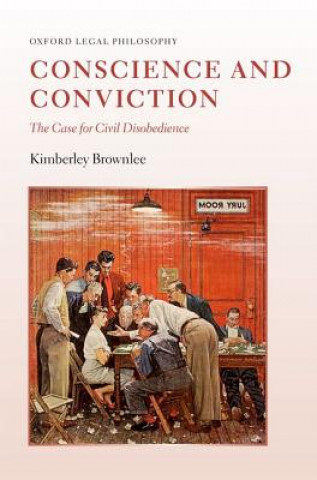
Conscience and Conviction
by Kimberley Brownlee
The book shows that civil disobedience is generally more defensible than private conscientious objection. Part I explores the morality of conviction and conscience. Each of these concepts informs a distinct argument for civil diso ... more


- Language:
 English
 - Binding: Hardback
- Number of pages: 280
Publisher: Oxford University Press, 2012
- More about this


You might also like
-

Jujutsu Kaisen, Vol. 1
13.42 € -

Monster: The Perfect Edition, Vol. 2
19.59 € -25 % -

Peppa Pig: Little Library
6.45 € -29 % -

Saga of the Swamp Thing Book Five
15.14 € -25 % -

C++ Software Design
56.05 € -25 % -

Most Heretical Last Boss Queen: From Villainess to Savior (Light Novel) Vol. 1
11.40 € -28 % -

Girl Who Fell From The Sky
14.84 € -24 % -

Sherlock Holmes II.
6.15 € -25 % -

Do This Before Bed
18.98 € -24 % -

Steel's Edge
6.45 € -29 % -

Millie Marotta's Brilliant Beasts
10.80 € -26 % -

Na písme zostalo
5.34 € -30 % -

Deep Purple Family Year By Year:
19.89 € -18 % -

Morris Park Crew: The Official History
33.12 € -5 % -

Pexeso Chemie Prvky
1.40 € -30 % -

Chicos-Chicas
34.64 € -

Expanse Game Master's Kit
23.22 € -9 % -

Anand Files
23.73 € -24 % -

Farthing
12.11 € -19 % -

Tata Oli umie wszystko. Tata Oli. Tom 12
8.07 € -18 % -

El candidato
13.02 € -

German Fallschirmjager in World War II
18.48 € -26 % -

Roman par Polanski
15.14 € -

The Book of Butter: A Text on the Making, Manufacture and Marketing of Butter
18.27 € -7 % -

Pro oči nevidím
10.39 € -15 % -

Logique Et Transcendance
34.23 € -

Born This Way
14.33 € -9 % -

Ravensburger 3D Puzzle 12523 - Cathédrale Notre-Dame de Paris - 324 Teile - Notre-Dame zum selber Puzzeln ab 10 Jahren
50.19 € -6 % -

Allied Special Forces Insignia
23.22 € -9 % -

Extensions of Minimal Transformation Groups
109.18 € -

Philosophical Foundations
17.06 € -

PUS Latwe cwiczenia do nauki czytania cz. 4
7.57 € -

Konštruktéri života
11.10 € -33 % -

VATICANGATE
22.52 € -2 % -
Nehru and Bose
18.58 € -9 % -

More Attention, Less Deficit
21 € -24 % -

Lost Diary of Kastur
19.48 € -

English Zone 3: Workbook with CD-ROM Pack
26.86 € -
Augustus
233.22 € -

Klóketen
5.14 € -26 % -

Ukulele Chord Songbook
15.24 € -21 % -

Chapters of the Biographical History of the French Academy
29.99 € -2 % -

Juste apres la vague
13.12 € -

France: Ariege
29.79 € -15 % -

Jodorowsky 90 ans T11 : Final Incal - Castaka - Les Armes Méta-Baron
49.38 € -

US International Lawyers in the Interwar Years
130.80 € -

Laws of Nobility
20.29 € -

Standard Operating Procedures Analytical Chemistry and Metabolism
51.61 € -7 % -

Soleil jusqu'à la fin
20.29 € -
Culture and the King
39.69 € -

Erkennung mehrerer Objekte durch parallele Suchagenten
33.93 € -11 % -

Popularity Papers
11.51 € -10 % -

Collections for Wall Frame Sets Series: Book of Eurostar Trains
31.10 € -7 % -

Malick Sidibe Photographs Hasselblad Award 2003 /anglais
82.62 € -

TDAH e terapia cognitiva comportamental
44.43 € -14 % -

Marxist Thought on Imperialism
249.08 € -

History of the British Isles 1714-2010
15.75 € -10 % -

Integrating Human Service Law, Ethics and Practice
59.59 € -

British Aesthetic Tradition
33.53 € -

Extracts from the Memorandums of Jane Bettle: With a Short Memoir Respecting Her.
13.93 € -24 % -

Introduction to Sustainable Resource Use
69.79 € -

Handbook of Instructional Practices for Literacy Teacher-educators
481.71 € -

Mediating Mobility
115.24 € -

Teaching Tolerance
15.34 € -18 % -

Corporate Collections
122.42 € -

Birthday Cakes Candies, And More A Celebration Coloring Book: Fun-Filled Coloring Activity Sheets, Illustrations And Designs Of Gifts, Cakes, And More
8.07 € -7 % -

Storia del Consiglio Dei Patrizi Di Trieste Dall'anno 1332 All'anno 1809 Con Documenti.
18.07 € -24 % -

Music
50.50 € -

Leading and Managing People in Education
33.42 € -9 % -

La Fatigue Des Sols En Zone Semi-Aride
49.79 € -11 % -

Evangelist
19.38 € -25 % -

Uncle Dick Wootton: The Pioneer Frontiersman Of The Rocky Mountain Region
39.08 € -1 % -

Servo Scanning 3D Micro Electro Discharge Machining
102.82 € -7 % -

Maestro de placer
5.44 € -

TERRA, CIENCIES NATURALS, 1 BATXILLERAT
55.34 € -

Services in the International Economy
111.20 € -

Coeur D'Alene
31.40 €
Give this book as a present today
- Order book and choose Gift Order.
- We will send you book gift voucher at once. You can give it out to anyone.
- Book will be send to donee, nothing more to care about.
More about Conscience and Conviction
You get 361 loyalty points
 Book synopsis
The book shows that civil disobedience is generally more defensible than private conscientious objection. Part I explores the morality of conviction and conscience. Each of these concepts informs a distinct argument for civil disobedience. The conviction argument begins with the communicative principle of conscientiousness (CPC). According to the CPC, having a conscientious moral conviction means not just acting consistently with our beliefs and judging ourselves and others by a common moral standard. It also means not seeking to evade the consequences of our beliefs and being willing to communicate them to others. The conviction argument shows that, as a constrained, communicative practice, civil disobedience has a better claim than private objection does to the protections that liberal societies give to conscientious dissent. This view reverses the standard liberal picture which sees private 'conscientious' objection as a modest act of personal belief and civil disobedience as a strategic, undemocratic act whose costs are only sometimes worth bearing. The conscience argument is narrower and shows that genuinely morally responsive civil disobedience honours the best of our moral responsibilities and is protected by a duty-based moral right of conscience. Part II translates the conviction argument and conscience argument into two legal defences. The first is a demands-of-conviction defence. The second is a necessity defence. Both of these defences apply more readily to civil disobedience than to private disobedience. Part II also examines lawful punishment, showing that, even when punishment is justifiable, civil disobedients have a moral right not to be punished. Oxford Legal Philosophy publishes the best new work in philosophically-oriented legal theory. It commissions and solicits monographs in all branches of the subject, including works on philosophical issues in all areas of public and private law, and in the national, transnational, and international realms; studies of the nature of law, legal institutions, and legal reasoning; treatments of problems in political morality as they bear on law; and explorations in the nature and development of legal philosophy itself. The series represents diverse traditions of thought but always with an emphasis on rigour and originality. It sets the standard in contemporary jurisprudence.
Book details
Book category Books in English Law Laws of Specific jurisdictions Constitutional & administrative law
149.08 €
- Full title: Conscience and Conviction
- Author: Kimberley Brownlee
- Language: English
- Binding: Hardback
- Number of pages: 280
- EAN: 9780199592944
- ISBN: 0199592942
- ID: 01323652
- Publisher: Oxford University Press
- Weight: 572 g
- Dimensions: 239 × 161 × 20 mm
- Date of publishing: 18. October 2012
Trending among others
-

The Cambridge Handbook of Constitutional Theory
208.78 € -

Comparative Constitutional Law
79.89 € -4 % -

Constitutional Courts in Comparison: The Us Supreme Court and the German Federal Constitutional Court
141.41 € -

Judicial Reasoning under the UK Human Rights Act
71.30 € -

Oxford Handbook of U.S. Judicial Behavior
199.79 € -

Federalist Papers
12.72 € -25 % -

Framers' Coup
21.71 € -24 % -
Matter of Interpretation
9.28 € -52 % -

Federalist Papers
6.76 € -30 % -

Constitution of the United States of America with the Declaration of Independence
14.84 € -19 % -

Local Matters
34.03 € -
Fourteenth Amendment and the States
51.61 € -7 % -

Federal Preemption
14.84 € -24 % -

Art of the Advocate
15.95 € -25 % -

Anti-Federalist Papers and the Constitutional Convention Debates
8.27 € -26 % -
America's Unwritten Constitution
30.09 € -
Law of Public and Utilities Procurement Volume 2
375.95 € -

EU Constitutional Law
43.42 € -

Age of Dignity
114.64 € -
Cyberwar
21.71 € -24 % -
Federalism: A Very Short Introduction
9.99 € -24 % -

Human Rights, Ownership, and the Individual
120.70 € -

Founders' Constitution, Volume 2
16.25 € -

Constitutionalizing the European Union
55.85 € -

Judicial Monarchs
33.73 € -

Data Privacy Law
228.17 € -
Fourteenth Amendment
41.61 € -

Law Express: Human Rights
19.79 € -

Colonial Origins of the American Constitution
16.25 € -

Familiar Exposition of the Constitution of the United States
27.47 € -9 % -

Magna Carta
13.93 € -24 % -

American Constitution and the Debate over Originalism
34.43 € -

European Convention on Human Rights
528.99 € -

Administrative Law for the 21st Century
133.63 € -7 % -

Gunfight
14.03 € -25 % -
Constitutionalism, Identity, Difference, and Legitimacy
41.10 € -

Gabby Petito's Story
1.10 € -

Theory of Interpretation of the European Convention on Human Rights
72.41 € -
Statism
13.12 € -18 % -

Deciphering the Genome of Constitutionalism
135.55 € -

Proportionality
71.81 € -

Rewriting Children's Rights Judgments
143.63 € -

Constitution of Romania
44.33 € -
First Amendment, Freedom of the Press
15.34 € -18 % -

View of the Constitution of the United States of America Second Edition
23.73 € -2 % -

Equal Rights Handbook
9.28 € -24 % -

Application of the Principle of Subsidiarity in Eu Law
48.88 € -2 % -
Commentaries on the Constitution of the United States Vol. III (in three volumes)
28.27 € -2 % -

Pennsylvania & Federal Constitution, 1787-1788
12.82 € -12 %
Collection points Bratislava a 13253 dalších
Copyright ©2008-26 najlacnejsie-knihy.sk All rights reservedPrivacyCookies

 26510 collection points
 Delivery 2.99 €
 02/210 210 99 (8-15.30h)