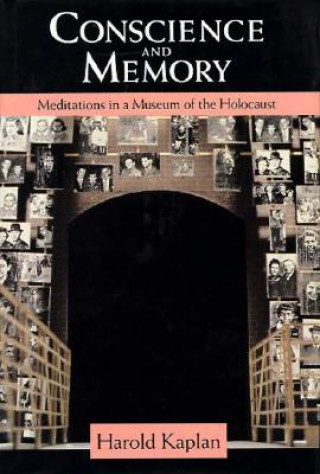
Code: 04039146
Conscience and Memory
by Harold Kaplan
Prompted by the suicides of Jean Amery and Primo Levi, Harold Kaplan sought to find out what the Holocaust can be said to affirm even in the face of its overwhelming negation of meaning. "I wrote this book," he explains, "to trans ... more


- Language:
 English
 - Binding: Hardback
- Number of pages: 230
Publisher: University of Chicago Press, 1994
- More about this

28.89 €
Availability:
50/50 We think title might be available. Upon your order we will do our best to get it within 6 weeks.
We search the world
You might also like
-

Simon Leach's Pottery Handbook
28.59 € -24 % -

Brisingr
21.41 € -20 % -
Criminal Volume 4: Bad Night
13.94 € -27 % -

Briefe an Milena
17.98 € -11 % -

Názvoslovie anorganických látok
9.08 € -19 % -

Crystal Frontier
16.76 € -20 % -
Pink Floyd
32.53 € -

Blank Cookbook For Kids
12.72 € -25 % -
Encyclopedia of Philosophy
2458.81 € -

Sexual Desire Disorders
111.45 € -

Confident Mother
14.04 € -25 % -

Europe in Crisis
119.03 € -
George Gascoigne, A Hundreth Sundrie Flowres
494.85 € -

Business Partnerships and Organizational Performance
154.20 € -7 % -

Holy Spirit in the New Testament
25.76 € -25 % -

The Motor Boys in Mexico
30 € -2 % -

The 201 on Building Web API with ASP.NET Core MVC
10.60 € -7 % -

quelques seconde pres
12.22 € -

Clean Sweep!
13.83 € -26 % -

Les Eglises Du Refuge En Angleterre. Tome 1
30.71 € -

Gravy Wars: South Philly Foods, Feuds & Attytudes
14.04 € -25 %
Give this book as a present today
- Order book and choose Gift Order.
- We will send you book gift voucher at once. You can give it out to anyone.
- Book will be send to donee, nothing more to care about.
Availability alert
Enter your e-mail address and once book will be available,
we will send you a message. It's that simple.
More about Conscience and Memory
You get 70 loyalty points
 Book synopsis
Prompted by the suicides of Jean Amery and Primo Levi, Harold Kaplan sought to find out what the Holocaust can be said to affirm even in the face of its overwhelming negation of meaning. "I wrote this book," he explains, "to translate the Holocaust out of the moral and intellectual shock which contemplates the alienation of humanity from itself. I wished to understand the "crime against humanity" as a viable category of the moral reason. And I wished to respond to the written testimony of Holocaust victims and survivors as if the issue of their survival were present to us today." Kaplan simulates the response to a long visit to the new Holocaust museum in Washington, DC, which, crucially for Kaplan, is sited in direct view of the Jefferson and Lincoln monuments, powerful symbols of humanist democracy. He insists the Holocaust be viewed not only in terms of personal ethics but modern political ethics as well: for Kaplan the affirmative legacy of the Holocaust is its focus on the dangers of nationalism, racism and all forms of separatist group identities. It challenges the historicism, cults of power and scientistic politics of modernity. And it challenges the moral passivity and relativism of mass politics in Western and Eastern societies. The opening of the Holocaust museum has sparked a debate that reflects a larger debate over the Holocaust's "meaning," its translatability for ordinary understanding. Some deny any possible response except that of overwhelming grief and horror. For others, the "lesson" of the Holocaust implies, in the words of Robert Nozick, that "mankind has fallen...Humanity has lost its claim to continue." The moral life and political institutions will remain endlessly tormented by the Holocaust. That, Kaplan tells us, is the ultimate content of its "meaning", and is what makes the discussion of "meaning" much more than a mourner's symposium. The museum itself, according to Kaplan, has become an impressive memorial to the principle of humanism, instructing the collective memory of this democracy and that of nations everywhere which aspire to civil existence. Out of its awful darkness the Holocaust throws the light of conscience for those capable of receiving it.
Book details
Book category Books in English Humanities History History: specific events & topics
28.89 €
- Full title: Conscience and Memory
- Author: Harold Kaplan
- Language: English
- Binding: Hardback
- Number of pages: 230
- EAN: 9780226424163
- ID: 04039146
- Publisher: University of Chicago Press
- Weight: 566 g
- Dimensions: 234 × 160 × 21 mm
- Date of publishing: 01. January 1994
Trending among others
-
Man's Search for Meaning
13.03 € -

Women, Race & Class
11 € -28 % -

Man's Search For Meaning
17.27 € -19 % -

Che Guevara
23.23 € -25 % -
Monk
11.91 € -

History of Tattooing
11.31 € -24 % -

Cold War Submarines
35.36 € -25 % -

Ranch Life and the Hunting Trail
14.04 € -25 % -

Entanglement
11.51 € -30 % -
Drowned And The Saved
13.94 € -24 % -
Man's Search For Meaning
10.70 € -34 % -

Eichmann in Jerusalem
13.13 € -24 % -

World Football Club Crests
18.08 € -22 % -

The Rape of Nanking
16.16 € -28 % -

The Complete MAUS
20.50 € -9 % -

Black Skin, White Masks
11.31 € -23 % -

Delirious New York
33.34 € -

Alphabet Logo: Trademarks & Symbols
21.82 € -16 % -
Nuremberg Diary
16.16 € -25 % -

Bloodlands
14.74 € -15 % -

Imperialism: The Highest Stage of Capitalism
8.07 € -30 % -

Brief History of Japan
12.02 € -24 % -

Knight's Own Book of Chivalry
22.52 € -7 % -

Shadows Of The Workhouse
11 € -30 % -

Guns, Germs and Steel
12.32 € -29 % -

Conquerors
13.03 € -29 % -

Out Of Place
14.14 € -23 % -
Critique of Dialectical Reason, Vol. 1
34.95 € -17 % -

Call The Midwife
14.04 € -5 % -

Exploring the Britannic
26.67 € -27 % -

Fashion Victims
23.94 € -24 % -

Race for the South Pole
16.46 € -12 % -

Fossil Capital
23.74 € -24 % -

In the Rose Garden of the Martyrs
10.20 € -17 % -

Farewell To The East End
11.11 € -29 % -

Thomas Sankara Speaks
14.84 € -24 % -
Ascent of Money
15.15 € -29 % -

Ordinary Men
13.94 € -20 % -

Diary of a Young Girl
7.37 € -34 % -

Madness and Civilization
14.84 € -24 % -

Eichmann in Jerusalem
14.04 € -25 % -

Ordinary Men
14.74 € -25 % -

Call The Midwife
11 € -30 % -

The Embarrassment of Riches
21.01 € -24 % -

Football in Sun and Shadow
11.51 € -27 % -

Secret Lives of Colour
17.37 € -27 % -

Black Earth
12.92 € -21 % -

Maps of the Ancient Sea Kings
19.49 € -22 % -

Wall Street and the Bolshevik Revolution
14.14 € -23 %
Collection points Bratislava a 12849 dalších
Copyright ©2008-26 najlacnejsie-knihy.sk All rights reservedPrivacyCookies

 25702 collection points
 Delivery 2.99 €
 02/210 210 99 (8-15.30h)