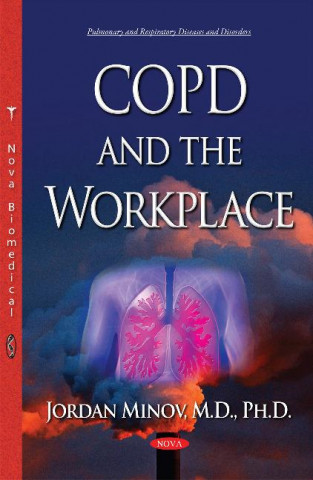
Code: 14262586
COPD & the Workplace
by Jordan Minov
Chronic obstructive pulmonary disease (COPD) is a major cause of disability and is the fourth leading cause of death throughout the world. Although cigarette smoking is the major and best studied causative factor of COPD, there is ... more


- Language:
 English
 - Binding: Paperback
- Number of pages: 83
Publisher: Nova Science Publishers Inc, 2016
- More about this

123.02 €
RRP: 136.68 €
You save 13.66 €
Availability:
50/50 We think title might be available. Upon your order we will do our best to get it within 6 weeks.
We search the world
You might also like
-

Malé velké pravdy
8.48 € -20 % -

Lines of Departure
11.72 € -25 % -

SHTF Survival Stories: Memories from the Balkan War
22.53 € -7 % -

See Inside Space
11.82 € -24 % -

Interior Design Guide
12.83 € -20 % -

Shikoku Pilgrimage, Japan: Travel Guide
26.07 € -6 % -

Love Stage!! 01
10.81 € -

European Consumer Law
121.20 € -

Sudba Ursitorů
6.86 € -16 % -

Shaman King. Final edition
7.47 € -

Iraq
55.69 € -

Brain Evolution by Design
226.04 € -7 % -

Chicken Ranch
7.88 € -24 % -

Eclipse - Journeys to the Dark Side of the Moon
19.60 € -25 % -

Altdeutsche Gartenflora
20.51 € -11 % -

Das Zahlenbuch 1. Schulbuch Klasse 1
23.24 € -

Brazilian and Afro-Cuban Jazz Conception. Gitarre. Lehrbuch mit CD.
31.13 € -

Reise durch Venedig
17.98 € -10 % -

Metodo Cuadro de Valores
24.15 € -

B3 Back to Bible Basic Book 2: Bible Basic Book 2
18.39 € -6 % -

Living In The Spirit Realm: What We Will Encounter In Heaven
14.95 € -6 % -

Coorie - Was Sie über den schottischen Lifestyle-Trend wissen müssen
13.54 € -10 % -

Heart Tears Of A Unicorn
30.72 € -

THE WRITINGS OF HENRY DAVID THOREAU: WIT
37.29 € -1 % -

Traite Theorique Et Pratique de Droit International Prive. Tome 4
39.52 € -

Sagen Niederösterreichs
38.30 € -11 % -

Good Old-Fashioned Puddings
20.11 € -25 % -

Winter's Chill
13.23 € -6 %
Give this book as a present today
- Order book and choose Gift Order.
- We will send you book gift voucher at once. You can give it out to anyone.
- Book will be send to donee, nothing more to care about.
Availability alert
Enter your e-mail address and once book will be available,
we will send you a message. It's that simple.
More about COPD & the Workplace
You get 298 loyalty points
 Book synopsis
Chronic obstructive pulmonary disease (COPD) is a major cause of disability and is the fourth leading cause of death throughout the world. Although cigarette smoking is the major and best studied causative factor of COPD, there is consistent evidence that a substantial proportion of COPD cases cannot be explained by smoking. Other noxious particles and gases, such as workplace dusts, vapours, fumes or gases, indoor air pollution from burning biomass fuels during cooking foods and heating spaces, and air pollution in urban areas are important risk factors of COPD. According to collected data, 15-20% of COPD cases are likely to be caused or made worse by work; around 4,000 COPD deaths every year are related to workplace exposures, and 40% of COPD patients are below the retirement age. The development of COPD as a consequence of workplace exposure is a matter of growing interest and importance. There is no doubt that certain workplace exposures enhance the risk of COPD and may do so independently of or in concordance with cigarette smoking. The evidence is most coherent for work that entails exposure to coal, silica, welding fumes, cadmium fumes, cotton dust, farming dusts, grain dust and/or wood dust. The research found consistent associations between workplace exposures and COPD across a wide range of sectors, describing a nearly uniform pattern of exposure-response relationships. Based on the research, affected occupations include miners, construction workers, road workers, tunnel workers, welders, glass workers, metal workers, foundry workers, textile workers, farm laborers, wood workers, chemical workers, and rubber workers; in other words, a working population including millions and millions workers worldwide have been affected. It seems that occupational risk for COPD, although variable, is smaller compared with that of cigarette smoking. However, it affects a large proportion of the population and its contribution to the total burden of COPD cannot not be neglected. In addition, existing evidence indicates that workplace exposure may influence the course of COPD as factors with significant impacts on the progression and severity of the disease. As in the case of the workplace agents being causative factors of COPD, the mechanisms underlying this effect still are not fully understood. This monograph contains seven chapters which cover the most important aspects of this issue. It summarizes results of the studies performed in this area of research and conclusions based on them. This monograph also presents the authors view regarding the influence of workplace exposures on the development and progression of COPD. In addition, it may be a basis for further research for better understanding of the association between COPD and workplace exposures.
Book details
Book category Books in English Medicine Clinical & internal medicine Respiratory medicine
123.02 €
- Full title: COPD & the Workplace
- Author: Jordan Minov
- Language: English
- Binding: Paperback
- Number of pages: 83
- EAN: 9781634842495
- ISBN: 1634842499
- ID: 14262586
- Publisher: Nova Science Publishers Inc
- Weight: 162 g
- Dimensions: 159 × 228 × 9 mm
- Date of publishing: 01. March 2016
Trending among others
-
Pilbeam's Mechanical Ventilation
131.01 € -4 % -
Pulmonary Physiology for Clinicians
55.49 € -9 % -
Atlas of Diffuse Lung Diseases
100.68 € -9 % -
Oxford Handbook of Respiratory Medicine
48.52 € -3 % -
Chest X-Ray: A Survival Guide
65.50 € -4 % -
Recognizing and Treating Breathing Disorders
68.63 € -5 % -
Goldsmith's Assisted Ventilation of the Neonate
99.26 € -5 % -

Living Water
23.24 € -25 % -
Introduction to Bronchoscopy
85.52 € -
Pediatric Pulmonology, Asthma, and Sleep Medicine
82.58 € -
Principles And Practice of Mechanical Ventilation, Third Edition
383.85 € -
Respiratory Muscle Training
73.89 € -5 % -
Crash Course Respiratory Medicine
40.33 € -
Murray & Nadel's Textbook of Respiratory Medicine, 2-Volume Set
395.07 € -5 % -
Essential Respiratory Medicine 1e
57.61 € -
Interpreting Lung Function Tests - A Step-by-Step Guide
61.56 € -2 % -
Pediatric Respiratory Diseases
170.94 € -9 % -
Practical Guide to Interventional Pulmonology
190.15 € -5 % -
Nunn and Lumb's Applied Respiratory Physiology
126.76 € -4 % -

High Flow Nasal Cannula
70.55 € -9 % -

Making Sense of Lung Function Tests
57.41 € -
Principles of Pulmonary Medicine
75 € -4 % -
Atlas of Electroencephalography in Sleep Medicine
115.74 € -9 % -
Echocardiography and Ultrasonography in the ICU
191.97 € -
Essentials of Sleep Medicine
160.93 € -9 % -
Pulmonary Rehabilitation
99.47 € -
Non-Invasive Ventilation Made Simple
37.70 € -20 % -

Textbook of Hyperbaric Medicine
351.70 € -9 % -

Spencer's Pathology of the Lung 2 Part Set with DVDs
449.86 € -15 % -

Non-Neoplastic Pulmonary Pathology with Online Resource
236.75 € -

Physiology and Medicine of Hyperbaric Oxygen Therapy
249.59 € -
Chronic Obstructive Pulmonary Disease
477.76 € -
Clinical Respiratory Medicine
147.99 € -4 % -

Pocket Tutor Understanding ABGs and Lung Function Tests
20.11 € -

Handbook of Tuberculosis
489.49 € -
Diagnostic Imaging: Chest
335.93 € -5 % -
Flexible Bronchoscopy 4e
185.20 € -5 % -

Chlamydia pneumoniae
51.65 € -7 % -
Lung and Pleural Pathology
272.54 € -

Lung Transplantation
130.81 € -9 % -

Extracorporeal Membrane Oxygenation for Adults
100.68 € -9 % -
Intermittent Hypoxia and Human Diseases
120.80 € -9 % -

Respiratory Endoscopy
150.92 € -9 % -
Pulmonology: A Case-Based Approach
122.31 € -12 % -
Murray & Nadel's Textbook of Respiratory Medicine, 2-Volume Set
442.58 € -5 % -
Respiratory: An Integrated Approach to Disease
102.10 € -
Tracheotomy and Airway
120.80 € -9 % -

Atlas of Flexible Bronchoscopy, Second Edition
204.40 € -
Comprehensive Tracheostomy Care
53.27 €
Collection points Bratislava a 13230 dalších
Copyright ©2008-26 najlacnejsie-knihy.sk All rights reservedPrivacyCookies

 26464 collection points
 Delivery 2.99 €
 02/210 210 99 (8-15.30h)