Code: 04727966
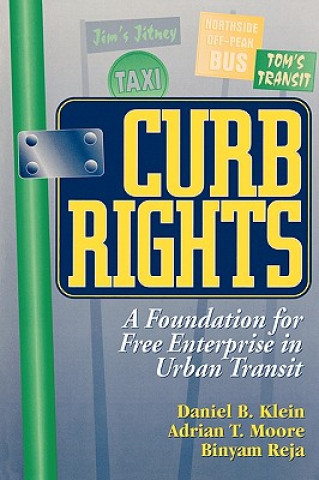
Curb Rights
by Daniel B. Klein, etc.
Transit services in the United States are in trouble. Ridership has dwindled, productivity has declined, and operating deficits have widened. The traditional approaches to running transit systems--government planning or operation ... more


- Language:
 English
- Binding: Paperback
- Number of pages: 164
Publisher: Brookings Institution, 1996
- More about this


You might also like
-

The Burnout Society
12.96 € -10 % -

Ulysses
5.22 € -29 % -

The Cake Bible, 35th Anniversary Edition
32.66 € -25 % -

Nightmare Before Christmas
12.35 € -34 % -

New Larousse Gastronomique
81.10 € -23 % -

Battle of Hackham Heath
9.64 € -25 % -

Lobster Is the Best Medicine
15.17 € -19 % -

Muay Thai Counter Techniques
27.93 € -25 % -

Topsy and Tim: Visit London
7.63 € -24 % -

Factfulness
30.14 € -

Krevní skupina A
5.82 € -16 % -

Правила дорожного движения 2025 с иллюстрациями
10.54 € -12 % -

Baking Made Easy
21.10 € -25 % -

Didn't I Say to Make My Abilities Average in the Next Life?! (Light Novel) Vol. 4
11.25 € -26 % -

Koren Shalem Siddur with Tabs, Compact, Denim
20.80 € -9 % -

Die ewige Suche des Menschen
16.78 € -16 % -

Handbuch Porsche 911 SC
49.24 € -16 % -

CD Schritte International 3
35.87 € -8 % -

Alfie
17.68 € -

Volkswagen: Model Documentation: Beetle to 412, Including Transporter (Boxer Engine Models)
26.94 € -9 % -

Cheating Cell
13.66 € -24 % -

Tajemniczy ogród. Edycja kolekcjonerska
18.48 € -3 % -

Ses Plus Belles Chansons, 2 Audio-CDs
14.66 € -

Microglia
337.01 € -7 % -

Complete Trading Course - Price Patterns, Strategies, Setups, and Execution Tactics
48.84 € -25 % -

Becoming God's Dwelling Place
14.36 € -7 % -

Telling Tales
14.36 € -25 % -

God, War, and Providence: The Epic Struggle of Roger Williams and the Narragansett Indians Against the Puritans of New England
14.36 € -25 % -

Japanese
108.65 € -

L'Astrologie grecque
72.36 € -

Napoleon III and the Second Empire
61.20 € -

Nickelodeon
30.55 € -

Leviticus XVIII and Marriage Between Affines.
11.45 € -24 % -

DB Private Venture Capital Investors Directory - III - 2014
53.06 € -11 % -

Sunday Best
16.88 € -

Introduzione al fenomeno della superconduttività
35.37 € -14 % -

Debugging by Thinking
88.14 € -

Brauchen Migranten Eine Andere Pflege?
12.55 € -10 % -

Call the Dead Again (Mitchell & Markby 11)
11.75 € -25 % -

In a Mysterious Way
7.83 € -6 % -

Verwaltung des General-Gouvernements in Elsass
20.49 € -10 % -

Cardiff
24.11 € -10 % -

Landscapes of the Ethnic Economy
57.99 € -

BEYOND PEYOTE Kieri and the Huichol Deer Shaman
29.14 € -25 % -

Bovine Neonatology, An Issue of Veterinary Clinics: Food Animal Practice
83.11 € -5 % -

Tuco and the Scattershot World
25.03 € -9 % -

Suzy the ADHD Taxi and the Sightseeing Adventure
16.47 € -18 % -

Die Meistersinger Von Nurnberg: Libretto
8.84 € -

LA OBRA LITERARIA DE MANUEL ALONSO ALCALDE (1919-1990)
10.04 € -10 % -

Des Retentions d'Urine. Critique Raisonnee Des Divers Traitements Qu'on a Employes
14.16 € -2 % -

Sourcebook on Environmental Law
62.81 € -

Traci's Pocket Posh Journal, Polka Dot
7.33 € -25 % -

Šperkovnice s motýlkem ve tvaru srdce - růžová
13.96 € -14 % -

Risk-sensitive Investment Management
151.06 € -

Johann Gottwerth Muller (Von Itzehoe)
14.16 € -2 % -

Swing Trading using the 4-hour chart 3
14.36 € -7 % -

King Henry
8.63 € -25 % -

Fleet Air Arm in the Second World War
231.17 € -

Les Nuits de l'âme
36.88 € -

A Greek And English Dictionary
32.56 € -1 % -

Neo-Adjuvant Chemotherapy
154.68 € -9 % -

JACKIE
38.08 € -2 % -

She
56.08 € -

Resources of Arizona. a Manual of Information Concerning the Territory. Compiled Under Authority of the Legislature
19.39 € -10 % -

Cinder
13.77 € -9 % -

Men Who Came Out of the Ground
11.75 € -25 % -

Right Honourable Annuitant Vindicated
11.65 € -14 % -

Governance in China
164.10 € -

H.G. Wells Reader
16.47 € -17 % -

Reckless Runaway
10.85 € -25 %
Give this book as a present today
- Order book and choose Gift Order.
- We will send you book gift voucher at once. You can give it out to anyone.
- Book will be send to donee, nothing more to care about.
More about Curb Rights
You get 67 loyalty points
 Book synopsis

Transit services in the United States are in trouble. Ridership has dwindled, productivity has declined, and operating deficits have widened. The traditional approaches to running transit systems--government planning or operation of bus and rail services, government subsidization of private operations, heavy regulation of all transit modes--have failed, and there is little hope of their ever succeeding under current practices. But public transportation cannot simply be abandoned. Can it, then, be made more self-supporting and efficient? The authors of this book say it's time to rethink the fundamental structure of transit policy. The book focuses on street-based transit--buses, shuttles, and jitneys. (While street-based transit in the U.S. today usually means bus service, in other times and places streets have also been served by smaller vehicles called jitneys that follow a route but not a schedule.) The authors examine a variety of transit services: jitney services from America's past, illegal jitneys today, airport shuttle van services, bus deregulation in Great Britain, and jitney services in less developed countries. The authors propose that urban transit be brought into the fold of market activity by establishing property rights not only in vehicles, but also in curb zones and transit stops. Market competition and entrepreneurship would depend on a foundation of what they call " curb rights." By creating exclusive and transferable curb rights (to bus stops and other pickup points) leased by auction, the authors contend that American cities can have the best of both kinds of markets--scheduled (and unsubsidized) bus service and unscheduled but faster and more flexiblejitneys. They maintain that a carefully planned transit system based on property rights would rid the transit market of inefficient government production and overregulation. It would also avoid the problems of a lawless market--cutthroat competition, schedule jockeying, and even curbside conflict among rival operators. Entrepreneurs would be able to introduce ever better service, revise schedules and route structures, establish connections among transit providers, and use new pricing strategies. And travelers would find public transit more attractive than they do now. Once the system of curb rights is sensibly implemented, the authors conclude, the market process will take over. Then the invisible hand can do in transit what it does so well in other parts of the economy.
Book details
Book category Books in English Technology, engineering, agriculture Transport technology & trades Automotive technology & trades
27.73 €
- Full title: Curb Rights
- Subtitle: A Foundation for Free Enterprise in Urban Transit
- Author: Daniel B. Klein, etc.
- Language: English
- Binding: Paperback
- Number of pages: 164
- EAN: 9780815749394
- ISBN: 0815749392
- ID: 04727966
- Publisher: Brookings Institution
- Weight: 333 g
- Dimensions: 229 × 152 × 9 mm
- Date of publishing: 30. December 1996
Trending among others
-

Sheet Metal Shaping
30.04 € -12 % -

Jahrbuch Schwertransprote 2027
15.97 € -15 % -

Yamaha XJ650 & 750 Fours (80 - 84)
54.37 € -10 % -

Race Car Aerodynamics
36.18 € -25 % -

Race Car Vehicle Dynamics
107.04 € -2 % -

Ford Mustang V8 (July 64 - 73)
34.47 € -24 % -

Volvo 120 and 130 Series Owner's Workshop Manual
51.05 € -4 % -

Race Car Design
77.39 € -5 % -

Chassis Engineering Hp1055
25.62 € -25 % -

Professional Sheet Metal Fabrication
35.28 € -9 % -

Mercedes-Benz 350 & 450 (71 - 80)
34.47 € -24 % -

Datsun 240Z, 260Z & 280Z (70 - 78)
34.47 € -24 % -

Maximum Boost
63.72 € -9 % -

Mercedes-Benz 170 V / 170 S / 220
113.07 € -12 % -

Jahrbuch Feuerwehrfahrzeuge 2027
15.97 € -15 % -

Chevrolet Corvette (68 - 82)
34.47 € -24 % -

Honda CB750 & CB900 Dohc Fours (78 - 84)
60.20 € -4 % -

How to Build, Modify & Power Tune Cylinder Heads Updates &
25.12 € -24 % -

The Science of Vehicle Dynamics
85.12 € -9 % -

Jahrbuch Lastwagen 2027
15.97 € -15 % -

Porsche 944 (83 - 89)
46.13 € -10 % -

Tuning The A-Series Engine
47.03 € -24 % -

Modifying the Aerodynamics of Your Road Car
41.80 € -25 % -

Honda CX/GL500 & 650 V-Twins (78 - 86)
54.37 € -10 % -

Honda CB400 & CB550 Fours (73 - 77)
60.20 € -4 % -

Toyota Land Cruiser (68 - 82)
46.23 € -9 % -

Chevrolet & GMC Pick Ups (67 - 87)
46.23 € -9 % -

Honda GL1000 Gold Wing (75 - 79)
60.20 € -4 % -

Honda GL1100 Gold Wing (79 - 81)
54.37 € -10 % -

H-D Shovelheads 66-84
83.22 € -

Machine That Changed the World
46.63 € -11 % -

Optimising Car Performance Modifications
15.87 € -25 % -

Automotive Master Technician
42.81 € -10 % -

Norton 500, 600, 650 & 750 Twins (57 - 70)
60.20 € -4 % -

Vespa Scooters (59 - 78)
46.43 € -4 % -

Hillier's Fundamentals of Motor Vehicle Technology Book 1
52.76 € -5 % -

Honda MB, MBX, MT & MTX50 (80 - 93)
54.37 € -10 % -

Honda CB250 & CB400N Super Dreams (78 - 84)
60.20 € -4 % -

Vehicle Dynamics
133.17 € -

Yamaha RD & DT125Lc (82 - 87)
54.37 € -10 % -

Fachkunde Nutzfahrzeugtechnik
37.78 € -6 % -

Spring Design and Manufacture
12.86 € -10 % -

Chevrolet and GMC Pick-ups
46.23 € -9 % -

Fundamentals of Automotive and Engine Technology
100.10 € -9 % -

4-Cylinder Engine Short Block High-Performance Manual
20.19 € -25 % -

Automotive Emissions Regulations and Exhaust Aftertreatment Systems
92.36 € -2 % -

Classic Miniature Vehicles: Made in Italy
13.26 € -26 % -

Illustrated Encyclopedia of Trucks
15.87 € -25 % -
SAAB
9.24 € -7 %
Collection points Bratislava a 13536 dalších
Copyright ©2008-26 najlacnejsie-knihy.sk All rights reservedPrivacyCookies

 27076 collection points
 Delivery 2.99 €
 02/210 210 99 (8-15.30h)
