Code: 43423048
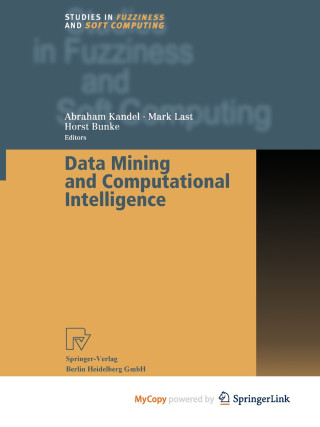
Data Mining and Computational Intelligence
by Abraham Kandel, Mark Last, Horst Bunke
Many business decisions are made in the absence of complete information about the decision consequences. Credit lines are approved without knowing the future behavior of the customers; stocks are bought and sold without knowing th ... more


- Language:
 English
 - Binding: Paperback
- Number of pages: 372
Publisher: Springer Nature B.V., 2014
- More about this

57.05 €
RRP: 57.06 €
You save 0.01 €

In stock at our supplier
Shipping in 10 - 18 days
You might also like
-

Moonwalk
14.08 € -18 % -

The Score
13.77 € -12 % -

The Deal
12.35 € -21 % -

The Mistake
14.48 € -

Jujutsu Kaisen, Vol. 30
9.41 € -24 % -

Berserk Deluxe Volume 1
35.66 € -25 % -

The Goal
14.58 € -7 % -
Invincible Compendium Volume 2
55.22 € -33 % -

Berserk Deluxe Volume 2
33.13 € -31 % -

Witch Hat Atelier: Grimoire Edition 1
34.65 € -29 % -

Lord of Mysteries, Vol. 3: The Clown, Part III
14.99 € -24 % -

Murdoku
14.28 € -30 % -

Legacy
11.95 € -24 % -

Moonwalk: A Memoir
19.95 € -31 % -

Jujutsu Kaisen, Vol. 25
9.72 € -25 % -

JoJo's Bizarre Adventure: Part 7--Steel Ball Run, Vol. 7
18.23 € -25 % -

Witch Hat Atelier Manga Box Set 1
51.37 € -31 % -

Heated Rivalry
12.56 € -7 % -

White Nights
4.75 € -11 % -

Jujutsu Kaisen, Vol. 26
9.31 € -25 % -

Berserk Deluxe Volume 3
55.02 €
Give this book as a present today
- Order book and choose Gift Order.
- We will send you book gift voucher at once. You can give it out to anyone.
- Book will be send to donee, nothing more to care about.
More about Data Mining and Computational Intelligence
You get 138 loyalty points
 Book synopsis
Many business decisions are made in the absence of complete information about the decision consequences. Credit lines are approved without knowing the future behavior of the customers; stocks are bought and sold without knowing their future prices; parts are manufactured without knowing all the factors affecting their final quality; etc. All these cases can be categorized as decision making under uncertainty. Decision makers (human or automated) can handle uncertainty in different ways. Deferring the decision due to the lack of sufficient information may not be an option, especially in real-time systems. Sometimes expert rules, based on experience and intuition, are used. Decision tree is a popular form of representing a set of mutually exclusive rules. An example of a two-branch tree is: if a credit applicant is a student, approve; otherwise, decline. Expert rules are usually based on some hidden assumptions, which are trying to predict the decision consequences. A hidden assumption of the last rule set is: a student will be a profitable customer. Since the direct predictions of the future may not be accurate, a decision maker can consider using some information from the past. The idea is to utilize the potential similarity between the patterns of the past (e.g., "most students used to be profitable") and the patterns of the future (e.g., "students will be profitable").
Book details
57.05 €
- Full title: Data Mining and Computational Intelligence
- Author: Abraham Kandel, Mark Last, Horst Bunke
- Language: English
- Binding: Paperback
- Number of pages: 372
- EAN: 9783662003589
- ID: 43423048
- Publisher: Springer Nature B.V.
- Weight: 837 g
- Dimensions: 279 × 210 mm
- Date of publishing: 12. March 2014
Collection points Bratislava a 12782 dalších
Copyright ©2008-26 najlacnejsie-knihy.sk All rights reservedPrivacyCookies

 25568 collection points
 Delivery 2.99 €
 02/210 210 99 (8-15.30h)