Code: 01650640
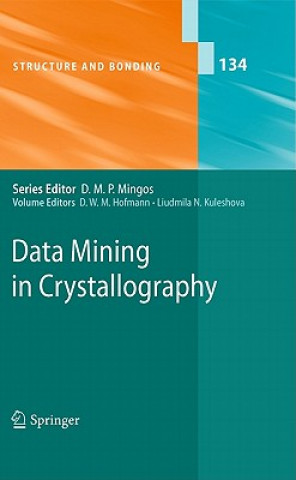
Data Mining in Crystallography
by D. W. M. Hofmann, Liudmila N. Kuleshova
Humans have been manually extracting patterns from data for centuries, but the increasing volume of data in modern times has called for more automatic approaches. Early methods of identifying patterns in data include Bayes theorem ... more


- Language:
 English
 - Binding: Hardback
- Number of pages: 172
Publisher: Springer-Verlag Berlin and Heidelberg GmbH & Co. KG, 2009
- More about this

205.74 €
RRP: 222.86 €
You save 17.11 €

In stock at our supplier
Shipping in 10 - 13 days
You might also like
-

Caraval
10.21 € -23 % -

Romy Schneider
8.79 € -13 % -

Na kole ke hvězdám
1.41 € -12 % -

Where's Wally Now?
13.95 € -24 % -

Команда скелетiв
23.46 € -12 % -

Practical Vocal Method (Vaccai) - Low Voice: Alto/Bass - Book/CD
27.10 € -9 % -

Luxusní zápisník Boncahier Víno Grand reserva/citáty
13.34 € -

Man Behind the Microchip
27.30 € -

Western Medicine
238.72 € -

Story of the Shakers
11.02 € -21 % -

Times Square and 42nd Street in Vintage Postcards
19.61 € -21 % -

Ein Motiv aus dem Kalender Zarte Schönheiten - Feine Hibiskusblüten (Puzzle)
34.38 € -4 % -

Introducción al Griego Bíblico: Pronunciación
9.80 € -6 % -

Requiem pour Charlie Johnson
34.08 € -

A Catalogue of Notable Middle Templars: With Brief Biographical Notices.
21.54 € -24 % -

Rheinsberg V1: Memorials Of Frederick The Great And Prince Henry Of Prussia (1880)
32.77 € -2 % -

Space Survival: Keeping People Alive in Space
22.45 € -26 % -

Short Story Criticism
456.31 € -

Advances in Invertebrate (Neuro)Endocrinology
115.92 € -

Chanson's Populaires Grecques (1876)
19.31 € -2 % -

Auswirkungen des Tourismus und Tragfähigkeit für Flusslandschaften
68.47 € -11 % -

The Works Of George Buchanan, In The Scottish Language: Containing The Chameleon, A Satire Against The Laird Of Lidingtone (1823)
18.40 € -1 % -

Herz der Finsternis
11.83 € -10 % -

Die Ätherischen Öle
16.98 € -11 % -

What Leadership Is Not
14.86 € -1 % -

Visual Sociology
58.56 € -4 % -

Live in a Better Way
21.44 € -18 % -

Barren Grounds
13.44 € -24 %
Give this book as a present today
- Order book and choose Gift Order.
- We will send you book gift voucher at once. You can give it out to anyone.
- Book will be send to donee, nothing more to care about.
More about Data Mining in Crystallography
You get 498 loyalty points
 Book synopsis
Humans have been manually extracting patterns from data for centuries, but the increasing volume of data in modern times has called for more automatic approaches. Early methods of identifying patterns in data include Bayes theorem (1700s) and Regression analysis (1800s). The proliferation, ubiquity and incre- ing power of computer technology has increased data collection and storage. As data sets have grown in size and complexity, direct hands-on data analysis has - creasingly been augmented with indirect, automatic data processing. Data mining has been developed as the tool for extracting hidden patterns from data, by using computing power and applying new techniques and methodologies for knowledge discovery. This has been aided by other discoveries in computer science, such as Neural networks, Clustering, Genetic algorithms (1950s), Decision trees (1960s) and Support vector machines (1980s). Data mining commonlyinvolves four classes of tasks: Classi cation: Arranges the data into prede ned groups. For example, an e-mail program might attempt to classify an e-mail as legitimate or spam. Common algorithmsinclude Nearest neighbor,Naive Bayes classi er and Neural network. Clustering: Is like classi cation but the groups are not prede ned, so the algorithm will try to group similar items together. Regression: Attempts to nd a function which models the data with the least error. A common method is to use Genetic Programming. Association rule learning: Searches for relationships between variables. For example, a supermarket might gather data of what each customer buys.
Book details
Book category Books in English Mathematics & science Physics Materials / States of matter
205.74 €
- Full title: Data Mining in Crystallography
- Author: D. W. M. Hofmann, Liudmila N. Kuleshova
- Language: English
- Binding: Hardback
- Number of pages: 172
- EAN: 9783642047589
- ISBN: 3642047580
- ID: 01650640
- Publisher: Springer-Verlag Berlin and Heidelberg GmbH & Co. KG
- Weight: 488 g
- Dimensions: 235 × 155 × 16 mm
- Date of publishing: 18. November 2009
Trending among others
-

Wave Propagation in Elastic Solids
73.53 € -

Quantum Field Theory for the Gifted Amateur
54.41 € -

A First Course in Magnetohydrodynamics
77.07 € -

Kittel's Introduction to Solid State Physics
75.76 € -4 % -

Space Physics
91.23 € -
Elements of Gas Dynamics
21.64 € -25 % -

Electronics for Guitarists
57.14 € -14 % -

Green's Functions For Solid State Physicists
65.94 € -

Analog and Digital Electronic Circuits
65.54 € -9 % -

Introduction to Random Vibrations, Spectral & Wavelet Analysis
21.64 € -25 % -

Atomic Physics
53.60 € -

Global Approach to Quantum Field Theory
130.79 € -

Earth's Ionosphere
94.57 € -

Basic Space Plasma Physics (Revised Edition)
68.98 € -

Solid State Physics
127.55 € -

Basic Notions of Condensed Matter Physics
102.66 € -

Many-Body Quantum Theory in Condensed Matter Physics
95.18 € -

Theoretical Astrophysics: Volume 1, Astrophysical Processes
105.29 € -

How to Solve Physics Problems
29.93 € -25 % -

Solid State Physics
106.31 € -

Basics of Crystallography and Diffraction
78.29 € -

Optical Properties of Solids
60.28 € -

Quantum Field Theory for the Gifted Amateur
131.29 € -

Theory of Optical Processes in Semiconductors
129.17 € -

Nature of Computation
113.59 € -

Advanced Solid State Physics
91.23 € -

Fluid Dynamics
115.71 € -

Condensed Matter Physics 2e
169.53 € -

Problems In Solid State Physics With Solutions
78.79 € -
Tokamaks
539.87 € -
Methods of Statistical Physics
33.07 € -59 % -

Fundamentals of Crystallography
114.60 € -

Introduction to Semiconductor Physics and Devices
55.83 € -

Bose-Einstein Condensation in Dilute Gases
114.40 € -

Solar Energy
26.80 € -25 % -
Physics of Condensed Matter
88.20 € -

Solid-State Physics
60.58 € -9 % -

Quantum Information
47.74 € -

Plasma Physics and Fusion Energy
115.61 € -

Plasma Physics
61.29 € -9 % -

Polymer Physics
98.11 € -

Solid State Physics
130.89 € -9 % -

Solid Propellant Rockets
75.45 € -28 % -

Solid State Physics 2e
83.95 € -

Introduction to the Atomic and Radiation Physics of Plasmas
82.74 € -
Statistical Physics of Spin Glasses and Information Processing
124.51 € -14 % -
Physical Kinetics
71.81 € -5 % -

Ultracold Atoms in Optical Lattices
146.87 € -

Principles of Plasma Physics for Engineers and Scientists
105.29 €
Collection points Bratislava a 12868 dalších
Copyright ©2008-26 najlacnejsie-knihy.sk All rights reservedPrivacyCookies

 25740 collection points
 Delivery 2.99 €
 02/210 210 99 (8-15.30h)