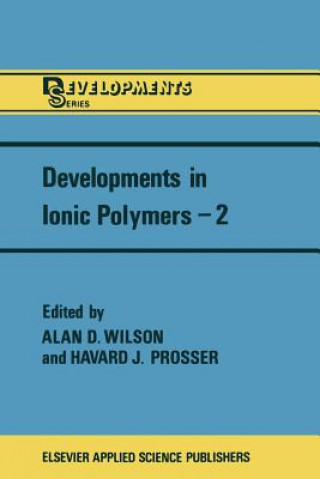
Code: 02185463
Developments in Ionic Polymers-2
by A.D. Wilson, rosser
Ionic polymers, like elephants, are easier to recognise than to define. Several methods of classification have been attempted but none is wholly satisfactory because of the extreme diversity of ionic polymers, which range from the ... more


- Language:
 English
 - Binding: Paperback
- Number of pages: 356
Publisher: Springer, 2011
- More about this

51.68 €
RRP: 55.96 €
You save 4.28 €

In stock at our supplier
Shipping in 5 - 8 days
You might also like
-

The Penguin Book of Murder Mysteries
13.04 € -29 % -

Harmonizing Your Craniosacral System
23.05 € -20 % -

Goetia: The Book of Evil Spirits, or The Lesser Key of Solomon: Necromancy, Witchcraft and the Black Arts
8.99 € -6 % -

Glider Flying Handbook (FAA-H-8083-13)
19.21 € -7 % -

Les Schtroumpfs Lombard - Tome 38 - Les Schtroumpfs et le vol des cigognes
17.19 € -

Beelzebub T01
10.81 € -

Foto/montáž tiskem/Photo/Montage in Print
46.83 € -16 % -

PALABRAS
6.87 € -

Milenaya Mektuplar
16.18 € -4 % -

DIE SERBO-CROAT-BEZIEHUNGEN IN JUGOSLAWIEN
70.40 € -11 % -

Let's play, Mom!
24.77 € -1 % -

Maxwellians
42.68 € -

Contexte Socio- conomique Et Soins Obst tricaux Au Niger
49.86 € -11 % -

Canyon through Time
34.18 € -

Feminist Fight Club
18.60 € -25 % -

Developments in Functional Equations and Related Topics
102.97 € -7 % -

Make Money with Binary Options: The Calends Strategy
9.80 € -6 % -

Ribband of Blue and Other Bible Studies
8.18 € -14 % -

UEberbetrieblicher Verfahrensvergleich
53.10 € -7 % -

Cowboy Way
13.95 € -24 % -

Changing Role of Government
110.55 € -

Rosi in der Geisterbahn, Mini-Ausgabe
7.27 € -

WJEC/Eduqas Religious Studies for A Level Year 1 & AS - Philosophy of Religion Revision Guide
21.33 € -

Mediengeschichte
21.94 € -

Shimada Kenji
45.11 € -

English-Ukrainian Trouble/Проблема Children's Bilingual Picture Book
11.42 € -7 % -

MSCs and Innovative Biomaterials in Dentistry
118.45 € -7 % -

Sand in der Seele
14.35 € -16 % -

Besondere
22.35 € -11 % -

Lipids in Photosynthesis: Structure, Function and Genetics
205.74 € -7 % -

Birds In The Calendar (1914)
20.22 € -1 % -

La vuelta a españa del corto maltés
21.84 € -

Labor Legislation, Labor Movements, and Labor Leaders (1902)
40.05 € -1 % -

Voyage Pittoresque De Paris Ou Indication De Tout Ce Qu'il Y A De Plus Beau Dans Cette Grande Ville En Peinture, Sculpture, Et Architecture
37.32 € -1 % -

Secretary or General?
43.99 € -

Einführung in die systemische Pädagogik
18.70 € -

Wisdom from the Monastery
20.12 € -

Purpose of Life
11.52 € -7 % -

The Cross of Victory
14.05 € -6 % -

Balthazar the Magus
29.22 € -1 % -

Fair Weather
53.70 € -

Sai-Ko and other stories
21.03 € -2 % -

Cindy Sherman's Office Killer
43.99 € -

Fictions of Mass Democracy in Nineteenth-Century America
131.09 € -

Collecting Cultures
120.67 € -4 % -

Agrartreibstoffe in Brasilien
22.45 € -11 % -

Cube of Space Workbook
30.84 € -

Living with Mania
15.37 € -

Die kommerzielle Nutzung menschlicher Körpersubstanzen.
65.94 € -6 %
Give this book as a present today
- Order book and choose Gift Order.
- We will send you book gift voucher at once. You can give it out to anyone.
- Book will be send to donee, nothing more to care about.
More about Developments in Ionic Polymers-2
You get 125 loyalty points
 Book synopsis
Ionic polymers, like elephants, are easier to recognise than to define. Several methods of classification have been attempted but none is wholly satisfactory because of the extreme diversity of ionic polymers, which range from the organic, water-soluble polyelectrolytes, through hydrogels and ionomer carboxylate rubbers, to the almost infusible inorganic silicate minerals. For this reason, a general classification is not only difficult, but has minimal utility. However, there are some characteristics of these materials that should be highlighted. The role of counterions is the significant one. These ions, either singly or as clusters, take part in the formation of ionic bonds which have a varying structural role. Often they act as crosslinks, but in the halato-polymers the ionic bonds form an integral part of the polymer backbone itself. Conversely, in polymers contain ing covalent crosslinks, such as the ion-exchange resins, the coun terions have virtually no structural role to play, since they dwell in cage-like structures without affecting the crosslinking, and are readily exchanged. They are, perhaps, best described as ion-containing polymers rather than structural ionic polymers. Another crucial factor is the role of water in ionic polymers. The presence of ionic bonds means that there is a tendency for these materials to interact with water. Where the ionic polymer contains a high proportion of ionic units, it acts as a hydrogel and may be highly soluble. Such interactions with water decrease sharply as the ionic content is reduced, though even then water can act as a plasticiser.
Book details
Book category Books in English Mathematics & science Chemistry Organic chemistry
51.68 €
- Full title: Developments in Ionic Polymers-2
- Author: A.D. Wilson, rosser
- Language: English
- Binding: Paperback
- Number of pages: 356
- EAN: 9789401083607
- ISBN: 9401083606
- ID: 02185463
- Publisher: Springer
- Weight: 544 g
- Dimensions: 229 × 152 × 21 mm
- Date of publishing: 26. September 2011
Trending among others
-

Strategic Applications of Named Reactions in Organic Synthesis
112.48 € -10 % -
Organic Chemistry
88 € -11 % -

Organic Chemistry
111.77 € -
Molecular Model Set for Organic Chemistry
33.68 € -

Injection Molding Handbook
82.43 € -7 % -

Atmospheric Chemistry and Physics: From Air Pollut ion to Climate Change, Third Edition
150.01 € -10 % -

Aromatic Heterocyclic Chemistry
28.52 € -

Solutions Manual to accompany Organic Chemistry
121.88 € -

Organic Chemistry: A Very Short Introduction
10 € -24 % -

Advanced Organic Chemistry
100.64 € -

3000 Solved Problems in Organic Chemistry
40.25 € -18 % -

Modern Physical Organic Chemistry
174.99 € -

Molecular Orbitals and Organic Chemical Reactions - Student Edition
62 € -

Schaum's Outline of Organic Chemistry
25.38 € -19 % -

Organic Chemistry of Biological Pathways
125.43 € -

Heterocyclic Chemistry 5e
64.63 € -

Advanced Organic Chemistry
111.47 € -

Organ Music for Manuals Only
12.74 € -24 % -

How to Succeed in Organic Chemistry
38.03 € -
pKa Prediction for Organic Acids and Bases
55.83 € -
Molymod MMS-003
48.04 € -

Advanced Organic Chemistry
70.80 € -8 % -

Organic Chemistry I For Dummies, 2nd Edition
18.30 € -24 % -

March's Advanced Organic Chemistry - Reactions, Mechanisms, and Structure, Eighth Edition
224.15 € -

Organic Synthesis - The Disconnection Approach 2e
51.78 € -

Organic Synthesis - Strategy and Control
77.48 € -

Workbook for Organic Synthesis: The Disconnection Approach
55.42 € -10 % -

Organic Chemistry: 100 Must-Know Mechanisms
64.43 € -24 % -

Fundamentals of Organic Chemistry, International Edition
112.98 € -

Way of Synthesis - Evolution of Design and Methods for Natural Products
110.35 € -
Organic Chemistry Fundamentals
12.94 € -
Student Solutions Manual for Modern Physical Organic Chemistry
66.55 € -
Polymer Chemistry
80.61 € -9 % -

Organic Chemistry with Biological Applications
123.20 € -

Workbook for Organic Synthesis - Strategy and Control
67.16 € -

Organometallics and Catalysis: An Introduction
66.55 € -

CCEA AS Unit 2 Chemistry Student Guide: Further Physical and Inorganic Chemistry and an Introduction to Organic Chemistry
17.39 € -

Chemistry of High Energy Materials
74.04 € -24 % -

Silica Aerogel Composites
102.97 € -7 % -

Organic Stereochemistry
46.32 € -

Mechanisms of Organic Reactions
46.32 € -

Nonlinear Optical Effects and Materials
51.68 € -7 % -

Amino Acids and Proteins for the Athlete: The Anabolic Edge
254.40 € -

Process Development
38.23 € -

Study Guide and Solutions Manual for Organic Chemistry, Global Edition
98.72 € -
Side Reactions in Peptide Synthesis
107.52 € -

Organic Chemistry
153.34 € -

Organotransition Metal Chemistry: From Bonding to Catalysis
148.29 € -

Experimental Organic Chemistry
96.19 €
Collection points Bratislava a 12441 dalších
Copyright ©2008-26 najlacnejsie-knihy.sk All rights reservedPrivacyCookies

 24886 collection points
 Delivery 2.99 €
 02/210 210 99 (8-15.30h)