Code: 50789619
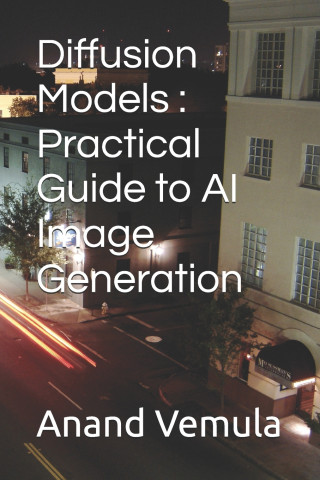
Diffusion Models
by Anand Vemula
This book delves into the fascinating world of diffusion models, a powerful tool in generative AI. It equips readers with the knowledge to understand how these models work, explore their applications, and stay informed about futur ... more


- Language:
 English
 - Binding: Paperback
- Number of pages: 30
Publisher: Independently published, 2024
- More about this

18.30 €
RRP: 19.71 €
You save 1.42 €

In stock at our supplier
Shipping in 14 - 21 days
You might also like
-

Moonwalk
13.95 € -18 % -

The Score
13.65 € -13 % -

The Deal
12.23 € -22 % -

The Mistake
13.44 € -15 % -

Jujutsu Kaisen, Vol. 30
9.90 € -20 % -

Berserk Deluxe Volume 1
35.70 € -25 % -

The Goal
14.56 € -

Berserk Deluxe Volume 2
33.17 € -31 % -

Invincible Compendium Volume 2
45.81 € -24 % -

Legacy
11.93 € -22 % -

Lord of Mysteries, Vol. 3: The Clown, Part III
17.09 € -13 % -

Murdoku
14.05 € -25 % -

Berserk Deluxe Volume 3
55.22 € -

Witch Hat Atelier Manga Box Set 1
51.28 € -31 % -

Chainsaw Man, Vol. 21
9.30 € -25 % -

Dancing The Dream
19.92 € -31 % -

White Nights
4.54 € -

Jujutsu Kaisen, Vol. 25
9.70 € -25 % -

Jujutsu Kaisen, Vol. 29
9.70 € -25 % -

Witch Hat Atelier: Grimoire Edition 1
35.29 € -29 % -

JoJo's Bizarre Adventure: Part 7--Steel Ball Run, Vol. 7
18.10 € -25 %
Give this book as a present today
- Order book and choose Gift Order.
- We will send you book gift voucher at once. You can give it out to anyone.
- Book will be send to donee, nothing more to care about.
More about Diffusion Models
You get 44 loyalty points
 Book synopsis
This book delves into the fascinating world of diffusion models, a powerful tool in generative AI. It equips readers with the knowledge to understand how these models work, explore their applications, and stay informed about future advancements.
Part 1: Introduction
- Chapter 1: Unveils the core concept of diffusion models. It explains how they work by adding noise to data and then learning to reverse the process, ultimately generating new, realistic outputs. The chapter also explores the various applications of diffusion models across diverse fields.
- Chapter 2: Introduces the broader landscape of generative AI models and compares diffusion models with other popular approaches like VAEs and GANs. This helps readers understand the unique strengths of diffusion models.
Part 2: Deep Dive
- Chapter 3: Dives deeper into the inner workings of diffusion models (optional for those without a strong mathematical background). It explores the concept of probability distributions and other key mathematical concepts that underpin these models.
- Chapter 4: Explains the diffusion process in detail, including the step-by-step addition of noise and different diffusion model architectures (e.g., U-Net, DDPM).
- Chapter 5: Explores how diffusion models learn to reverse the noise addition process. It delves into the training techniques and optimization methods used to achieve this remarkable feat.
- Chapter 6: Explains how to use a trained diffusion model to generate entirely new data. It covers different strategies for initiating the sampling process and controlling the generation by providing prompts or specific styles.
Part 3: Applications and Beyond
- Chapter 7: Showcases how diffusion models can be used for image editing tasks like inpainting (filling in missing parts) and style transfer (applying the style of one image to another).
- Chapter 8: Pushes the boundaries beyond images. It explores how diffusion models can be adapted to generate different data formats like text, audio, and even 3D structures, opening doors for creative writing, music generation, and scientific research.
- Chapter 9: Explores cutting-edge research on diffusion models, highlighting their increasing capabilities and potential future directions. This includes improving efficiency and control, making models more interpretable, and addressing ethical considerations.
Part 4: Conclusion
- Chapter 10: Discusses the significant impact of diffusion models on generative AI and various fields. It emphasizes the importance of responsible use and explores ethical considerations like bias, misinformation, and copyright ownership. The chapter concludes with a hopeful outlook on the future of diffusion models and their potential for human-AI collaboration.
Overall, this book offers a comprehensive and engaging introduction to diffusion models, empowering readers to not only understand but also leverage this powerful technology for creative exploration and innovation.
Book details
18.30 €
- Full title: Diffusion Models
- Subtitle: Practical Guide to AI Image Generation
- Author: Anand Vemula
- Language: English
- Binding: Paperback
- Number of pages: 30
- EAN: 9798325970764
- ID: 50789619
- Publisher: Independently published
- Weight: 56 g
- Dimensions: 229 × 152 × 2 mm
- Date of publishing: 18. May 2024
Collection points Bratislava a 12868 dalších
Copyright ©2008-26 najlacnejsie-knihy.sk All rights reservedPrivacyCookies

 25740 collection points
 Delivery 2.99 €
 02/210 210 99 (8-15.30h)