Code: 51006091
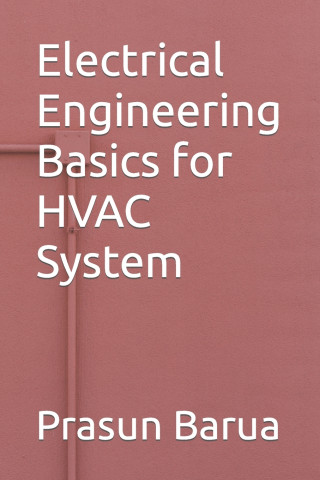
Electrical Engineering Basics for HVAC System
by Prasun Barua
Welcome to Electrical Engineering Basics for HVAC System! This is a nonfiction science book which covers fundamentals of electrical engineering that HVAC engineers and other mechanical engineers would find beneficial in their dail ... more


- Language:
 English
 - Binding: Paperback
- Number of pages: 114
Publisher: Independently published, 2023
- More about this

26.90 €
RRP: 28.93 €
You save 2.03 €

In stock at our supplier
Shipping in 14 - 21 days
You might also like
-

Moonwalk
14.05 € -18 % -

The Score
13.75 € -10 % -

Berserk Deluxe Volume 1
35.70 € -25 % -

The Deal
12.33 € -9 % -

The Mistake
13.54 € -14 % -

Jujutsu Kaisen, Vol. 30
9.70 € -25 % -

Berserk Deluxe Volume 2
33.17 € -30 % -

Dancing The Dream
19.92 € -31 % -

Murdoku
14.05 € -25 % -

Berserk Deluxe Volume 3
55.22 € -

The Goal
14.66 € -

White Nights
4.54 € -14 % -

Chainsaw Man, Vol. 21
9.90 € -20 % -

Invincible Compendium Volume 2
45.81 € -24 % -

The Legacy
11.93 € -22 % -

Jujutsu Kaisen, Vol. 29
9.90 € -20 % -

Invincible Compendium Volume 3
45.81 € -24 % -

Lord of Mysteries, Vol. 3: The Clown, Part III
17.09 € -13 % -

Jujutsu Kaisen, Vol. 26
9.90 € -20 % -

Witch Hat Atelier: Grimoire Edition 1
34.99 € -29 % -

JoJo's Bizarre Adventure: Part 7--Steel Ball Run, Vol. 7
18.20 € -25 %
Give this book as a present today
- Order book and choose Gift Order.
- We will send you book gift voucher at once. You can give it out to anyone.
- Book will be send to donee, nothing more to care about.
More about Electrical Engineering Basics for HVAC System
You get 65 loyalty points
 Book synopsis
Welcome to Electrical Engineering Basics for HVAC System! This is a nonfiction science book which covers fundamentals of electrical engineering that HVAC engineers and other mechanical engineers would find beneficial in their daily work. A heating, ventilation, and air-conditioning (HVAC) system is a simple system of heating and cooling exchangers that use water or refrigerant as the medium (direct expansion system). Pumps transport warm or cooled water to exchangers. The warmed or cooled air produced by the exchangers is subsequently moved to the occupied building interiors via fans. As a result, heating and cooling occur in two stages. They are as follows: water stage and air stage. Water is the most efficient and cost-effective medium for cooling (through a chiller) or heating (via a boiler). Because it may be cooled or heated through coils, air is the medium for heat exchange in the building. Fans are utilized in HVAC systems for air circulation and ventilation. Cooling is performed through the use of chillers to provide chilled water for large buildings or direct expansion cooling devices such as packaged air conditioners for small structures. In the heating system, boilers are most commonly used to provide hot water for heating, but electric heaters are also widely utilized for zonal reheat. Pumps are used to circulate hot water, chilled water, and condenser water. Heat rejection is accomplished by the use of cooling towers. The cooling tower fan and pumps consume the most energy. Non-electrical engineers may find power distribution systems and equipment needed to power HVAC machines, motors, and other auxiliaries to be difficult. This is the first edition of the book. Thanks for reading the book.
Book details
26.90 €
- Full title: Electrical Engineering Basics for HVAC System
- Author: Prasun Barua
- Language: English
- Binding: Paperback
- Number of pages: 114
- EAN: 9798395555649
- ID: 51006091
- Publisher: Independently published
- Weight: 165 g
- Dimensions: 229 × 152 × 6 mm
- Date of publishing: 22. May 2023
Collection points Bratislava a 12830 dalších
Copyright ©2008-26 najlacnejsie-knihy.sk All rights reservedPrivacyCookies

 25664 collection points
 Delivery 2.99 €
 02/210 210 99 (8-15.30h)