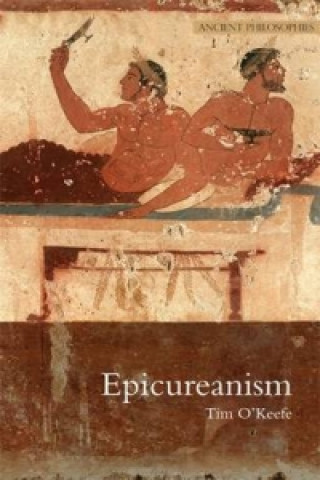
Code: 04267947
Epicureanism
by Tim O´Keefe
The Epicurean school of philosophy was one of the dominant philosophies of the Hellenistic period. Founded by Epicurus of Samos (century 341-270 BCE), it was characterized by an empiricist epistemology and a hedonistic ethics. Thi ... more


- Language:
 English
 - Binding: Paperback
- Number of pages: 224
Publisher: Taylor & Francis Ltd, 2009
- More about this


You might also like
-

ADAPTIVE RIFLE
18.30 € -24 % -

Jacobean Embroidery
17.09 € -

Ancient Language of Sacred Sound
21.74 € -24 % -

Panini UK Football Sticker Collections 1986-1993 (Volume Two)
43.49 € -22 % -

Art of Skin Health Restoration and Rejuvenation
305.28 € -

German Army on the Eastern Front: The Advance
21.64 € -4 % -

Skills in Transactional Analysis Counselling & Psychotherapy
36.61 € -10 % -

Esoteric Cosmology
9.40 € -2 % -

Going Underground
28.21 € -

Perricone Promise
8.69 € -25 % -

British Language and Culture
12.23 € -

Paleobotany and the Evolution of Plants
104.08 € -

Stress Testing Credit Risk
15.47 € -2 % -

Guide to Freshwater Fishes of Oregon
18.10 € -22 % -

Early Rome to 290 Bc
193.50 € -

Exploring Translation and Multilingual Text Production
148.89 € -4 % -

Humanity 2.0
55.83 € -

Mogador
12.03 € -24 % -

Mis primeros clásicos. El Mago de Oz
10.61 € -10 % -

Le Grand Mort - Tome 04
21.64 € -

Propaganda and Intelligence in the Cold War
71.91 € -

YouTube Reader
28.72 € -4 % -

bambini sono matti
11.93 € -

MY HOME HERO NUM. 13
14.05 € -

Virgin and Veteran Readings of Ulysses
55.83 € -

Lettre A Un Seigneur Etranger, Sur Les Ouvrages Periodiques de France
13.85 € -2 % -

My Southern Journey
13.44 € -24 % -

Una història de colors
3.63 € -

Los transportes (Mira y Aprende)
13.54 € -9 % -

Vous êtes votre meilleur psy !
11.22 € -

Comme d'habitude
22.24 € -

Sewing Machinery
16.18 € -14 % -

Reforms in Long-Term Care Policies in Europe
102.97 € -7 % -

Doppler
12.13 € -5 % -

Eponym Dictionary of Mammals
73.73 € -

Nasty Little F!#*ers
12.33 € -7 % -

Cybernics
154.36 € -7 % -

Wohnungsnot in den Grossstadten und die Mittel zu ihrer Abhilfe
17.89 € -11 % -

Contributions Indirectes. Guide Pratique de l'Employe
13.04 € -1 % -

Catalogue Des Gentilshommes de Perigord, Aunis, Saintonge Et Augoumois (Ed.1864)
13.85 € -2 % -

El castillo blanco
21.44 € -

Gesammelte Dramen
134.63 € -7 % -

Making Needlework Accessories
19.01 € -10 % -

Journey to Love: A Book of Poems
48.24 € -6 % -

Internet and Distributed Computing Systems
51.68 € -7 % -

Ethics of Our Climate
63.01 € -

Higher Education in Crisis
33.78 € -

How to Spell Presbyterian, Newly Revised Edition
12.03 € -25 % -

Alexia & Melvin
16.58 € -2 %
Give this book as a present today
- Order book and choose Gift Order.
- We will send you book gift voucher at once. You can give it out to anyone.
- Book will be send to donee, nothing more to care about.
More about Epicureanism
You get 143 loyalty points
 Book synopsis
The Epicurean school of philosophy was one of the dominant philosophies of the Hellenistic period. Founded by Epicurus of Samos (century 341-270 BCE), it was characterized by an empiricist epistemology and a hedonistic ethics. This new introduction to Epicurus offers readers clear exposition of the central tenets of Epicurus' philosophy, with particular stress placed on those features that have enduring philosophical interest and where parallels can be drawn with debates in contemporary analytic philosophy. Part 1 of the book examines the fundamentals of Epicurus' metaphysics, including atoms and the void, emergent and sensible properties, cosmology, mechanistic biology, the nature and functioning of the mind, death, and freedom of action. Part 2 explores Epicurus' epistemology, including his arguments against scepticism and his ideas on sensations, preconceptions and feelings. The final part deals with Epicurus' ethics, exploring his arguments for hedonism, his distinctive conceptions of types of pleasure and desire, his belief in virtue, his notions of justice, friendship and his theology. O'Keefe provides extended exegesis of the arguments supporting Epicurus' positions, indicating their strengths and weaknesses, while showing the connections between the various parts of his philosophy and how Epicureanism hangs together as a whole.
Book details
Book category Books in English Humanities Philosophy History of Western philosophy
58.96 €
- Full title: Epicureanism
- Author: Tim O´Keefe
- Language: English
- Binding: Paperback
- Number of pages: 224
- EAN: 9781844651702
- ISBN: 1844651703
- ID: 04267947
- Publisher: Taylor & Francis Ltd
- Weight: 284 g
- Dimensions: 215 × 140 × 17 mm
- Date of publishing: 28. October 2009
Trending among others
-

Meditations
8.18 € -30 % -

The Myth of Sisyphus
9.90 € -11 % -

Nausea
11.62 € -14 % -
The Republic
10.71 € -19 % -

Beyond Good and Evil
10 € -24 % -

Ride the Tiger
18.91 € -22 % -

Discourses and Selected Writings
11.22 € -24 % -
Letters from a Stoic
10.92 € -24 % -

Simulacra and Simulation
11.32 € -49 % -

Aphorisms on Love and Hate
4.04 € -17 % -

On the Shortness of Life
7.88 € -29 % -

Phenomenology of Spirit
17.59 € -24 % -

The Nicomachean Ethics
10.41 € -30 % -

Anti-Oedipus
16.88 € -24 % -

Myth of Sisyphus
12.74 € -19 % -

The Sickness Unto Death
12.03 € -23 % -

Spell of the Sensuous
13.44 € -28 % -

Intellectual Life
4.85 € -79 % -

Letters from a Stoic
14.15 € -29 % -

Great Dialogues Of Plato
2.82 € -31 % -
The Symposium
8.59 € -25 % -

Meditations
14.96 € -19 % -

Leviathan
6.67 € -24 % -

Camera Lucida
10.51 € -29 % -

Twilight of the Idols with The Antichrist and Ecce Homo
6.36 € -19 % -

Groundwork for the Metaphysics of Morals
9.30 € -29 % -

Principles of Human Knowledge and Three Dialogues
10.61 € -25 % -

Fear and Trembling and The Sickness Unto Death
11.32 € -24 % -

Meditations
17.59 € -24 % -

Montaigne
12.94 € -27 % -

Plato: Five Dialogues
16.68 € -10 % -

History of Western Philosophy
21.74 € -24 % -

Dialogues and Essays
10.41 € -24 % -

Politics
13.75 € -3 % -

Sayings and Anecdotes
11.93 € -24 % -

Order of Things
27.61 € -

Candide and Other Stories
6.56 € -24 % -

Discourse on the Method
7.17 € -25 % -

Dark Ecology
24.87 € -12 % -

The End of Certainty
21.03 € -24 % -

Human, All Too Human
12.43 € -21 % -
History of Philosophy Volume 1
33.47 € -5 % -

Aristotle for Everybody
14.05 € -25 % -

Hegel: A Very Short Introduction
10 € -24 % -
Early Greek Philosophy
33.98 € -

Discourse On Method
27.40 € -2 % -

Homo Sacer
21.44 € -11 % -

Basic Works of Aristotle
18.91 € -25 % -

History of Philosophy
27.10 € -20 %
Collection points Bratislava a 12868 dalších
Copyright ©2008-26 najlacnejsie-knihy.sk All rights reservedPrivacyCookies

 25740 collection points
 Delivery 2.99 €
 02/210 210 99 (8-15.30h)