Code: 15194071
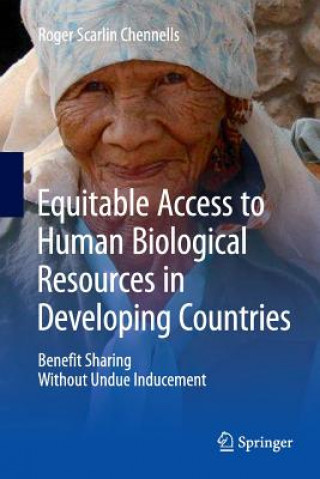
Equitable Access to Human Biological Resources in Developing Countries
by Roger Chennells
The main question explored by the book is: How can cross-border access to human genetic resources, such as blood or DNA samples, be governed in such a way as to achieve equity for vulnerable populations in developing countries? Th ... more


- Language:
 English
 - Binding: Paperback
- Number of pages: 197
Publisher: Springer International Publishing AG, 2016
- More about this

102.71 €
RRP: 111.32 €
You save 8.60 €

In stock at our supplier
Shipping in 5 - 8 days
You might also like
-

Rise and Fall of Nations - Forces of Change in the Post-Crisis World
9.68 € -25 % -

Kalendarz 2026 Poradnik z przepisami i magnesem na lodówkę
1.30 € -

Temptation Trails
13.41 € -24 % -

Aquaman/Green Arrow - Deep Target
18.05 € -9 % -

Atentát na Heydricha
10.28 € -16 % -

Cómo me hice monja ; La prueba ; El llanto
20.37 € -

Piano Play-Along
13.92 € -9 % -

The Magi: Who They Were, How They've Been Remembered, and Why They Still Fascinate
20.27 € -24 % -

Reinhard Heydrich: Hangman of the Third Reich
31.98 € -5 % -

Für Unsere Blasmusik Freunde
21.99 € -

Schiers
19.57 € -

La daga y el fuego
26.02 € -9 % -

L'automobile
12.40 € -

Elvis Presley
24.31 € -

Die Reform Des Steuerlichen Reisekostenrechts 2014
48.22 € -7 % -

Appendix to Journals of Assembly, of the Tenth Session of the Legislature of the State of California, 1859 (Classic Reprint)
24.31 € -

Encens Naturel - 20 grs - Satya - à l'unité
3.62 € -

The ACT Advantage: Beat Your Best Score!
18.25 € -24 % -

Süper Cengel Bulmaca
9.17 € -4 % -

Sexism and the War System
14.72 € -25 % -

Planning Process Drama
199.28 € -

El Método Oaklander: aprender Gestalt infanto-juvenil con juego y arte
28.85 € -

Happy Dreamer
7.86 € -24 % -

The Girl with the Green Eyes: A Play in Four Acts
28.24 € -1 % -

Passage of Time
15.53 € -

Remembering Me
23 € -25 % -

Les Rapports Du Quatri?me Évangile Avec l'Ancien Testament: Th?se...
30.87 € -2 % -

Soul Warriors vs. Witches
15.73 € -7 % -
Literacy Edition Storyworlds Stage 8, Fantasy World, Workbook
3.42 € -

Life Journey Above and Beneath
17.55 € -18 % -
Disease control priorities
36.32 € -
SINFONIA N. 6 OP. 262 ORCHESTRE
99.08 € -

Small German Courts in the Eighteenth Century
183.74 € -

Proverbes Illustrés Afghans (French Edition): In French and Dari Persian
17.35 € -7 % -

O neopentecostalismo como fator de crise pastoral
48.83 € -14 % -

Study Guide for William Shakespeare's The Tempest
11.19 € -2 % -

Letters on the English Nation
32.68 € -2 % -

Performance in a Time of Terror
104.63 € -4 % -

Stop The 'Pocalypse! I Wanna Get Off!
11.59 € -18 % -

Masculinities in a Global Era
102.71 € -7 % -

Essays on Ijtihad in the 21st century
13.41 € -7 % -

Vegetarian NOSH for Students
19.16 € -9 %
Give this book as a present today
- Order book and choose Gift Order.
- We will send you book gift voucher at once. You can give it out to anyone.
- Book will be send to donee, nothing more to care about.
More about Equitable Access to Human Biological Resources in Developing Countries
You get 249 loyalty points
 Book synopsis
The main question explored by the book is: How can cross-border access to human genetic resources, such as blood or DNA samples, be governed in such a way as to achieve equity for vulnerable populations in developing countries? The book situates the field of genomic and genetic research within global health and research frameworks, describing the concerns that have been raised about the potential unfairness in exchanges during recent decades. Access to and sharing in the benefits of human biological resources are aspects not regulated by any international legal framework such as the Convention on Biological Diversity, which applies only to the exchange of plants, animals and microorganisms, as well as to associated traditional knowledge. Examples of genetic research perceived as exploitative are provided in order to illustrate the legal vacuum concerning the global governance of human genetic resources. The main conclusions drawn from the legal and ethical analysis are: - Benefit sharing is crucial in order to avoid the exploitation of developing countries in human genetic research. - With functioning research ethics committees, undue inducement is less of a concern in genetic research than in other areas of medical research (e.g. clinical trials). - Concerns remain over research involving indigenous populations; accordingly, recommendations are provided. In drawing these conclusions, the book addresses in detail a highly pressing topic in global bioethics and international law. In this regard, it combines bioethical arguments with jurisprudence, in particular with reference to the law of equity and the legal concepts of duress (coercion), unconscionable dealing, and undue inducement.
Book details
Book category Books in English Law Laws of Specific jurisdictions Social law
102.71 €
- Full title: Equitable Access to Human Biological Resources in Developing Countries
- Subtitle: Benefit Sharing Without Undue Inducement
- Author: Roger Chennells
- Language: English
- Binding: Paperback
- Number of pages: 197
- EAN: 9783319369747
- ISBN: 3319369741
- ID: 15194071
- Publisher: Springer International Publishing AG
- Weight: 3401 g
- Dimensions: 235 × 155 × 14 mm
- Date of publishing: 15. October 2016
Trending among others
-
Horrors of Vaccination Exposed and Illustrated
15.43 € -
Medical Law: A Very Short Introduction
9.98 € -24 % -

Regulating Human Embryonic Stem Cell in China
109.07 € -

Neuroscience and Law
236.52 € -

EU Consumer Law and Policy - Second Edition
175.87 € -

Ashgate Handbook of Legal Translation
78.60 € -

Vaccine Whistleblower
17.55 € -10 % -
The Law and Ethics of Data Sharing in Health Sciences
153.97 € -7 % -
Under Observation: The Interplay Between eHealth and Surveillance
143.68 € -7 % -

Medical Law
53.47 € -15 % -

150 Years of ObamaCare
28.95 € -
Nonclinical Safety Assessment - A Guide to International Pharmaceutical Regulations
160.84 € -9 % -

Medicine, Malpractice and Misapprehensions
31.07 € -

TASER (R) Conducted Electrical Weapons: Physiology, Pathology, and Law
140.65 € -9 % -

EU Food Law
120.98 € -
Information Technology in Medical Diagnostics
194.74 € -

100 Cases in Clinical Ethics and Law
54.98 € -

Legal Medicine in History
142.98 € -

Consumer ADR in Europe
143.48 € -

Beyond Elder Law
102.71 € -7 % -

Dodd-Frank Wall Street Reform & Consumer Protection Act
398.77 € -10 % -
Routledge Handbook of Complementary and Alternative Medicine
72.34 € -

Animal Experimentation
51.35 € -

FDA Regulatory Affairs
243.88 € -

Cure for Obamacare
7.26 € -
Clinical Forensic Medicine
128.24 € -

Medical Malpractice
33.59 € -

Private Foundations
598.87 € -

Marijuana 360
46 € -
Law and Neuroscience
107.05 € -31 % -

Healthcare Research Ethics and Law
73.65 € -

Legitimacy of Medical Treatment
71.73 € -

Consumer Law and Policy
108.16 € -

Why We Need a New Welfare State
53.98 € -

Anathema! America's War on Medicine
14.22 € -

Why We Need a New Welfare State
106.24 € -
Conflicts of Interest and the Future of Medicine
33.69 € -

Suing Alma Mater
63.56 € -

Practical Guide to Medicine and the Law
102.71 € -7 % -

Pandemics and Ethics
174.46 € -7 % -

Surrogacy, Law and Human Rights
199.28 € -

Stem Cell Research and the Collaborative Regulation of Innovation
224.10 € -

EU Consumer Law and Human Rights
182.43 € -

Hollywood's Copyright Wars
39.44 € -

Genetic Privacy
146.71 € -

Text, Cases and Materials on Medical Law and Ethics
80.61 € -

Child Welfare in the Legal Setting
38.64 € -

Governing Biobanks
146.61 € -

Sex, Morality, and the Law
67.80 €
Collection points Bratislava a 12986 dalších
Copyright ©2008-26 najlacnejsie-knihy.sk All rights reservedPrivacyCookies

 25976 collection points
 Delivery 2.99 €
 02/210 210 99 (8-15.30h)