Code: 42084598
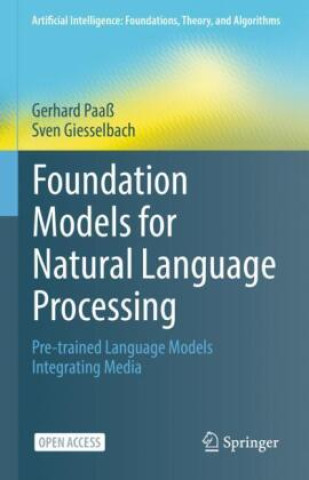
Foundation Models for Natural Language Processing
by Gerhard Paaß, Sven Giesselbach
Over the recent years, a revolutionary new paradigm has been developed for training models for Natural Language Processing (NLP). These models are first pre-trained on large collections of text documents to acquire general syntact ... more


- Language:
 English
 - Binding: Hardback
- Number of pages: 456
Publisher: Springer, Berlin, 2023
- More about this


You might also like
-

Moonwalk
13.95 € -18 % -

The Score
13.65 € -13 % -

The Deal
12.23 € -22 % -

The Mistake
13.44 € -1 % -

Jujutsu Kaisen, Vol. 30
9.90 € -20 % -

Berserk Deluxe Volume 1
35.70 € -25 % -

The Goal
14.56 € -

Berserk Deluxe Volume 2
33.17 € -30 % -

Dancing The Dream
19.92 € -31 % -

Invincible Compendium Volume 2
45.81 € -24 % -

Berserk Deluxe Volume 3
55.22 € -

Legacy
11.93 € -22 % -

Lord of Mysteries, Vol. 3: The Clown, Part III
17.09 € -13 % -

Murdoku
14.05 € -28 % -

White Nights
4.54 € -

Chainsaw Man, Vol. 21
7.68 € -30 % -

Witch Hat Atelier Manga Box Set 1
55.83 € -29 % -

Invincible Compendium Volume 3
46.42 € -23 % -

Jujutsu Kaisen, Vol. 29
9.90 € -20 % -

Jujutsu Kaisen, Vol. 25
9.70 € -25 % -

Witch Hat Atelier: Grimoire Edition 1
35.29 € -29 %
Give this book as a present today
- Order book and choose Gift Order.
- We will send you book gift voucher at once. You can give it out to anyone.
- Book will be send to donee, nothing more to care about.
More about Foundation Models for Natural Language Processing
You get 85 loyalty points
 Book synopsis
Over the recent years, a revolutionary new paradigm has been developed for training models for Natural Language Processing (NLP). These models are first pre-trained on large collections of text documents to acquire general syntactic knowledge and semantic information. Then, they are fine-tuned for specific tasks, which they can often solve with superhuman accuracy. When the models are large enough, they can be instructed by prompts to solve new tasks without any fine-tuning. Moreover, they can be applied to a wide range of different media and problem domains, ranging from image and video processing to robot control learning. Because they provide a blueprint for solving many tasks in artificial intelligence, they have been called Foundation Models. This book provides a comprehensive overview of the state of the art in research and applications of Foundation Models and is intended for readers familiar with basic NLP concepts. After a brief introduction to basic NLP models the main pre-trained language models BERT, GPT and sequence-to-sequence transformer are described, as well as the concepts of self-attention and context-sensitive embedding. Then, different approaches to improving these models are discussed, such as expanding the pre-training criteria, increasing the length of input texts, or including extra knowledge. An overview of the best-performing models for about twenty application areas is then presented, e.g., question answering, translation, story generation, dialog systems, generating images from text, etc. For each application area, the strengths and weaknesses of current models are discussed, and an outlook on further developments is given. In addition, links are provided to freely available program code. A concluding chapter summarizes the economic opportunities, mitigation of risks, and potential developments of AI. This is an open access book.
Book details
Book category Books in English Computing & information technology Computer science Artificial intelligence
35.09 €
- Full title: Foundation Models for Natural Language Processing
- Subtitle: Pre-trained Language Models Integrating Media
- Author: Gerhard Paaß, Sven Giesselbach
- Language: English
- Binding: Hardback
- Number of pages: 456
- EAN: 9783031231896
- ID: 42084598
- Publisher: Springer, Berlin
- Weight: 811 g
- Dimensions: 235 × 155 mm
- Published: 2023
Collection points Bratislava a 12841 dalších
Copyright ©2008-26 najlacnejsie-knihy.sk All rights reservedPrivacyCookies

 25686 collection points
 Delivery 2.99 €
 02/210 210 99 (8-15.30h)