Code: 46816176
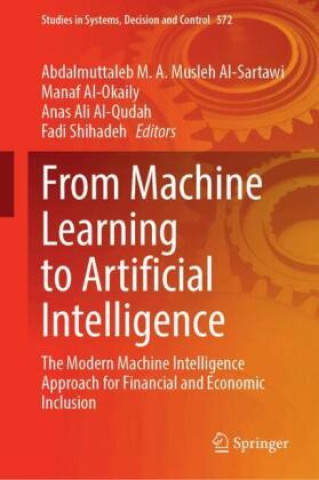
From Machine Learning to Artificial Intelligence
by Abdalmuttaleb M. A. Musleh Al-Sartawi, Manaf Al-Okaily, Anas Ali Al-Qudah, Fadi Shihadeh
The world is on a cusp of something great. Technology has advanced from solving simple issues to complex issues in both human life and other aspects such as social, economic, and environmental issues. The significance of machine i ... more


- Language:
 English
 - Binding: Hardback
- Number of pages: 1690
Publisher: Springer, Berlin, 2025
- More about this

257.03 €
RRP: 278.49 €
You save 21.46 €

In stock at our supplier
Shipping in 10 - 13 days
You might also like
-

Seraph of the End, Vol. 12
9.30 € -25 % -

Macbeth
4.24 € -29 % -

Industry 4.0
45.81 € -24 % -
Fundamentals of Machine Learning for Predictive Data Analytics
97.51 € -

Machine Learning with R - Fourth Edition
46.32 € -2 % -
Python Programming: 2 Manuscripts - Crash Course and For Data Analysis
19.21 € -7 % -

In Mekka
25.08 € -14 % -

Fallacies of States' Rights
55.83 € -

History: A Mess
13.95 € -24 % -

Les incollables - Quiz famille Hiver - Réédition 2023
20.32 € -

Highly Conductive PEDOT:PSS Films for Transparent Electrode
52.59 € -14 % -

Learning to Walk Again Was the 'Easy' Part
19.82 € -1 % -

Advances in Oncology, 2024
206.96 € -5 % -

JÄLLE NEED NAKSITRALLID
38.23 € -11 % -

Find it Bedtime
6.56 € -24 % -

Unrealogical
27.10 € -25 % -

Hunting
21.74 € -24 % -

Machine Learning for Sustainable Manufacturing in Industry 4.0
71.91 € -

Midnight Sea
13.24 € -9 % -

Bird Magic
10.61 € -25 % -

काव्य शाखाएँ
11.22 € -2 % -

German Cooking
23.96 € -

Tradition and Transition in East Africa
303.97 € -

The Dockyards, Shipyards, And Marine Of France (1864)
21.44 € -2 % -

Rethinking Racial Justice
106.51 € -

HEGEL, HAITI Y LA HISTORIA UNIVERSAL
12.53 € -

Selected Poems of Frank Prewett
8.69 € -10 % -
Smart Computing Techniques in Industrial IoT
185.11 € -7 % -

Conflagration
20.93 € -

Chroniques
17.39 € -7 % -

Big Data Applications in Industry 4.0
64.93 € -

Pr server Le Patrimoine Audiovisuel Africain
32.06 € -11 % -

Studying The Short Story: Sixteen Short Story Classics With Introductions, Notes And A New Laboratory Study Method For Individual Reading And Us
37.32 € -1 % -

Per tenir casa cal guanyar la guerra
14.25 € -

International Business
78.29 € -14 % -

Contribucion al estudio de la interferencia lingueistica
47.74 € -4 % -

Emerging Analytical Techniques for Chemical Speciation Studies
108.63 € -

5 DIVISION Divisional Troops Royal Army Service Corps Divisional Train (4, 6, 33, 37 Companies A.S.C.)
59.57 € -

A Divine Madness: An Anthology of Modern Love Poetry Volume 1
43.99 € -6 % -

Falcon's Rise: the Early Years of Anne Boleyn
12.74 € -

Approches du Christ
30.24 € -

Lugard and the Abeokuta Uprising
224.66 € -

Classic Graphic Fiction Pack A of 4
35.90 € -9 % -

Requesting Rain - Hamulak ba Udan
10.31 € -2 % -

Giacomo Puccini: The Man, His Life, His Work
30.03 € -2 % -

Contento Libro da Colorare 1
9.80 € -6 % -

LES CRISES ECONOMIQUES CYCLIQUES SONT ELLES DUES A UNE FATALITE ?
17.79 € -

The Salt Machine: Book #1 of and in Their Passing: A Darkness
8.69 € -10 % -

Beggars Bush from the Works of Francis Beaumont and John Fletcher
8.99 € -15 % -

Bericht über eine Reise nach Niederländisch West-Indien
16.18 € -10 % -

Ich bin eine Spinne, na und? 6
9.09 € -10 % -

The Old Bailey Chronicle; Containing a Circumstantial Account of the Lives, Trials, and Confessions, of the Most Notorious Offenders, Who Have Suffere
25.68 € -24 % -

DRUNKEN CITY
16.48 € -12 % -

Diagnóstico y tratamiento en enfermedades metabólicas
114.10 € -

CLARA Y LOS BUHOS
13.14 € -

Kombucha. L'antico tonico orientale: storia, scienza e ricette
29.83 € -9 %
Give this book as a present today
- Order book and choose Gift Order.
- We will send you book gift voucher at once. You can give it out to anyone.
- Book will be send to donee, nothing more to care about.
More about From Machine Learning to Artificial Intelligence
You get 622 loyalty points
 Book synopsis
The world is on a cusp of something great. Technology has advanced from solving simple issues to complex issues in both human life and other aspects such as social, economic, and environmental issues. The significance of machine intelligence as a tool to propel human as well as economic development is an important and hot topic today. This book is about how modern machine intelligence, AI, and machine learning applications can be used by governments and firms for financial and economic inclusion, as well as for providing solutions to bridge the digital divide. It aims to cover philosophical discussions, frameworks, and applications on central topics in machine intelligence, deep learning, mesh networks, frugal engineering, frugal innovation, blockchain technology, alternate networks, and intelligent digital financial inclusion system architectures. This book also aims to discuss the initiatives, policies, strategies, and governance issues related to furnishing technologies for technology access, financial inclusion and in turn economic growth.
Financial inclusion is defined as the proportion of people and corporations that use financial services. It further describes the fair, equal, and attainable access to financial services (Rawat et al., 2023). Financial inclusion is key to economic inclusion and economic growth as it enables the poor to improve their lives. Chapters in the book will improve our understanding of the advances and challenges of applying machine intelligence for financial inclusion and economic growth in different contexts including financial markets, governments, and corporations in both developing and developed countries. Access to financial services is essential to development efforts of markets, economies and eventually societies. Hence, in this context, financial inclusion can be explained as the process of ensuring that individuals particular impoverished people have access to essential financial services in the formal financial sector. Financial inclusion, recently, has been receiving traction from scholars and policymakers whereby it is one of the major strategies used by economies and societies in achieving UN's sustainable development goals. Rawat et al. (2023) argues that it is vital to increase the use of "low-cost digital methods" for the economically marginalized and under-served people and sectors. There is a need for financial inclusion for the rapidly dynamic Industry 4.0. Therefore, linking technology, more particularly machine intelligence with financial inclusion and technology access is quite crucial given the current technological environment. Additionally, financial inclusion helps in enhancing the level of economic and social inclusion in many societies and developing countries as well as help in reducing poverty levels. Policy makers in several countries continue to commit significant resources and technologies to increase the level of financial inclusion in their countries to reduce financial exclusion. In developing countries, financial inclusion remains below potential in part due to the digital divide, limited technology access and the challenge for financial institutions in developing products for the low-income mass market (Hook IV, 2019; Marimuthu et al., 2022).
These matters are important topics to be researched and discussed, especially with the advancement of technology such as artificial intelligence, machine learning, blockchain, business intelligence, online education, in the current post-pandemic environment which catalysed these digital transformations. Therefore, this book has been proposed to discuss a very important and emerging topics which contributes significantly to policy and the SDGs in the digital economy.
Book details
Book category Books in English Technology, engineering, agriculture Mechanical engineering & materials Mechanical engineering
257.03 €
- Full title: From Machine Learning to Artificial Intelligence
- Subtitle: The Modern Machine Intelligence Approach for Financial and Economic Inclusion
- Author: Abdalmuttaleb M. A. Musleh Al-Sartawi, Manaf Al-Okaily, Anas Ali Al-Qudah, Fadi Shihadeh
- Language: English
- Binding: Hardback
- Number of pages: 1690
- EAN: 9783031760105
- ID: 46816176
- Publisher: Springer, Berlin
- Weight: 3087 g
- Dimensions: 235 × 155 mm
- Published: 2025
Trending among others
-

Building a Portable Steam Engine
19.72 € -28 % -

Clymer Harley-Davidson FXD Twin Cam 88
46.72 € -5 % -

Illustrated Sourcebook of Mechanical Components
169.63 € -2 % -

Weber/Zenith Stromberg/Su Carburetor Manual
39.95 € -9 % -

Engineering Mechanics: Statics, Study Pack, SI Edition
20.63 € -14 % -

Materials Selection in Mechanical Design
80.61 € -

Modern Engineering for Design of Liquid-Propellant Rocket Engines
107.92 € -7 % -

Schwalm Embroidery
14.56 € -21 % -

Small Diesel Engine Srvc Ed 3
53.81 € -10 % -

Tire and Vehicle Dynamics
94.57 € -

Elements of Mechanical Design
31.65 € -

Mastermyr Find
14.66 € -17 % -

Electric Motors Principles, Controls, Service, & Maintenance Instructor's Guide
3.63 € -17 % -

Dictionary of Mechanical Engineering
19.11 € -25 % -

Suzuki Vs1400 Intruder/Boulevard S83 1987-2007
46.72 € -5 % -

CNC Machining Handbook: Building, Programming, and Implementation
40.35 € -17 % -

Building Simple Model Steam Engines
12.94 € -10 % -

Contemporary Irish Knitting
21.74 € -24 % -

Clymer Manuals Yamaha VMX1200 V-M
42.27 € -9 % -

Jet Engine 5e
66.45 € -5 % -

How to Repair Briggs and Stratton Engines, 4th Ed.
20.32 € -24 % -

English for Mechanical Engineering Course Book + CDs
37.32 € -

507 Mechanical Movements
9.30 € -24 % -

Freeform Knitting and Crochet
16.18 € -24 % -

Stirling Engine Design Manual
37.32 € -1 % -

Pipe Fitter's Math Guide
25.99 € -22 % -

Suzuki GSX-R1000 2005-2006
42.27 € -9 % -

Modern Steam Engines
17.49 € -2 % -

Mechanical Vibrations in SI Units
86.28 € -14 % -

Gas Turbine Engineering Handbook
174.99 € -

Engineering Mechanics 1
33.47 € -9 % -

Engines of Pratt & Whitney
43.89 € -7 % -

Lace Collection for Knitting
13.75 € -26 % -

Finite Elements and Approximation
14.76 € -25 % -

Systems Engineering & Management
201.19 € -9 % -

Gasoline Engine Management
120.87 € -9 % -

Automating with SIMATIC S7-1200 3e - Configuring, Programming and Testing with STEP 7
74.34 € -9 % -

Internal Combustion Engine Fundamentals 2E
156.68 € -14 % -

Tunisian Crochet
18.40 € -27 % -

Jet Engines
24.07 € -14 % -

Two-Stroke Engine Repair and Maintenance
20.32 € -24 % -

Kaw Vulcan 800 & Classic 95-05
42.27 € -9 % -

Make - Rockets
28.62 € -24 % -

Encyclopedia of Mechanical Engineering
122.39 € -11 % -

How to Be Chic and Elegant
9.80 € -6 % -

How to Rebuild and Modify Your Manual Transmission
26.90 € -7 % -

Jet Propulsion
69.38 € -

Mechanical Engineer's Pocket Book
52.69 € -4 % -
Compliant Mechanisms
160.63 € -1 %
Collection points Bratislava a 12841 dalších
Copyright ©2008-26 najlacnejsie-knihy.sk All rights reservedPrivacyCookies

 25686 collection points
 Delivery 2.99 €
 02/210 210 99 (8-15.30h)