Code: 06335010
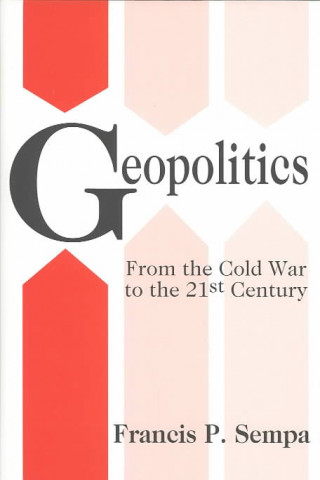
Geopolitics
by Francis P. Sempa
Writers, observers, and practitioners of international politics frequently invoke the term "geopolitics" to describe, explain, or analyze specific foreign policy issues and problems. Such generalized usage ignores the fact that ge ... more


- Language:
 English
- Binding: Hardback
- Number of pages: 107
Publisher: Transaction Publishers, 2002
- More about this


You might also like
-

The Toxic Tooth
28.84 € -2 % -

Curious Incident of the Dog in the Night-time
11.75 € -24 % -

Audiology Answers for Otolaryngologists
52.47 € -

Kráľovstvo Hriešnych - s oriezkou
16.08 € -24 % -

Warrior Goddess Wisdom
13.96 € -22 % -

Delorme Atlas & Gazetteer: Tennessee
21.50 € -27 % -

Nestresuj se
2.81 € -31 % -

The Second Jungle Book
9.94 € -7 % -

Zahnzonen Übersichtskarte
5.82 € -

Nemesis : Reloaded
24.02 € -

Květy lásky a hořkosti
4.11 € -28 % -

Cent ANS Aux Pyrenees. Tome 4
18.79 € -1 % -

Un Mot Sur Le Roi Louis-Philippe
13.26 € -1 % -

Pídeme lo que quieras o déjame
17.68 € -1 % -

STRAWBERRY CULTURE
29.75 € -2 % -

Brief History of 1917
26.83 € -

Smack
17.49 € -10 % -

Ecdad ve Evlad
12.06 € -5 % -

Traitors
22.91 € -2 % -

Rosso come il fuoco: Senza sfumature
12.56 € -6 % -

L'Histoire Veritable, Ou Le Voyage Des Princes Fortunez. Entreprise II
19.49 € -5 % -

Der Prinz aus Zamunda 2
10.04 € -

Concise Dictionary of British Literary Biography
264.30 € -

It Comes from the River
17.99 € -24 % -

Dawn's Rise
6.32 € -2 % -

Generosity
28.25 € -9 % -

Human Agency and Material Welfare: Revisions in Microeconomics and their Implications for Public Policy
102.33 € -7 % -

Generation 'Bloodied But Unbowed'
22.51 € -

La recherche scientifique : un droit fondamental ? Tome I
34.27 € -

Der Buddhismus, seine Dogmen, Geschichte und Literatur
21.40 € -3 % -

Verachtung nach unten
23.21 € -11 % -

Vocabulary Ladders: Understanding Word Nuances Level 3 (Level 3): Understanding Word Nuances [With CDROM]
20.60 € -22 % -

Mammography
50.16 € -9 % -

GU GAZTEOK
9.74 € -

The Commercialized Crafts of Thailand: Hill Tribes and Lowland Villages
24.93 €
Give this book as a present today
- Order book and choose Gift Order.
- We will send you book gift voucher at once. You can give it out to anyone.
- Book will be send to donee, nothing more to care about.
More about Geopolitics
You get 581 loyalty points
 Book synopsis

Writers, observers, and practitioners of international politics frequently invoke the term "geopolitics" to describe, explain, or analyze specific foreign policy issues and problems. Such generalized usage ignores the fact that geopolitics as a method of understanding international relations has a history that includes a common vocabulary, well-established if sometimes conflicting concepts, an extensive body of thought, and a recognized group of theorists and scholars. In Geopolitics, Francis P. Sempa presents a history of geopolitical thought and applies its classical analyses to Cold War and post-Cold War international relations.While mindful of the impact of such concepts as "globalization" and the "information revolution" on our understanding of contemporary events, Sempa emphasizes traditional geopolitical theories in explaining the outcome of the Cold War. Using the work of Halford Mackinder, James Burnham, Nicholas Spykman, Alfred Thayer Mahan, and others, he shows that, even though the struggle between the Western allies and the Soviet empire was unique in its ideological component and nuclear standoff, the Cold War fits into a recurring geopolitical pattern. It can be seen as a consequence of competition between land powers and sea powers, and between a potential Eurasian he-gemonic power and a coalition of states opposed to that would-be hegemony.The collapse of the Soviet empire ended the most recent threat to global stability. At the dawn of the twenty-first century, no power or alliance of powers poses an immediate threat to the global balance of power. Indeed, the end of the Cold War generated hopes for a "new world order" and predictions that economics would replacegeopolitics as the driving force in international politics. However, as Sempa points out, Russian instability, the nuclear dimension of the India-Pakistan conflict, and Chinese bids for dominance have turned the Asia-Pacific region into what Mahan called "debatable and deb
Book details
Book category Books in English Society & social sciences Politics & government International relations
238.56 €
- Full title: Geopolitics
- Subtitle: From the Cold War to the 21st Century
- Author: Francis P. Sempa
- Language: English
- Binding: Hardback
- Number of pages: 107
- EAN: 9780765801227
- ISBN: 9780765801227
- ID: 06335010
- Publisher: Transaction Publishers
- Weight: 327 g
- Dimensions: 229 × 152 × 15 mm
- Date of publishing: 31. March 2002
Trending among others
-

Diplomacy
21.71 € -5 % -

World Order
14.17 € -23 % -

Tragedy of Great Power Politics
16.98 € -24 % -

The Spy and the Traitor
13.36 € -18 % -

Going to Tehran
24.22 € -25 % -

Grand Chessboard
20.70 € -

Dead Hand
16.38 € -27 % -

Directorate S
15.07 € -25 % -

American Occupation of Japan
35.88 € -

Haunted Wood
21.91 € -17 % -
World Order
11.45 € -29 % -

Israel Lobby and US Foreign Policy
15.47 € -27 % -

Political Order and Political Decay
18.29 € -10 % -

Countdown to Zero Day
15.47 € -23 % -

On Palestine
11.85 € -13 % -

Cold War
19.39 € -24 % -

Adults In The Room
15.87 € -11 % -

Hell of Good Intentions
15.77 € -25 % -

Revenge of Geography
16.18 € -26 % -

Strategic Vision
14.37 € -29 % -

Rise and Kill First
16.78 € -25 % -
Who Rules the World?
9.24 € -30 % -

Planetary Cycles Mundane Astrology
17.88 € -1 % -
How Spies Think
14.06 € -13 % -

Legacy of Ashes
16.58 € -28 % -

PEACE TO END ALL PEACE
20.80 € -24 % -
Geopolitics: A Very Short Introduction
9.84 € -28 % -

Lords of the Desert
9.94 € -27 % -

Deterrence
20.30 € -10 % -

Against Our Better Judgment
10.24 € -6 % -

Treacherous Alliance
19.09 € -30 % -

Understanding Modern Warfare
51.56 € -

Oxford Handbook of European History, 1914-1945
43.92 € -29 % -

Target-Centric Network Modeling
122.54 € -5 % -

English for Diplomatic Purposes
42.72 € -9 % -

Enemy Of Europe/The Enemy of Our Enemies
13.26 € -2 % -

America's Strategy in World Politics
76.50 € -
Grand Illusion?
30.85 € -

International Security: A Very Short Introduction
10.14 € -25 % -

Perfect Weapon
14.57 € -30 % -

History of Diplomacy
29.95 € -

Coming Caesars
15.07 € -25 % -

Buying Time
26.73 € -21 % -

Intermarium
53.57 € -7 % -

Value Chains
24.72 € -20 % -

Voices for Peace
11.75 € -25 % -

Head Hunters
11.75 € -25 % -

Disordered World
10.95 € -30 % -

Principled Approach to Abuse of Dominance in European Competition Law
77.70 €
Collection points Bratislava a 13606 dalších
Copyright ©2008-26 najlacnejsie-knihy.sk All rights reservedPrivacyCookies

 27216 collection points
 Delivery 2.99 €
 02/210 210 99 (8-15.30h)
