Code: 44569580
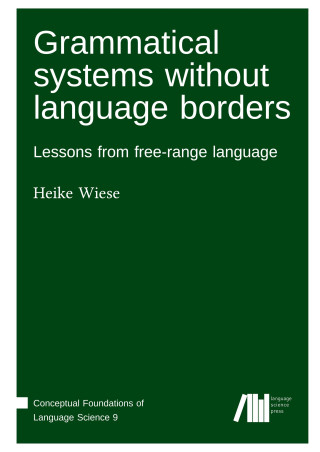
Grammatical systems without language borders
by Heike Wiese
Current research in grammatical analysis and sociolinguistics points to two core characteristics of language that seem incommensurable at first sight: (1) research on linguistic structure indicates internal organisation and cohere ... more


- Language:
 English
 - Binding: Hardback
- Number of pages: 108
Publisher: Language Science Press, 2023
- More about this

22.40 €
RRP: 26.27 €
You save 3.87 €

In stock at our supplier
Shipping in 10 - 13 days
You might also like
-

Moonwalk
14.02 € -18 % -

The Score
13.72 € -10 % -

The Deal
12.30 € -21 % -

The Mistake
13.51 € -

Jujutsu Kaisen, Vol. 30
9.88 € -20 % -

Berserk Deluxe Volume 1
35.72 € -25 % -

Berserk Deluxe Volume 2
33.20 € -30 % -

The Goal
14.62 € -

Dancing The Dream
19.87 € -31 % -

Berserk Deluxe Volume 3
55.10 € -

Invincible Compendium Volume 2
45.71 € -24 % -

Murdoku
14.02 € -28 % -

Legacy
11.90 € -22 % -

Lord of Mysteries, Vol. 3: The Clown, Part III
17.05 € -13 % -

White Nights
4.53 € -14 % -

Chainsaw Man, Vol. 21
7.66 € -30 % -

Invincible Compendium Volume 3
46.32 € -23 % -

Jujutsu Kaisen, Vol. 29
9.88 € -20 % -

Witch Hat Atelier Manga Box Set 1
55.70 € -29 % -

JoJo's Bizarre Adventure: Part 7--Steel Ball Run, Vol. 7
18.16 € -25 % -

Witch Hat Atelier: Grimoire Edition 1
35.21 € -29 %
Give this book as a present today
- Order book and choose Gift Order.
- We will send you book gift voucher at once. You can give it out to anyone.
- Book will be send to donee, nothing more to care about.
More about Grammatical systems without language borders
You get 54 loyalty points
 Book synopsis
Current research in grammatical analysis and sociolinguistics points to two core characteristics of language that seem incommensurable at first sight: (1) research on linguistic structure indicates internal organisation and coherence, and the workings and interactions of distinct grammatical systems, but (2) sociolinguistic research suggests that language borders and bound "languages" are counterfactual social constructs that cannot capture the diversity and fluidity of actual language use. This seems to constitute something like a "quantum-linguistic" paradox: language systems aren't real (they are just ideological constructions), but at the same time, they are a reflection of actual structure. This book shows how this paradox can be resolved through an architecture that allows for grammatical systems without presupposing language borders: this architecture puts communicative situations, rather than languages, at the core of linguistic systematicity, while named languages are captured as optional sociolinguistic indices. The approach builds on insights from "free-range" language, a metaphor for language in settings that are less confined by monoglossic ideologies. The author looks at four different kinds of settings: urban markets, heritage language settings, multiethnic adolescent peer-groups, and digital social media. Central lessons to be learned from such free-range language settings are: (1) communicative situations support linguistic differentiation and can thus be the basis for fluid registers; (2) grammatical systematicity is grounded in communicative situations and does not require bound languages and linguistic borders; (3) named "languages" can emerge as social indices signalling belonging, but this is an optional, not a necessary development.
Book details
Book category Books in German Geisteswissenschaften, Kunst, Musik Sprach- und Literaturwissenschaft Sonstige Sprachen / Sonstige Literaturen
22.40 €
- Full title: Grammatical systems without language borders
- Author: Heike Wiese
- Language: English
- Binding: Hardback
- Number of pages: 108
- EAN: 9783985540877
- ISBN: 398554087X
- ID: 44569580
- Publisher: Language Science Press
- Weight: 398 g
- Dimensions: 246 × 175 × 13 mm
- Date of publishing: 11. December 2023
Collection points Bratislava a 12948 dalších
Copyright ©2008-26 najlacnejsie-knihy.sk All rights reservedPrivacyCookies

 25900 collection points
 Delivery 2.99 €
 02/210 210 99 (8-15.30h)