Code: 04940196
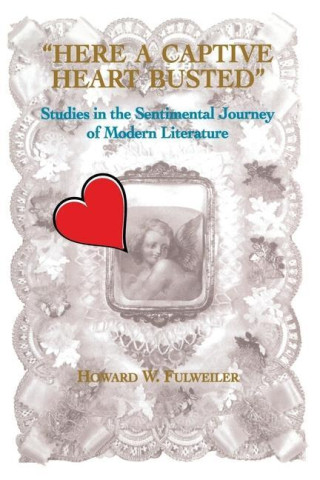
Here a Captive Heart Busted
by Howard W. Fulweiler
Contemporary readers who look at late-eigteenth-century or nineteenth-century imaginative literature must be struch by a phenomenon that is nearly universal in the period: the powerful presence of sentimentality. An often overlook ... more


- Language:
 English
 - Binding: Hardback
- Number of pages: 207
Publisher: Fordham University Press, 1993
- More about this


You might also like
-

English Master B2 Key Word Transformation: 20 practice tests for the Cambridge First
12.86 € -24 % -

BX-ATTACK ON TITAN 35 FLY COLLECTORS BOX
167.11 € -28 % -

DESIGN THINKING PLAYBOOK - Mindful Digital Transformation of Teams, Products, Services, Businesses and Ecosystems
25.83 € -27 % -

Petit Larousse de la cuisine
32.42 € -

Spider-Verse: Across the Multiverse
32.22 € -25 % -

150 sladkých receptů
18.84 € -17 % -

Temné sestry
11.44 € -20 % -

Anang and the Ribbon Skirt: A Graphic Novel
18.33 € -24 % -

Complete Classic Pilates Method
13.98 € -24 % -

Photobook
36.27 € -

Les 101 Dalmatiens CP Niveau 1
6.27 € -

La flexibilidad en las artes marciales : bases médicas para desarrollarla
8.60 € -

I Can Save the Earth!
5.16 € -24 % -

Life and Times of St. Anselm
30.70 € -25 % -

Social Problems, Law, and Society
76 € -

Nonlinear Dynamics and Chaos with Applications to Hydrodynamics and Hydrological Modelling
203.90 € -

Nuclear Statecraft
56.95 € -

Les femmes ou les silences de l'histoire
17.83 € -

Les Chants de Maldoror
7.69 € -7 % -

Chancen und Risiken von Markenallianzen dargestellt am Beispiel von Lebensmitteln
17.12 € -10 % -

eLancing-Motivationen
44.58 € -11 % -

Hexenweiber
7.29 € -

Der neue Herr
41.95 € -11 % -

Harold Monro
109.54 € -

Spring Time in Victoria, BC Canada: Adult Coloring Book Volume 1
10.73 € -7 % -

Les somnambules
17.93 € -

Return to Cherry Blossom Way
9.01 € -20 % -

180 Days Reading 2nd Ed, Writing, Spelling, & Language Grade 3: 4-Book Set
88.77 € -9 % -

El siglo de las mujeres
21.48 € -9 % -

Otho: A Tragedy in Five Acts
21.98 € -2 % -

Tropics of Desire
42.15 € -

Ich weiß, daß du weißt
19.55 € -2 % -

Eine Woche und sieben Tage - Der Weg zum Sternenhaus
8.20 € -9 % -

ANIMAL ADVENTURE
9.82 € -6 % -

Kids' Catalog of Animals and the Earth
12.76 € -24 % -

Sligo, el lugar donde encontré el amor
6.98 € -6 % -

EHPAD : Je ne veux pas y mourir !
22.29 € -

Learning and Teaching
191.84 € -14 % -

6. Klasse, Schülerheft - Klarinette. Bd.2
18.64 € -4 % -

Mémoires De M. Gisquet, Écrits Par Lui-M?me, Volume 1
37.39 € -1 % -

Nakama 2, Enhanced
65.86 € -

Les Cosaques, Relation Charivarique: Comique Et Surtour Veridique Des Hauts Faits Des Russes En Orient...
23.60 € -25 % -

Spi box rouge (éd. 2017)
12.05 € -

Integrative Medicine for Binge Eating
26.54 € -2 % -

Health Through New Thought and Fasting
23.91 € -1 % -

Economic and Compliance Consequences of Taxation
109.54 € -

Prayer Has Spoiled Everything
131.94 € -

Assessing Mental Health Across Cultures
25.12 € -25 % -

Designing an Icon-based Mobile Communication Tool
43.87 € -14 %
Give this book as a present today
- Order book and choose Gift Order.
- We will send you book gift voucher at once. You can give it out to anyone.
- Book will be send to donee, nothing more to care about.
More about Here a Captive Heart Busted
You get 240 loyalty points
 Book synopsis
Contemporary readers who look at late-eigteenth-century or nineteenth-century imaginative literature must be struch by a phenomenon that is nearly universal in the period: the powerful presence of sentimentality. An often overlooked fact is that Sentimentalitynot only is a critical term, but is limited to a historical period, from roughly 1700 to the present. Fulweiler's hypothesis is that setimentality in writing has played a crucial part in shaping Western consciousness. As a study of evolution of consciousness-rather than the history of ideas- the argument grows out of the work of philosophers such as Ernst Cassirer and Susanne Langer, historical philosophers including R.G. Collingwood, Thomas Kuhn, and Michel Foucault, historically oriented literary critics such as Erich Auerbach, and finally the eclectic writing of Owen Barfield. Fulweiler's hypothesis is that the general consciousness of Western society has undergone severe shocks as a result of the loss-and sometimes repression- of an older human awareness of what anthropologists have called participation,a term that may be defined as a non-sensory link between human beings and nature. This loss of participation has become gradually apparant with the erosiion of its visible emblems: The Church (with its supporting Law); the extended family, as visualized in feudal, hierarchical theories of society; and finally the nineteeth-century ideal, the nuclear family, with its sacred location, the home, and its glorified Proprietress, the Woman. Sentimentality emerges, then, as a desperate, if often illegitimate, attempt to regain what has been lost, so that imaginative literature of the nineteenth century, even very good literature, is overwhelmed by domestic sentimentality. In the twentieth century it has been heavily, although covertly, affected by a sexual sentimentality of the previous era. This sentimental journey is traced by focusing on six major writers: Tennyson and Dickens as the giants of Victorian domestic sentimentality, Hopkins and Hardy as transitional figures in whom the sentimental tropes of the ninteenth century are moving toward the sexual sentimentality of the twentieth, Lawrence and Eliot as representatives, in different ways, of that era. This multi-faceted study will be of considerable interest to specialists across a number of fields including literature, history, psychology, philosophy, and religious studies.
Book details
Book category Books in English Literature & literary studies Literature: history & criticism Literary studies: general
99.31 €
- Full title: Here a Captive Heart Busted
- Subtitle: Studies in the Sentimental Journey of Modern Literature
- Author: Howard W. Fulweiler
- Language: English
- Binding: Hardback
- Number of pages: 207
- EAN: 9780823214952
- ISBN: 0823214958
- ID: 04940196
- Publisher: Fordham University Press
- Weight: 544 g
- Dimensions: 229 × 152 × 21 mm
- Date of publishing: 01. January 1993
Trending among others
-

How to Read a Book
14.58 € -7 % -

The Karamazov Brothers
10.43 € -24 % -

Devils
9.31 € -24 % -

Zofloya or The Moor
10.43 € -24 % -

Iliad
4.75 € -9 % -

Saga of Tanya the Evil, Vol. 3
10.02 € -24 % -

The Iliad - Penguin Classics Deluxe Edition
15.50 € -25 % -

Odyssey (Deckle Edge)
16.21 € -25 % -
Metamorphoses
7.19 € -25 % -

SEOUL University Korean 1B Workbook (QR), m. 1 Audio
34.14 € -

SEOUL University Korean 1B Student's Book (QR), m. 1 Audio
50.16 € -

Woodlanders
9.72 € -26 % -
Odyssey
33.84 € -

The Poetic Edda
29.28 € -9 % -
Great God Pan and Other Horror Stories
16.81 € -25 % -

Animus and Anima in Fairy Tales
17.12 € -24 % -

I Saw Ramallah
12.76 € -25 % -

How to Read Literature
14.89 € -9 % -

Odyssey
5.46 € -26 % -

Pickwick Papers
9.31 € -24 % -

News from Nowhere and Other Writings
11.85 € -25 % -
North and South
8.10 € -30 % -

Life of Samuel Johnson
17.93 € -25 % -

War and the Iliad
12.76 € -24 % -
Poetics
9.31 € -30 % -

Brontes
21.27 € -25 % -

La Dame aux Camelias
9.92 € -25 % -

Kim
5.87 € -24 % -

House of the Seven Gables
7.39 € -29 % -

Complete Fables
10.12 € -29 % -

Strange Things
15.19 € -18 % -

Quest for the Unity of Knowledge
59.07 € -

Little Women
10.63 € -

War Stories and Poems
9.92 € -25 % -
Dictionary of Classical Antiquities, Mythology, Religion, Literature and Art
72.05 € -

Cambridge Greek Lexicon 2 Volume Hardback Set
104.98 € -

Shakespeare Book
22.79 € -15 % -

Motives of Eloquence
23.10 € -25 % -

Culture Series of Iain M. Banks
33.84 € -

Belly of Paris
9.92 € -25 % -

The Golden Treasury
10.43 € -30 % -

Yellow Wall-Paper and Other Stories
9.72 € -25 % -
Gorgias: Encomium of Helen
35.16 € -

The Picture of Dorian Gray
7.19 € -17 % -

Weird and the Eerie
13.37 € -
Odyssey
9.31 € -29 % -

Count of Monte Cristo
10.23 € -28 % -

If Not, Winter: Fragments Of Sappho
18.13 € -24 % -

Moveable Feast
8.81 € -28 %
Collection points Bratislava a 12839 dalších
Copyright ©2008-26 najlacnejsie-knihy.sk All rights reservedPrivacyCookies

 25682 collection points
 Delivery 2.99 €
 02/210 210 99 (8-15.30h)