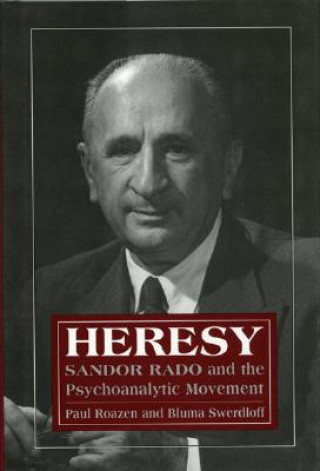
Code: 05083192
Heresy
by Paul Roazen, Bluma Swerdloff
'My mother was the source of my brains and my father the mother of kindness,' said Sandor Rado, a Hungarian analyst whom Freud first embraced but with whom he was later displeased. In Heresy: Sandor Rado and the Psychoanalytic Mov ... more


- Language:
 English
 - Binding: Hardback
- Number of pages: 232
Publisher: Jason Aronson Inc. Publishers, 1977
- More about this

101.71 €
RRP: 106.77 €
You save 5.06 €
Availability:
50/50 We think title might be available. Upon your order we will do our best to get it within 6 weeks.
We search the world
You might also like
-

Period Power
14.43 € -29 % -

Areopagitica and Other Writings
13.12 € -26 % -

Dinosaurs--The Grand Tour, Second Edition: Everything Worth Knowing about Dinosaurs from Aardonyx to Zuniceratops
18.17 € -25 % -

Way of the Peaceful Warrior
13.53 € -24 % -

Fortunata Y Jacinta
15.65 € -2 % -

Che
25.24 € -26 % -

You Are We
12.72 € -

Silent night
4.54 € -15 % -

Magia rytualna
9.28 € -15 % -

It Follows
31.30 € -

Jean-Luc Nancy and Plural Thinking
36.76 € -

Advances in Chemical Physics V91
492.82 € -10 % -

Paul Martin & Companies
11.81 € -14 % -

Boundary Value Problems From Higher Order Differential Equations
78.88 €
Give this book as a present today
- Order book and choose Gift Order.
- We will send you book gift voucher at once. You can give it out to anyone.
- Book will be send to donee, nothing more to care about.
Availability alert
Enter your e-mail address and once book will be available,
we will send you a message. It's that simple.
More about Heresy
You get 246 loyalty points
 Book synopsis
'My mother was the source of my brains and my father the mother of kindness,' said Sandor Rado, a Hungarian analyst whom Freud first embraced but with whom he was later displeased. In Heresy: Sandor Rado and the Psychoanalytic Movement, Paul Roazen and Bluma Swerdloff use interviews with Rado and his family to bring to life one of Freud's foremost followers, who later founded his own institute and psychodynamic orientation, one that focused on motivation rather than instinct. Based on interviews sponsored by the Columbia University Oral History Project, and including Freud's letters to Rado, this is a personal account of Rado and the life events that shaped him and his theories. Rado's life in late nineteenth-century Hungary, the enduring influence of his mother, his meetings with Freud (who made three slips of the tongue during their first encounter), his analysis with Karl Abraham, his affair with Helene Deutsch (she called it a 'companionship of suffering'), and Rank and Ferenczi's downfalls are vividly depicted. Rado's radical departure from Freudian theories of femininity, a reformulation daringly in keeping with today's gender debates, is also included. Rado freed himself from phallocentrism, abandoning the notions of universal castration fear and penis envy. He contended that men and woman are different, which does not mean that women are inferior. He saw women as having a greater emotional capacity based on their biological role as child bearers and nurturers. In 1963, as further evidence of his prescience, Rado prophesied the current crisis in psychotherapy, noting that 'the old-fashioned therapeutic practice will disappear for lack of money.' He anticipated that the influence of biochemical genetics was going to be 'so enormous that it would be bootless to try to outline it.' Dr. Swerdloff uses Rado's predictions and an analysis of the present debate to demonstrate the need to steer psychoanalysis toward a more scientific course.
Book details
Book category Books in English Society & social sciences Society & culture: general Cultural studies
101.71 €
- Full title: Heresy
- Subtitle: Sandor Rado and the Psychoanalytic Movement
- Author: Paul Roazen, Bluma Swerdloff
- Language: English
- Binding: Hardback
- Number of pages: 232
- EAN: 9781568213217
- ISBN: 1568213212
- ID: 05083192
- Publisher: Jason Aronson Inc. Publishers
- Weight: 454 g
- Dimensions: 217 × 148 × 20 mm
- Date of publishing: 07. July 1977
Trending among others
-

All About Love
12.92 € -12 % -

Sapiens
12.21 € -25 % -

Tihkal
23.73 € -25 % -

How to Invent Everything
26.96 € -19 % -

Why Nude?
11.91 € -

Wabi-Sabi for Artists, Designers, Poets & Philosophers
14.74 € -25 % -

Telling Lies
13.12 € -26 % -

Egregores
12.72 € -25 % -

Convergence Culture
36.76 € -

Critique Of Cynical Reason
29.69 € -5 % -

Medieval Costume and How to Recreate it
11 € -30 % -

Communion
11.81 € -25 % -

Georg Wilhelm Friedrich Hegel: The Science of Logic
73.12 € -

The Year of Living Danishly
11.40 € -30 % -

Cosmos and Psyche
16.76 € -22 % -

Audio Culture, Revised Edition: Readings in Modern Music
53.32 € -

MORAL PANICS AND THE MEDIA
36.15 € -

Music in Everyday Life
19.59 € -25 % -

On Collective Memory
36.76 € -

Empire of Illusion
14.03 € -25 % -

Bakunin: Statism and Anarchy
18.48 € -23 % -

Pihkal
25.04 € -25 % -

The Chalice and the Blade
14.03 € -25 % -

Notes on Camp
4.23 € -30 % -

Self-Made Man
12.62 € -29 % -

Tudor Tailor
26.35 € -25 % -

The Conquest of Bread
11.81 € -25 % -

Utopia for Realists
13.53 € -22 % -
Social and Cultural Anthropology: A Very Short Introduction
9.99 € -24 % -

Berserk: With Darkness Ink
21.61 € -25 % -

Origins and History of Consciousness
19.79 € -26 % -

Symbol Sourcebook - An Authoritative Guide to International Graphic Symbols
52.31 € -7 % -

Vader's Little Princess
13.83 € -18 % -
Pragmatism and Other Writings
11.91 € -24 % -

Watching the English
16.15 € -24 % -

Hell's Angels
18.27 € -24 % -

Stirner: The Ego and its Own
52.52 € -

Action Park
13.42 € -24 % -

The Tipping Point
12.62 € -29 % -

Money
5.95 € -35 % -

Postmodernism
27.97 € -

Jaws: We're Gonna Need a Bigger Boat
10.60 € -20 % -

Homo Ludens
11.40 € -

Why We Love Dogs, Eat Pigs and Wear Cows
14.23 € -27 % -
Understanding Media
26.86 € -4 % -

Poor but Sexy - Culture Clashes in Europe East and West
18.48 € -17 % -

Conspicuous Consumption
8.07 € -30 % -

Pimpology
13.42 € -24 % -

Icons of Men's Style mini
12.92 € -23 %
Collection points Bratislava a 12824 dalších
Copyright ©2008-26 najlacnejsie-knihy.sk All rights reservedPrivacyCookies

 25652 collection points
 Delivery 2.99 €
 02/210 210 99 (8-15.30h)