Code: 06811706
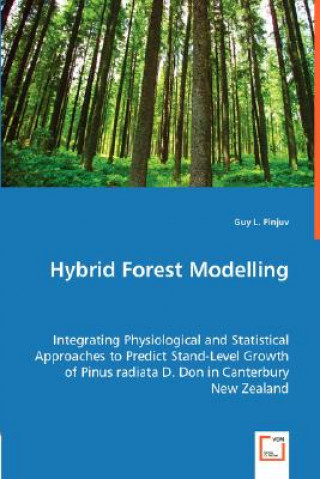
Hybrid Forest Modelling
by Guy L. Pinjuv
Forestry growth models are categorized according to their level of mechanistic detail, complexity, and generality. At one end of the scale are empirical growth and yield models, which are curves fitted to historical data of forest ... more


- Language:
 English
 - Binding: Paperback
- Number of pages: 224
Publisher: VDM Verlag Dr. Mueller E.K., 2008
- More about this

77.97 €
RRP: 79.61 €
You save 1.64 €

In stock at our supplier
Shipping in 14 - 21 days
You might also like
-

700 Journaling stickers série 1
18.68 € -

Oloncho o Ňurgunu Booturovi
15.95 € -29 % -

Biomimetics for Architecture
25.04 € -25 % -

Leon Polk Smith
39.69 € -9 % -

Invitation to Chateau du Grand-Luce
44.84 € -9 % -

Pursuit of Harmony
41.61 € -

Napoleon I. - eine Biographie
33.42 € -11 % -

The Rhetoric of Conversation: With Hints Specially to Christians on the Use of the Tongue (1860)
33.63 € -2 % -

XML, DTDs, Schemas: The Personal Trainer
35.34 € -7 % -

Caracteristicas mecanicas de la brazada en nadadores de aguas abiertas
63.93 € -14 % -

Historical Survey of the Astronomy of the Ancients
53.42 € -2 % -

India's Water Security Challenges
31.51 € -10 % -

European Intregration & National Adaptations
145.45 € -10 % -

Quality Parameters in Canned Seafoods
122.92 € -10 % -

Ruling the Spirit
67.47 € -

Religious Weaver
15.34 € -24 % -

Nicht authentisches Lachen in Sitcoms aus soziologischer Sicht
14.43 € -10 % -
Potere e conflitto. Saggi sulla Costituzione di Weimar
32.62 € -9 % -

Cases of Six Usutu Punished for Having Taken Part in the Disturbances of 1888 Book 9
11.51 € -5 % -

Interconnects in VLSI Design
154.13 € -7 % -

Road Taken: Three Sequences of Poems
11.30 € -2 % -

Hostage
18.07 € -9 % -

Melomaniacs (1917)
32.72 € -2 % -

Pandas and Their Chopsticks
15.75 € -9 % -

Human Leukemias
154.13 € -7 % -

Immigration Inspections & Enforcement At & Between Ports of Entry
87.97 € -9 % -

BABADADA, OEsterreichisches Deutsch mit Artikeln - Dansk, das Bildwoerterbuch - billedordbog
26.86 € -7 % -

Employment Secrets
31.20 € -

El jardín de medianoche
21.20 € -

Nemeennes
20.19 € -1 % -

Nailing It!: The Ultimate Guide for the Ultimate Sales Machine in getting Ultimate New Patients
34.54 € -7 % -

Troisieme Voyage Agricole En Angleterre Et En Ecosse
22.82 € -

Ryan Rides Back
11.61 € -18 % -

Jeanne
9.59 € -7 % -

enigma della vacca intera
19.38 €
Give this book as a present today
- Order book and choose Gift Order.
- We will send you book gift voucher at once. You can give it out to anyone.
- Book will be send to donee, nothing more to care about.
More about Hybrid Forest Modelling
You get 189 loyalty points
 Book synopsis
Forestry growth models are categorized according to their level of mechanistic detail, complexity, and generality. At one end of the scale are empirical growth and yield models, which are curves fitted to historical data of forest growth. In contrast, process-based models are based on the mechanisms which underlie growth. Hybrid models can avoid the shortcomings of both approaches, these models incorporate a mechanistic description of the environmental influences into an empirical growth and yield model. Two models were developed in this work to predict growth of Pinus radiata plantations in Canterbury, New Zealand. The first, CanSPBL(1.2), is an empirical model, and the second CanSPBL(water), is a hybrid growth model that incorporates an index of root zone water balance over the simulation period. This work also includes an objective comparison and validation of a range of model types from empirical, hybrid, to process-based, with the main criteria for comparison being each models ability to match historical measurements of forest growth in an independent data set. This analysis should shed some light on the debate between modelling approaches and offers a method of integration. It should be especially useful to scientists, policy makers, and natural resource managers interested in predicting the growth of forest stands over time.
Book details
Book category Books in English Mathematics & science Biology, life sciences Life sciences: general issues
77.97 €
- Full title: Hybrid Forest Modelling
- Subtitle: Integrating Physiological and Statistical Approaches to Predict Stand-Level Growth of Pinus radiata D. Don in Canterbury New Zealand
- Author: Guy L. Pinjuv
- Language: English
- Binding: Paperback
- Number of pages: 224
- EAN: 9783639017618
- ISBN: 3639017617
- ID: 06811706
- Publisher: VDM Verlag Dr. Mueller E.K.
- Weight: 304 g
- Dimensions: 229 × 152 × 12 mm
- Date of publishing: 05. May 2008
Trending among others
-

Story Genius
13.42 € -24 % -
Why Evolution is True
14.64 € -9 % -

Tale of the Duelling Neurosurgeons
12.92 € -30 % -

A Comprehensive Guide to the Surgical Oncology
209.18 € -

Stealing Fire
14.03 € -25 % -
Cognitive Neuroscience: A Very Short Introduction
9.99 € -24 % -

Seven Daughters Of Eve
11.51 € -27 % -

Case-Based Practical Training of Colposcopy and Cervical Pathology
170.60 € -10 % -

Origins of Virtue
13.93 € -24 % -

Strange Order Of Things
13.93 € -24 % -

Eugenics and Other Evils
12.31 € -18 % -

Consciousness
14.64 € -28 % -

Sports Medicine and the Pelvic Floor
157.26 € -

Life's Greatest Secret
16.76 € -20 % -

Aortic Valve Repair
166.66 € -

The Selfish Gene
13.83 € -18 % -

Descartes' Error
15.34 € -17 % -
Life Ascending
12.92 € -30 % -

Brain's Way of Healing
13.93 € -24 % -

The Molecule of More
19.89 € -
On the Origin of Species
9.28 € -24 % -

Homo Deus
10.19 € -28 % -

Brain
11.40 € -25 % -

Conscious Mind
21.71 € -24 % -

Biocentrism
12.72 € -24 % -

Moral Animal
16.05 € -24 % -

Letters to a Young Scientist
11.30 € -24 % -

Sapiens
29.18 € -21 % -

Power of Habit
13.73 € -7 % -
Hidden Spring
13.42 € -34 % -

Diversity of Life
13.93 € -24 % -

New History of Life
15.14 € -26 % -
Life Cycles
20.29 € -15 % -

Incognito
12.41 € -31 % -

Psychopath Inside
14.23 € -24 % -

The Extended Phenotype
16.15 € -25 % -
Why Evolution Is True
13.73 € -26 % -

The Story of the Human Body
16.05 € -25 % -

Speculations on the Evolution of Human Intelligence
7.87 € -25 % -

Feeling Of What Happens
13.93 € -24 % -

Your Brain Is a Time Machine
13.32 € -25 % -

On the Origin of Species
9.89 € -28 % -
Climbing Mount Improbable
12.92 € -30 % -
Systems View of Life
24.74 € -29 % -

Into the Magic Shop
12.92 € -32 % -

Blind Watchmaker
13.42 € -34 % -

Homo Deus
34.13 € -

Undoing Project
11.71 € -14 % -

Life on a Young Planet
22.41 € -5 %
Collection points Bratislava a 12824 dalších
Copyright ©2008-26 najlacnejsie-knihy.sk All rights reservedPrivacyCookies

 25652 collection points
 Delivery 2.99 €
 02/210 210 99 (8-15.30h)