Code: 04940413
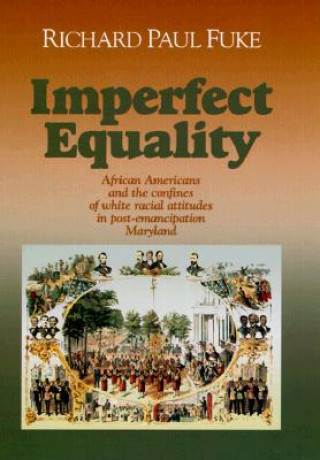
Imperfect Equality
by Richard Paul Fuke
In Imperfect Equality, Richard Fuke has explores the immediate aftermath of slavery in Maryland, which differed in important ways from the slaveholding states of the South: it never left the Union; white radicals had a period of a ... more


- Language:
 English
 - Binding: Hardback
- Number of pages: 307
Publisher: Fordham University Press, 1999
- More about this


You might also like
-

Ti si opasna faca
15.02 € -

Gecko und das Glück des Gebens
14.41 € -10 % -

Po polsku? Tak! Elementarz
8.77 € -

Arena A2
33.58 € -4 % -

Mujercitas (Edición Conmemorativa) / Little Women (Commemorative Edition)
15.83 € -10 % -

Deadpool Osa
9.37 € -30 % -

Zagor. Il buono e il cattivo
17.54 € -

Domeček dřevěná farma Moje první zvířátka
13.61 € -29 % -

Heart of the Qur'an
9.87 € -25 % -
Miller's Bolt
16.13 € -17 % -

Guide Vert Hongrie
25.11 € -

Albert Angelo
11.99 € -24 % -

Discrimination by Default
36.71 € -

Collected Papers in Theoretical Economics
56.98 € -

Heavenly Vaults
71.30 € -

Effects of Background Music on Reading Performance
48.81 € -2 % -

50% American
63.43 € -

Senior Power or Senior Peril
25.91 € -7 % -

North Telford, Wellington, Oakengates and Surrounding Areas
16.03 € -24 % -

Magic Life
7.86 € -24 % -

Gangland
14.82 € -19 % -

Hrestomatiya specialista po sovremennoj informacionnoj bezopasnosti. Tom.1
84.21 € -14 % -

Volkspark Calling Vol.2
19.86 € -

JUNTOS
20.06 € -

Guide Du Touriste Au Havre Et Dans Ses Environs Fecamp, Bolbec, Lillebonne, Tancarville
25.91 € -

Management Ethics
51.53 € -7 % -

Tomorrow's Schools
64.75 € -

Loyalty to Church and State
19.66 € -14 %
Give this book as a present today
- Order book and choose Gift Order.
- We will send you book gift voucher at once. You can give it out to anyone.
- Book will be send to donee, nothing more to care about.
More about Imperfect Equality
You get 252 loyalty points
 Book synopsis
In Imperfect Equality, Richard Fuke has explores the immediate aftermath of slavery in Maryland, which differed in important ways from the slaveholding states of the South: it never left the Union; white radicals had a period of access to power; and even prior to legal emancipation, a large free black population resided there. Moreover, the presence of Baltimore, a major city and port, provided abundant evidence with which to compare the rural and the urban experience of black Marylanders. This state study is therefore uniquely revealing of the successes and failures of the post-emancipation period. The transition in Maryland from a slave to a free society, Fuke argues, presented to black Marylanders opportunities to achieve previously inaccessible goals. Blacks were able to realize some goals, such as greater land ownership, control over the labor of their children, education, and the formation of independent cultural and social organizations, through their own intrepidity combined with the support of white radicals as well as with the assistance of the Freedmen's Bureau, the United States Army, and some state-controlled agencies. Other goals-such as social equality, economic opportunity and advancement, and suffrage-remained beyond the reach of blacks, not only because of conservative white opposition, but also, Fuke argues, because of the attitudinal limitations of white radicals unable to confront the full range of post-emancipation possibilities. Calling upon a very broad range of sources, Fuke demonstrates that after emancipation, Black Marylanders neither enjoyed total freedom nor suffered absolute coercion, but their struggle made two things clear: much of whatever they might accomplish, they would have to do by themselves; and such efforts would remain confined by white attitudes determined to regulate them.
Book details
Book category Books in English Society & social sciences Society & culture: general Social groups
103.98 €
- Full title: Imperfect Equality
- Subtitle: African Americans and the Confines of White Ideology in Post-Emancipation Maryland.
- Author: Richard Paul Fuke
- Language: English
- Binding: Hardback
- Number of pages: 307
- EAN: 9780823219629
- ISBN: 0823219623
- ID: 04940413
- Publisher: Fordham University Press
- Weight: 612 g
- Dimensions: 229 × 152 × 24 mm
- Date of publishing: 01. January 1999
Trending among others
-

Women Who Run with the Wolves
9.37 € -34 % -

Orientalism
13.20 € -24 % -
When God Was A Woman
13.30 € -29 % -

The Second Sex
14.92 € -29 % -

Women Who Run With The Wolves
14.51 € -27 % -

Manhood
21.17 € -25 % -

Who Cooked the Last Supper?
19.15 € -10 % -

The Velvet Rage
13.71 € -30 % -

How Europe Underdeveloped Africa
22.79 € -5 % -

Pink Marine
14.72 € -25 % -

We Should All Be Feminists
7.96 € -29 % -

Iron John
14.72 € -25 % -

Why Does He Do That?
16.13 € -28 % -

The Way of Men
12.19 € -23 % -
Eros and Mysteries of Love
14.72 € -25 % -

Woman's Dictionary of Sacred Objects
19.36 € -32 % -

Raising Kanye
17.44 € -6 % -

Studies in Freemasonry and the Compagnonnage
21.88 € -2 % -

Sister Outsider
9.67 € -34 % -

Forbidden Flowers
11.79 € -25 % -

Uncle Tom's Cabin
5.13 € -30 % -
Delusions of Gender
13.30 € -25 % -

1491 (Second Edition)
15.42 € -25 % -

Occult Anatomy of Man; To Which Is Added a Treatise on Occult Masonry
6.85 € -

Empire of the Summer Moon
13.30 € -28 % -

Off Limits
15.93 € -22 % -

Women's History of the World
17.34 € -20 % -

Oxford Handbook of Feminist Theory
56.78 € -

Honest Courtesan
35.09 € -
Gender and Power
27.02 € -11 % -

Ancient Land: Sacred Whale
22.28 € -

All the Single Ladies
14.01 € -25 % -

Dark Matters
28.13 € -

Mental Load
13.71 € -29 % -

Language of Cities
13 € -25 % -

Three Years Among the Comanches
12.30 € -18 % -

Do Muslim Women Need Saving?
18.85 € -21 % -

Bible, the Talmud, and the New Testament
95.71 € -
Mayan Calendar and the Transformation of Consciousness
17.54 € -24 % -

I, Rigoberta Menchu
18.15 € -25 % -

The Manipulated Man
11.99 € -24 % -
Goddesses in Everywoman
15.62 € -27 % -

The Autobiography of Malcolm X
7.86 € -29 % -

Muqaddimah
18.35 € -24 % -

Witches, Midwives, And Nurses
11.69 € -

Generations
16.13 € -25 % -

The Mastery of Love
10.88 € -26 % -

Gender Trouble
27.73 € -14 % -

Complete Persepolis
20.06 € -30 %
Collection points Bratislava a 12799 dalších
Copyright ©2008-26 najlacnejsie-knihy.sk All rights reservedPrivacyCookies

 25602 collection points
 Delivery 2.99 €
 02/210 210 99 (8-15.30h)