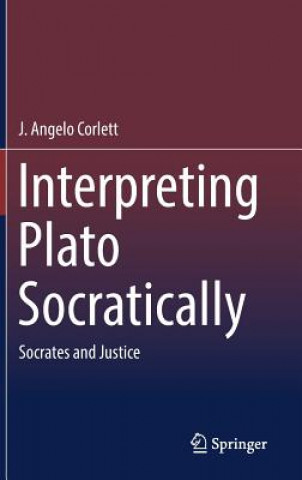
Code: 18942971
Interpreting Plato Socratically
by J. Angelo Corlett
J. Angelo Corlett's new book, Interpreting Plato Socratically continues the critical discussion of the Platonic Question where Corlett's book, Interpreting Plato's Dialogues concluded. New arguments in favor of the Mouthpiece Inte ... more


- Language:
 English
 - Binding: Hardback
- Number of pages: 243
Publisher: Springer International Publishing AG, 2018
- More about this

109.45 €

Low in stock at our supplier
Shipping in 11 - 15 days
Potřebujete více kusů?Máte-li zájem o více kusů, prověřte, prosím, nejprve dostupnost titulu na naši zákaznické podpoře.
Add to wishlist
You might also like
-

Sailor Moon 1
10.01 € -24 % -

Psychotic Core
180.24 € -

Birds in Our Lives
292.33 € -

Peace Education from the Grassroots
115.83 € -

Transforming Distressed Global Communities
199.98 € -
Linguistic Prefabrication
114.72 €
Give this book as a present today
- Order book and choose Gift Order.
- We will send you book gift voucher at once. You can give it out to anyone.
- Book will be send to donee, nothing more to care about.
More about Interpreting Plato Socratically
You get 265 loyalty points
 Book synopsis
J. Angelo Corlett's new book, Interpreting Plato Socratically continues the critical discussion of the Platonic Question where Corlett's book, Interpreting Plato's Dialogues concluded. New arguments in favor of the Mouthpiece Interpretation of Plato's works are considered and shown to be fallacious, as are new objections to some competing approaches to Plato's works. The Platonic Question is the problem of how to approach and interpret Plato's writings most of which are dialogues. How, if at all, can Plato's beliefs, doctrines, theories and such be extracted from dialogues where there is no direct indication from Plato that his own views are even to be found therein? Most philosophers of Plato attempt to decipher from Plato's texts seemingly all manner of ideas expressed by Socrates which they then attribute to Plato. They seek to ascribe to Plato particular views about justice, art, love, virtue, knowledge, and the like because, they believe, Socrates is Plato's mouthpiece through the dialogues. But is such an approach justified? What are the arguments in favor of such an approach? Is there a viable alternative approach to Plato's dialogues? In this rigorous account of the dominant approach to Plato's dialogues, there is no room left for reasonable doubt about the problematic reasons given for the notion that Plato's dialogues reveal either Plato's or Socrates' beliefs, doctrines or theories about substantive philosophical matters. Corlett's approach to Plato's dialogues is applied to a variety of passages throughout Plato's works on a wide range of topics concerning justice. In-depth discussions of themes such as legal obligation, punishment and compensatory justice are clarified and with some surprising results. Plato's works serve as a rich source of philosophical thinking about such matters. A central question in today's Platonic studies is whether Socrates, or any other protagonist in the dialogues, presents views that the author wanted to assert or defend. Professor Corlett offers a detailed defense of his view that the role of Socrates is to raise questions rather than to provide the author's answers to them. This defense is timely as intellectual historians consider the part played by Academic scholars centuries after Plato in systematizing Platonism. J. J. Mulhern , University of Pennsylvania
Book details
Book category Books in English Literature & literary studies Literature: history & criticism Literary studies: general
109.45 €
- Full title: Interpreting Plato Socratically
- Author: J. Angelo Corlett
- Language: English
- Binding: Hardback
- Number of pages: 243
- EAN: 9783319773193
- ISBN: 3319773194
- ID: 18942971
- Publisher: Springer International Publishing AG
- Weight: 552 g
- Dimensions: 164 × 243 × 23 mm
- Date of publishing: 26. April 2018
Trending among others
-
How to Read a Book
14.67 € -7 % -

Weird and the Eerie
11.33 € -13 % -

Moveable Feast
8.09 € -34 % -
SEOUL University Korean 1B Workbook (QR), m. 1 Audio
34.12 € -
Essential Writings of Ralph Waldo Emerson
18.32 € -24 % -

Simple Passion
7.48 € -30 % -
Complete Short Stories of Ambrose Bierce
21.66 € -25 % -
Captain is Out to Lunch
14.77 € -25 % -
Edda
7.89 € -24 % -
Consolation of Philosophy
11.84 € -25 % -

Tenant of Wildfell Hall
9.10 € -30 % -
Macbeth
11.84 € -14 % -

Splintered Light
21.25 € -
Plainwater
14.07 € -25 % -
Portrait of the Artist as a Young Man
7.69 € -25 % -
SEOUL University Korean 1B Student's Book (QR), m. 1 Audio
50.11 € -
Analysis of Donna Haraway's A Cyborg Manifesto
8.60 € -6 % -

Libertine
130.52 € -9 % -
Hamlet: The Oxford Shakespeare
8.60 € -24 % -
Tain
13.46 € -24 % -

Lyrical Ballads
10.62 € -25 % -
Literature and Evil
11.84 € -25 % -
Byron's Poetry and Prose
28.75 € -
Leaves of Grass
17.71 € -
Tempest
8.60 € -25 % -
Byron
19.23 € -24 % -

Japan and the Culture of the Four Seasons
39.58 € -
Greek Lyrics
17.81 € -
Religion After Postmodernism
28.75 € -
Poetics of Postmodernism
63.08 € -

Daphne Du Maurier
11.84 € -25 % -
Coriolanus
11.84 € -14 % -
Postmodernism and the Contemporary Novel
48.19 € -
Metafiction
59.03 € -
Art of Rhetoric
4.55 € -7 % -
Dubliners
9 € -29 % -
Zofloya
10.12 € -29 % -

Karamazov Brothers
9.71 € -32 % -

The Picture of Dorian Gray
7.18 € -30 % -
Iliad
4.75 € -30 % -
Odyssey
10.12 € -29 % -
Two Treatises of Government
7.89 € -24 % -
Moby-Dick
18.62 € -
Odyssey (Deckle Edge)
16.09 € -28 % -

Saga of Tanya the Evil, Vol. 3
12.24 € -15 % -
Persuasion
5.05 € -26 % -
Great God Pan and Other Horror Stories
16.80 € -25 % -

Room With A View
9.31 € -25 % -
Life of Samuel Johnson
17.91 € -26 %
Collection points Bratislava a 12742 dalších
Copyright ©2008-26 najlacnejsie-knihy.sk All rights reservedPrivacyCookies

 25488 collection points
 Delivery 2.99 €
 02/210 210 99 (8-15.30h)