Code: 36637704
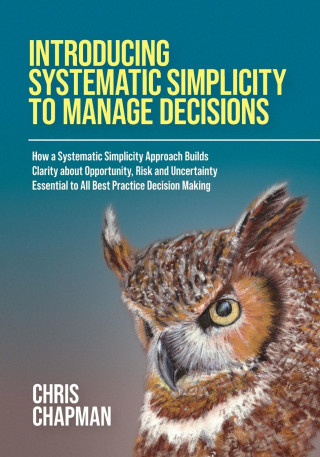
Introducing Systematic Simplicity to Manage Decisions
by Chris Chapman
Chris initially developed the systematic simplicity approach explored in this book working as a consultant with BP International for eight years in the 1970s and 80s on offshore North Sea oil projects. When the BP board approved t ... more


- Language:
 English
 - Binding: Paperback
- Number of pages: 256
Publisher: Consilience Media, 2021
- More about this


You might also like
-

Moonwalk
13.95 € -18 % -

The Score
13.65 € -13 % -

The Deal
12.23 € -22 % -

The Mistake
13.44 € -15 % -

Jujutsu Kaisen, Vol. 30
9.90 € -20 % -

Berserk Deluxe Volume 1
35.70 € -25 % -

The Goal
14.66 € -

Berserk Deluxe Volume 2
33.27 € -30 % -

Invincible Compendium Volume 2
45.81 € -24 % -

Legacy
11.93 € -22 % -

Lord of Mysteries, Vol. 3: The Clown, Part III
17.09 € -13 % -

Murdoku
14.05 € -25 % -

Berserk Deluxe Volume 3
55.22 € -

Witch Hat Atelier Manga Box Set 1
51.28 € -31 % -

Chainsaw Man, Vol. 21
9.30 € -25 % -

Dancing The Dream
19.92 € -31 % -

White Nights
4.54 € -

Jujutsu Kaisen, Vol. 25
9.70 € -25 % -

Jujutsu Kaisen, Vol. 29
9.70 € -25 % -

Witch Hat Atelier: Grimoire Edition 1
35.29 € -29 % -

JoJo's Bizarre Adventure: Part 7--Steel Ball Run, Vol. 7
18.10 € -25 %
Give this book as a present today
- Order book and choose Gift Order.
- We will send you book gift voucher at once. You can give it out to anyone.
- Book will be send to donee, nothing more to care about.
More about Introducing Systematic Simplicity to Manage Decisions
You get 44 loyalty points
 Book synopsis
Chris initially developed the systematic simplicity approach explored in this book working as a consultant with BP International for eight years in the 1970s and 80s on offshore North Sea oil projects. When the BP board approved the first project applying this approach, they mandated its use worldwide for all large or sensitive projects. The BP objectives included achieving 'risk efficiency' (a minimum level of risk for any given level of expected reward) in a 'clarity efficient' manner (a maximum level of relevant clarity for any given level of effort/cost) plus the delivery of projects on time and within budget. These objectives were realised for the decade this approach was employed, prior to placing more risk with contractors and a portfolio of other interrelated corporate changes. IBM UK used Chris in a central role for a 1990s culture change programme addressing what is now seen as 'opportunity management', adapting a version of the BP approach to enable all IBM staff to avoid risk of the wrong kind, but take more risk of the right kind, understanding the difference, and understanding the difference between good luck and good management, bad luck and bad management.
This book explores the basic deliverables of the systematic simplicity approach used by IBM and its BP foundations as subsequently employed by many other adopters in Part 1. Parts 2 and 3 address further aspects of project, operations and corporate management, including strategy formation, safety and the processes underlying all systematic simplicity approaches. They use further examples based on extensive Ontario Hydro, National Power, UK Nirex, Railtrack and UK MoD consultancy engagements.
Routledge published the book 'Enlightened Planning' by Chris Chapman in 2019. It generalises the systematic simplicity approach and associated critiques of common practice in the 2011 Wiley book 'How to Manage Project Opportunity and Risk' by Chris Chapman and Stephen Ward, the extensively revised and retitled third edition of their 1997 bestseller 'Project Risk Management'. These books received strong endorsements from a wide range of international experts, but they provide a level of detail some readers of this book may not need.
This book has been written for a very wide audience, to provide a concise and relatively short but comprehensive introduction to the systematic simplicity concepts and operational tools covered by the book 'Enlightened Planning' plus the underlying earlier literature it builds upon. It is about how systematic simplicity can deliver what all 'best practice' ought to deliver.
Book details
Book category Books in German Sozialwissenschaften, Recht, Wirtschaft Wirtschaft Wirtschaft - Sonstiges
18.30 €
- Full title: Introducing Systematic Simplicity to Manage Decisions
- Author: Chris Chapman
- Language: English
- Binding: Paperback
- Number of pages: 256
- EAN: 9781914195457
- ISBN: 1914195450
- ID: 36637704
- Publisher: Consilience Media
- Weight: 451 g
- Dimensions: 254 × 178 × 14 mm
- Date of publishing: 13. July 2021
Collection points Bratislava a 12868 dalších
Copyright ©2008-26 najlacnejsie-knihy.sk All rights reservedPrivacyCookies

 25740 collection points
 Delivery 2.99 €
 02/210 210 99 (8-15.30h)