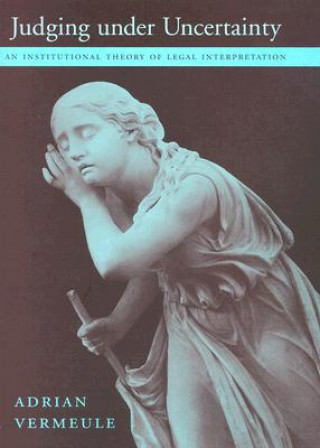
Code: 04634878
Judging under Uncertainty
by Adrian Vermeule
How should judges, in America and elsewhere, interpret statutes and the Constitution? Previous work on these fundamental questions has typically started from abstract views about the nature of democracy or constitutionalism, or th ... more


- Language:
 English
 - Binding: Hardback
- Number of pages: 346
Publisher: Harvard University Press, 2006
- More about this


You might also like
-

House of the Dragon: Light-Up Dragon Egg
12.93 € -22 % -

Harry Potter and the Philosopher's Stone
34.77 € -34 % -

Society of the Spectacle
11.01 € -2 % -

Black Paradox
14.25 € -30 % -

Alya Sometimes Hides Her Feelings in Russian, Vol. 4.5
12.02 € -25 % -

NRSV, Catholic Bible, Gift Edition, Leathersoft, White, Comfort Print
25.07 € -28 % -

Doom Breaker Volume Two
15.36 € -22 % -
Analysis of Amos Tversky and Daniel Kahneman's Judgment under Uncertainty
9.49 € -

Local Man Deluxe Hardcover
42.46 € -24 % -

Wie gut ist Ihr Deutsch? - Das Quiz
6.87 € -18 % -

Understanding Psychosis
51.05 € -

Mój rok relaksu i odpoczynku
8.28 € -16 % -

Graveyard Book Graphic Novel: Volume 1
9.29 € -30 % -

Ženy z rodu Lucemburků
10 € -40 % -

Obrazový slovníček Angličtina Zaměstnání
5.96 € -27 % -

Chainsaw Man - Vol.2 - Blu-ray
52.37 € -

Mali odkrywcy. Ćwiczenia 4-latka
2.01 € -18 % -

CRC Encyclopedia of Mathematics, Third Edition - 3 Volume Set
584.34 € -

Zbraslavská kronika
9.60 € -22 % -

Witaj, przedszkole. Po prostu Mania
6.36 € -14 % -

Cleaning Data for Effective Data Science
42.66 € -2 % -

Eileen Chang - Romancing Languages, Cultures and Genres
37.50 € -

Outline of Mathematical Logic
51.66 € -7 % -

El precio de la perfección
14.25 € -6 % -

Le Risque Professionnel Et La Responsabilite En Cas d'Accidents
14.75 € -2 % -

Dünyanin En Berbat Cocuklari
26.08 € -4 % -

Cher: Closer to the Truth (Bone Coloured) LP
28.61 € -20 % -

Mountain Bike Training
15.97 € -24 % -

Limes. Rivista italiana di geopolitica
17.58 € -

Being Jewish in 21st Century Central Europe
21.73 € -24 % -

Prehistoric Political Dynamics
23.75 € -25 % -

Die Traumdeutung
10.30 € -15 % -

Terra chiama luna. L'avvincente storia dell'Apollo 11
20.42 € -

Business Process Management
154.29 € -7 % -

Sixth Grade Math Volume 2: Adding and Subtracting a.) Fractions 2.) Mixed Numbers, Multiplying Mixed Numbers, Dividing Mixed Numbers
14.05 € -7 % -

Moodhurai
6.36 € -7 % -

JEWISH DOCTRINE OF MEDIATION
30.93 € -2 % -
Transcendental Numbers. (AM-16)
70.06 € -

Talleyrand Maxim
27.39 € -

When Shiva Smiles
8.69 € -24 % -

Sonic Color Line
38.82 € -
Zu Wasser und Land: Geschichten aus See und von der fasten Wall. Tl.3
39.22 € -11 %
Give this book as a present today
- Order book and choose Gift Order.
- We will send you book gift voucher at once. You can give it out to anyone.
- Book will be send to donee, nothing more to care about.
More about Judging under Uncertainty
You get 250 loyalty points
 Book synopsis
How should judges, in America and elsewhere, interpret statutes and the Constitution? Previous work on these fundamental questions has typically started from abstract views about the nature of democracy or constitutionalism, or the nature of legal language, or the essence of the rule of law. From these conceptual premises, theorists typically deduce an ambitious role for judges, particularly in striking down statutes on constitutional grounds. In this book, Adrian Vermeule breaks new ground by rejecting both the conceptual approach and the judge-centred conclusions of older theorists. Vermeule shows that any approach to legal interpretation rests on institutional and empirical premises about the capacities of judges and the systemic effects of their rulings. Drawing upon a range of social science tools from political science, economics, decision theory and other disciplines, he argues that legal interpretation is above all an exercise in decision-making under severe empirical uncertainty. In view of their limited information and competence, judges should adopt a restrictive, unambitious set of tools for interpreting statutory and constitutional provisions, deferring to administrative agencies where statutes are nuclear and deferring to legislatures where constitutional language is unclear or states general aspirations.
Book details
Book category Books in English Law Jurisprudence & general issues
103.43 €
- Full title: Judging under Uncertainty
- Subtitle: An Institutional Theory of Legal Interpretation
- Author: Adrian Vermeule
- Language: English
- Binding: Hardback
- Number of pages: 346
- EAN: 9780674022102
- ISBN: 0674022106
- ID: 04634878
- Publisher: Harvard University Press
- Weight: 704 g
- Dimensions: 245 × 164 × 27 mm
- Date of publishing: 01. May 2006
Trending among others
-

Tools of Argument
11.92 € -7 % -

State Aid Uncovered
57.02 € -19 % -

Evolution of a Judicial Philosophy
47.92 € -4 % -

Towards Juristocracy
34.67 € -

Negotiate Without Fear - Strategies and Tools to Maximize Your Outcomes
21.83 € -24 % -

Anatomy of Violence
16.17 € -25 % -

Merriam-Webster's Dictionary of Law
12.73 € -24 % -

Police Use of Force, Tasers and Other Less-Lethal Weapons
1.41 € -92 % -

Introduction to Law
50.55 € -9 % -

Law For Dummies 2e
18.09 € -25 % -

Fruit from a Poisonous Tree
13.54 € -23 % -

EU General Data Protection Regulation (GDPR)
46.10 € -

Military Hapkido: Police Tactical Training Vol. 1
10 € -34 % -

Chinese-English English-Chinese Pocket Legal Dictionary
14.75 € -25 % -

Atlas of Legal Medicine
2.21 € -2 % -

Construction Law and Dispute Resolution Practice
78.05 € -2 % -
Beyond Good and Evil
27.39 € -2 % -

Contracts 101: Learn to Review and Negotiate Services Agreements (including Intellectual Property Licensing)
49.33 € -

Law and Revolution
44.99 € -

Russian-English/English-Russian Pocket Legal Dictionary
14.75 € -25 % -

DICTIONARY LEGAL and ECONOMICS ENGLISH GERMAN
26.89 € -7 % -

The Sacrament of Language: An Archaeology of the Oath
17.38 € -11 % -

Rudimentary Treatise On The Power Of Water
23.75 € -2 % -

Herbal Formulations
49.84 € -2 % -
Principles and Methods of Law and Economics
57.73 € -

Law: The Basics
30.22 € -

Fiqh Islamic Law & Usul Al-Fiqh
18.29 € -7 % -

Principles, Politics, and Fundamental Law
47.92 € -4 % -

Chemical Sense Marks
79.87 € -4 % -

Miscarriages of Justice (and How to Avoid Them)
3.93 € -2 % -

Foundations of English Administrative Law
19.61 € -60 % -

You Don't Look Like a Lawyer
44.78 € -

אגרת לציבור
6.36 € -1 % -

IMMIGRATION, A WORLD MOVEMENT AND ITS AM
37.30 € -1 % -

In Search of a Model for the Legal Protection of a Whistleblower in the Workplace in Poland. A legal and comparative study
48.22 € -4 % -

Übersetzungen des polnischen Strafgesetzbuches ins Deutsche
47.82 € -

Contemporary Panopticism
26.89 € -14 % -

Is the Bible Really the Law?
17.99 € -

Fixing Broken Windows
14.75 € -25 % -

Realities Of Life (1838)
24.66 € -2 % -

Death in Ancient Rome
42.15 € -

Podcast, Blog & New Media Producer's Legal Survival Guide (paperback)
17.08 € -9 % -

Romanized School Dictionary
38.21 € -1 % -

Three Felonies A Day
19.61 € -24 % -

American Jury System
46.50 € -

History of the Common Law of England
36.29 € -

Law and Revolution
47.72 € -

Triumph of Venus
93.72 € -

From Apology to Utopia
64.80 €
Collection points Bratislava a 12833 dalších
Copyright ©2008-26 najlacnejsie-knihy.sk All rights reservedPrivacyCookies

 25670 collection points
 Delivery 2.99 €
 02/210 210 99 (8-15.30h)