Code: 04634349
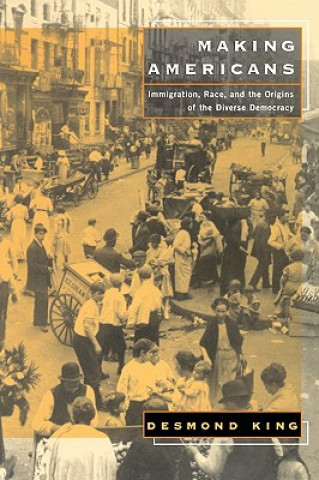
Making Americans
by Desmond S. King
In the 19th century, virtually anyone could get into the United Sates. But by the 1920s, US immigration policy had become a finely filtered regime of selection. Desmond King looks at this dramatic shift, and the debates behind it, ... more


- Language:
 English
 - Binding: Paperback
- Number of pages: 400
Publisher: Harvard University Press, 2002
- More about this


You might also like
-

No Promises, No Lies
19.24 € -2 % -

Battles with the Nachtjagd: : The Night Airwar over Eure 1939-1945
42.12 € -26 % -

A co já s tím?
8.25 € -22 % -

Puzzle Maxi Bing Atak sztuki! 24
11.78 € -

Страна радости
18.23 € -12 % -

Terrific Mother
5.94 € -19 % -

Union Pacific
53.30 € -

Villa del seminario
21.56 € -

Atlas of Fine Needle Aspiration Cytology
248.52 € -

Rebellion of Ronald Reagan
21.36 € -18 % -
Curriculum*-in-the-Making
158.72 € -10 % -

Monety - zamek - nagrobek
12.39 € -16 % -

U2
36.67 € -

Parallel Problem Solving from Nature ? PPSN XVIII
82.13 € -7 % -

Słowa światłości. Archiwum Burzowego Światła. Tom 2. Wydanie jubileuszowe
21.15 € -3 % -

Trudy's Rock Story
9.87 € -25 % -

Atlantic American Societies
199.04 € -

Macrobius
29.32 € -

Deception
9.77 € -6 % -

Governing Europe under a Constitution
102.59 € -7 % -

Brightwood Stillness
15.91 € -21 % -

On Religious Liberty
30.93 € -2 % -

The Jungle Baby (Traditional Chinese): 08 Tongyong Pinyin with IPA Paperback B&w
22.46 € -7 % -

Lorine Niedecker: Enough to Carry Me Through: A Fictional Autobiography
5.84 € -7 % -

Beyond Preservation
91.30 € -5 % -

Revolutionary Constitution
49.78 € -

Miracle of Intervale Avenue
41.51 € -

CRITICISM ON THE DECLARATION OF INDEPEND
15.61 € -2 % -

Rheinbach
17.93 € -11 % -

Jingle Bell Jokes for Funny Kids
8.86 € -25 % -
Matèria vivent, vida pensant
21.96 € -

Transnationalism and German-Language Literature in the Twenty-First Century
116.49 € -4 % -

Book of the Alchemist
14.40 € -

Basta Studiare
14 € -6 % -

Waste of Time - Business is Picking Up Every Day - Memoirs of A Garbologist
11.48 € -6 % -

Killing Americans
48.06 € -

Les Beautes de Lord Byron: Galerie de Quinze Tableaux Tires de Ses Oeuvres
18.33 € -1 % -

The 12 Most Influential Movies of All Time
41.51 € -

Iconic Warrior
19.24 € -2 % -

Lettres Spirituelles, Volume 2
29.12 € -1 % -

Der Monolog Im Drama (1908)
21.86 € -2 % -

Eugen Enderlen 1863-1963
52.90 € -7 %
Give this book as a present today
- Order book and choose Gift Order.
- We will send you book gift voucher at once. You can give it out to anyone.
- Book will be send to donee, nothing more to care about.
More about Making Americans
You get 140 loyalty points
 Book synopsis
In the 19th century, virtually anyone could get into the United Sates. But by the 1920s, US immigration policy had become a finely filtered regime of selection. Desmond King looks at this dramatic shift, and the debates behind it, for what they reveal about the construction of an "American" identity. Specifically, the debates in the three decades leading up to 1929 were conceived in terms of desirable versus undesirable immigrants. This not only cemented judgements about specific European groups but reinforced prevailing biases against groups already present in the United States, particularly African Americans, whose inferior status and second-class citizenship - enshrined in Jim Crow laws and embedded in pseudo-scientific arguments about racial classifications - appear to have been consolidated in these decades, Although the values of different groups have always been recognised in the United States, King gives the most thorough account yet of how eugenic arguments were used to establish barriers and to favour an Anglo-Saxon conception of American identity, rejecting claims of other traditions. thus the immigration controversy emerges here as a significant precursor to recent multicultural debates. This book shows how the choices made about immigration policy in the 1920s played a fundamental role in shaping democracy and ideas about group rights in America.
Book details
Book category Books in English Society & social sciences Society & culture: general Social issues & processes
57.74 €
- Full title: Making Americans
- Subtitle: Immigration, Race, and the Origins of the Diverse Democracy
- Author: Desmond S. King
- Language: English
- Binding: Paperback
- Number of pages: 400
- EAN: 9780674008120
- ISBN: 067400812X
- ID: 04634349
- Publisher: Harvard University Press
- Weight: 562 g
- Dimensions: 227 × 144 × 27 mm
- Date of publishing: 15. June 2002
Trending among others
-

Pedagogy of the Oppressed
10.47 € -29 % -

The Second Sex
7.45 € -33 % -

Women & Power
8.56 € -30 % -

Regarding the Pain of Others
12.99 € -23 % -

The Feminine Mystique
11.98 € -19 % -

Violence
10.67 € -34 % -

Bodies That Matter
32.04 € -4 % -

The Divide
11.58 € -29 % -

Pleasure Activism
14.91 € -25 % -

Everyday Sexism
12.69 € -11 % -

Blitzed
12.59 € -29 % -

Golden Cage
35.06 € -

Fourth Political Theory
28.21 € -1 % -

The Lucifer Effect
16.82 € -30 % -

Third Wave
7.85 € -25 % -

Reefer Madness
22.97 € -25 % -

Feminist Theory
30.93 € -2 % -

Art of Conversation
12.89 € -30 % -

Bullying at School - What We Know and What We Can Do
31.74 € -2 % -

Who Stole Feminism?: How Women Have Betrayed Women
15.41 € -25 % -

Fourth Industrial Revolution
17.53 € -14 % -

Gospel of Wealth
9.87 € -25 % -

Misogynation
11.78 € -25 % -

Girl Up
14.10 € -23 % -

Superforecasting
11.28 € -23 % -

Leisure: The Basis of Culture
14 € -25 % -

Staying with the Trouble
27.30 € -6 % -

The Beauty Myth
8.66 € -10 % -

Zeros and Ones
10.17 € -17 % -

Shock Doctrine
15.31 € -33 % -

Alone Together
16.32 € -24 % -

Toxic Parents
14.10 € -23 % -

No Logo
10.37 € -30 % -

Animal Liberation
17.43 € -32 % -

Reclaiming Conversation
13.90 € -28 % -
Food Of The Gods
16.82 € -30 % -

Perfect Daughters
12.69 € -24 % -

Living in the End Times
18.33 € -29 % -

Sacred Knowledge
21.56 € -25 % -

Development as Freedom
16.22 € -24 % -

Conflict Is Not Abuse
16.12 € -24 % -

Heart of Social Change
6.64 € -21 % -

Second Sex
21.15 € -25 % -

Soft Power
14 € -25 % -
Rebel Witch
18.03 € -25 % -

Chronology of Water
11.18 € -24 % -

Alcoholics Anonymous Big Book
25.89 € -

Singularity Is Near
18.84 € -25 % -

Sitting in the Fire
16.82 €
Collection points Bratislava a 12772 dalších
Copyright ©2008-26 najlacnejsie-knihy.sk All rights reservedPrivacyCookies

 25548 collection points
 Delivery 2.99 €
 02/210 210 99 (8-15.30h)