Code: 15176326
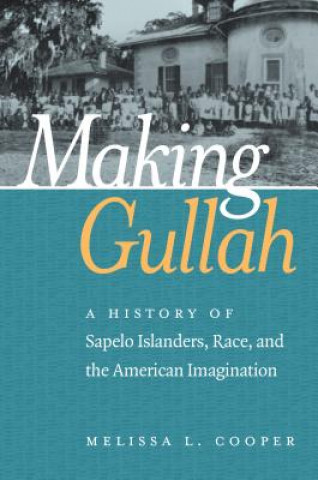
Making Gullah
by Melissa Cooper
During the 1920s and 1930s, anthropologists and folklorists became obsessed with uncovering connections between African Americans and their African roots. At the same time, popular print media and artistic productions tapped the n ... more


- Language:
 English
 - Binding: Hardback
- Number of pages: 320
Publisher: The University of North Carolina Press, 2017
- More about this


You might also like
-

Niubi!
21.42 € -18 % -

Making Progress to First Certificate Workbook
10.20 € -7 % -

Life-Cycle-Cost in der Beschaffung und Logistik
17.07 € -10 % -

Dernier cri avant l'oubli
9.59 € -

Deutsche Corporate Governance Kodex
42.75 € -11 % -

Capture a Dream
19.60 € -24 % -

D-Day and the Battle of Normandy - Italian
8.08 € -19 %
Give this book as a present today
- Order book and choose Gift Order.
- We will send you book gift voucher at once. You can give it out to anyone.
- Book will be send to donee, nothing more to care about.
More about Making Gullah
You get 279 loyalty points
 Book synopsis
During the 1920s and 1930s, anthropologists and folklorists became obsessed with uncovering connections between African Americans and their African roots. At the same time, popular print media and artistic productions tapped the new appeal of black folk life, highlighting African-styled voodoo as an essential element of black folk culture. A number of researchers converged on one site in particular, Sapelo Island, Georgia, to seek support for their theories about "African survivals," bringing with them a curious mix of both influences. The legacy of that body of research is the area's contemporary identification as a Gullah community. This wide-ranging history upends a long tradition of scrutinizing the Low Country blacks of Sapelo Island by refocusing the observational lens on those who studied them. Cooper uses a wide variety of sources to unmask the connections between the rise of the social sciences, the voodoo craze during the interwar years, the black studies movement, and black land loss and land struggles in coastal black communities in the Low Country. What emerges is a fascinating examination of Gullah people's heritage, and how it was reimagined and transformed to serve vastly divergent ends over the decades.
Book details
Book category Books in English Humanities History Regional & national history
115.34 €
- Full title: Making Gullah
- Author: Melissa Cooper
- Language: English
- Binding: Hardback
- Number of pages: 320
- EAN: 9781469632674
- ISBN: 1469632675
- ID: 15176326
- Publisher: The University of North Carolina Press
- Weight: 648 g
- Dimensions: 235 × 155 × 23 mm
- Date of publishing: 28. February 2017
Trending among others
-

Hundred Years' War on Palestine
13.13 € -20 % -

Europe's Tragedy
19.80 € -30 % -

Bury My Heart At Wounded Knee
11.41 € -34 % -

Ethnic Cleansing of Palestine
14.55 € -16 % -

The Fourth Turning
20.01 € -11 % -

Decline and Fall of the Roman Empire
6.56 € -25 % -

Osman's Dream
50.23 € -

How to Listen to Jazz
17.18 € -11 % -

Waffen-SS (2)
14.85 € -24 % -

Alexander the Great
18.09 € -24 % -

Conquest of New Spain
13.94 € -24 % -

Footnotes in Gaza
23.24 € -25 % -

Florence
56.60 € -24 % -
Culture of Growth
19.80 € -26 % -

The Secret Diaries Of Miss Anne Lister: Vol. 1
13.23 € -16 % -

Viking Way
43.97 € -6 % -

Campaigns of Alexander
13.94 € -24 % -

Reconstruction of Nations
28.20 € -
Alexiad
16.17 € -25 % -

Lords of the Horizons
12.93 € -30 % -
Persians
20.01 € -26 % -

Estonian Textbook
27.59 € -

Rise and Fall of the House of Medici
17.58 € -17 % -

Butchering Art
11.41 € -34 % -

Concise History of Switzerland
24.45 € -24 % -

Later Roman Empire
15.96 € -25 % -

Shortest History of Europe
10.81 € -24 % -

Battle Cry of Freedom
20.11 € -25 % -

Flight to Arras
11.82 € -25 % -

Restoration of Rome
23.95 € -19 % -

Austro-Hungarian Forces 1914-18
15.76 € -15 % -

Jewish War
12.83 € -30 % -

Austrian Napoleonic Artillery 1792-1815
15.66 € -15 % -

Empire of Liberty
21.73 € -24 % -

Interpreting Our Heritage
18.29 € -24 % -

The Balkans, 1804-2012
21.22 € -24 % -

Diana: Her True Story - In Her Own Words
12.93 € -25 % -

Iran-Iraq War
41.44 € -6 % -

Medici Money
11.82 € -25 % -
History of Crete
13.94 € -24 % -

Anatomy of the Nuremberg Trials
21.73 € -24 % -

Sumer and the Sumerians
56.40 € -
Religion in Ancient Mesopotamia
32.64 € -

Concise History of Bulgaria
23.04 € -25 % -

Radicalism of the American Revolution
16.06 € -27 % -

Sheela-na-gig
14.75 € -25 % -

Art of Not Being Governed
24.25 € -7 % -

Pope in Poland
21.73 € -24 % -

Army Group South: The Wehrmacht in Russia 1941-1945
28.70 € -25 %
Collection points Bratislava a 13220 dalších
Copyright ©2008-26 najlacnejsie-knihy.sk All rights reservedPrivacyCookies

 26444 collection points
 Delivery 2.99 €
 02/210 210 99 (8-15.30h)