Code: 04610956
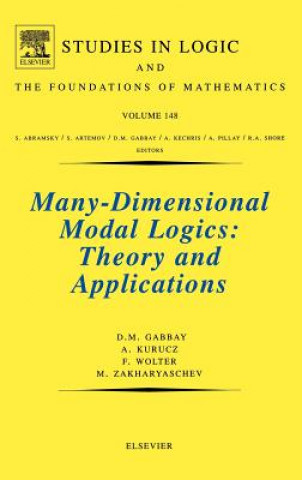
Many-Dimensional Modal Logics: Theory and Applications
by Dov M. Gabbay, A. Kurucz, Frank Wolter, Michael Zakharyaschev
Modal logics, originally conceived in philosophy, have recently found many applications in computer science, artificial intelligence, the foundations of mathematics, linguistics and other disciplines. Celebrated for their good com ... more


- Language:
 English
 - Binding: Hardback
- Number of pages: 766
Publisher: North-Holland, 2003
- More about this


You might also like
-

300 Creative Physics Problems with Solutions
34.94 € -

Astrology and Cosmology in the World's Religions
35.44 € -9 % -

O věčnosti světa
7.67 € -15 % -

La passe-miroir 3
13.73 € -

Sanrio Pink Black Party Series XXL Mousepad Hello Kitty & Friends Pop
28.07 € -7 % -

Kid's Box Level 3 Interactive DVD (PAL) with Teacher's Booklet
42.11 € -8 % -

LA HISTORIA INFOGRÁFICA DEL MUNDO
31.30 € -

Un fil à la patte
6.76 € -

Kimberley's Pocket Posh Journal, Polka Dot
7.26 € -24 % -

Cinematic Emotion in Horror Films and Thrillers
249.08 € -

4-Chord Songbook
20.80 € -

Overflow
28.68 € -

Handbuch der Schiffs-Dampfmaschinenkunde (1867)
31.20 € -11 % -

The Idaho Political Field Guide 2014
14.84 € -7 % -

Without a Scratch
18.27 € -7 % -

La résolution des conflits dans les contes de tricots chez les Igbo
49.79 € -14 % -

Oscar Wilde
116.25 € -

Little Book of Cool Tools for Hot Topics
4.64 € -

Chronicle of Hugh of Flavigny
233.22 € -

FANTASIA CONTRAPPUNTISTICA BUSONIVERZ 25
48.78 € -

Calcudoku Puzzle Books - 400 Easy to Master Puzzles 8x8 (Volume 9)
15.85 € -10 %
Give this book as a present today
- Order book and choose Gift Order.
- We will send you book gift voucher at once. You can give it out to anyone.
- Book will be send to donee, nothing more to care about.
More about Many-Dimensional Modal Logics: Theory and Applications
You get 450 loyalty points
 Book synopsis
Modal logics, originally conceived in philosophy, have recently found many applications in computer science, artificial intelligence, the foundations of mathematics, linguistics and other disciplines. Celebrated for their good computational behaviour, modal logics are used as effective formalisms for talking about time, space, knowledge, beliefs, actions, obligations, provability, etc. However, the nice computational properties can drastically change if we combine some of these formalisms into a many-dimensional system, say, to reason about knowledge bases developing in time or moving objects. To study the computational behaviour of many-dimensional modal logics is the main aim of this book. On the one hand, it is concerned with providing a solid mathematical foundation for this discipline, while on the other hand, it shows that many seemingly different applied many-dimensional systems (e.g., multi-agent systems, description logics with epistemic, temporal and dynamic operators, spatio-temporal logics, etc.) fit in perfectly with this theoretical framework, and so their computational behaviour can be analyzed using the developed machinery. We start with concrete examples of applied one- and many-dimensional modal logics such as temporal, epistemic, dynamic, description, spatial logics, and various combinations of these. Then we develop a mathematical theory for handling a spectrum of 'abstract' combinations of modal logics - fusions and products of modal logics, fragments of first-order modal and temporal logics - focusing on three major problems: decidability, axiomatizability, and computational complexity. Besides the standard methods of modal logic, the technical toolkit includes the method of quasimodels, mosaics, tilings, reductions to monadic second-order logic, algebraic logic techniques. Finally, we apply the developed machinery and obtained results to three case studies from the field of knowledge representation and reasoning: temporal epistemic logics for reasoning about multi-agent systems, modalized description logics for dynamic ontologies, and spatio-temporal logics. The genre of the book can be defined as a research monograph. It brings the reader to the front line of current research in the field by showing both recent achievements and directions of future investigations (in particular, multiple open problems). On the other hand, well-known results from modal and first-order logic are formulated without proofs and supplied with references to accessible sources. The intended audience of this book is logicians as well as those researchers who use logic in computer science and artificial intelligence. More specific application areas are, e.g., knowledge representation and reasoning, in particular, terminological, temporal and spatial reasoning, or reasoning about agents. And we also believe that researchers from certain other disciplines, say, temporal and spatial databases or geographical information systems, will benefit from this book as well. Key features include: integrated approach to modern modal and temporal logics and their applications in artificial intelligence and computer science; written by internationally leading researchers in the field of pure and applied logic; combines mathematical theory of modal logic and applications in artificial intelligence and computer science; numerous open problems for further research; and well illustrated with pictures and tables.
Book details
Book category Books in English Mathematics & science Mathematics Mathematical foundations
185.55 €
- Full title: Many-Dimensional Modal Logics: Theory and Applications
- Author: Dov M. Gabbay, A. Kurucz, Frank Wolter, Michael Zakharyaschev
- Language: English
- Binding: Hardback
- Number of pages: 766
- EAN: 9780444508263
- ISBN: 0444508260
- ID: 04610956
- Publisher: North-Holland
- Weight: 1250 g
- Dimensions: 229 × 166 × 34 mm
- Date of publishing: 01. October 2003
Trending among others
-

Math Mammoth Grade 4-B Worktext
21.10 € -25 % -

Can You Solve My Problems?
11.81 € -24 % -

Category Theory in Context
25.04 € -25 % -
Set Theory and the Continuum Hypothesis
11.30 € -24 % -
Introduction to Logic
11.30 € -24 % -

Proofs and Refutations
21 € -24 % -

Illustrated Book of Bad Arguments
12.72 € -24 % -

Alan Turing's Systems of Logic
14.74 € -2 % -

Set Theory
205.45 € -7 % -

Math Mammoth Grade 1-A Worktext
17.46 € -25 % -

Set Theory, Logic and their Limitations
64.13 € -

Mathematical Circle Diaries, Year 2
65.34 € -

Math Mammoth Grade 2-A Worktext
18.48 € -25 % -

Goedel's Proof
13.42 € -24 % -
Logic: A Very Short Introduction
9.99 € -24 % -

To Mock a Mockingbird: and Other Logic Puzzles
15.14 € -23 % -

Introduction to Logic and to the Methodology of Deductive Sciences
12.01 € -
Model Theory
25.04 € -25 % -
First-order Logic
8.58 € -24 % -

Beginner's Guide to Mathematical Logic
22.21 € -25 % -

Conceptual Mathematics
67.97 € -

Introduction to Mathematical Logic
21.61 € -25 % -

Contributions to the Founding of the Theory of Transfinite Numbers
12.82 € -

Categories for Types
91.10 € -

Lambda-Calculus and Combinators
91.10 € -

Limitless Mind
16.86 € -24 % -

Foundations of Geometry
9.79 € -

Foundation Maths
75.55 € -
Topoi
21.61 € -25 % -

Naive Set Theory
9.79 € -

Set Theory
25.75 € -9 % -

Foundations of Mathematics and Other Logical Essays
17.46 € -
Set Theory and Logic
16.76 € -25 % -

Taking Sudoku Seriously
54.43 € -
Undecidable Theories
11.30 € -24 % -

Beginner's Further Guide To Mathematical Logic, A
25.24 € -

Sets for Mathematics
67.97 € -

Naive Set Theory
10.29 € -

Algebraic Logic
11.30 € -15 % -

Haskell Road to Logic, Maths and Programming
25.14 € -10 % -
Gödel's Incompleteness Theorems
55.44 € -9 % -

From Frege to Goedel
59.89 € -

Philosophical Applications of Modal Logic
36.86 € -1 % -

Lattice Theory: Foundation
98.37 € -

Handbook of Epistemic Logic
29.79 € -10 % -

Computability and Logic
40.90 € -1 % -

How to Read and Do Proofs - An Introduction to Mathematical Thought Processes, Sixth Edition
77.36 € -

Model Theory : An Introduction
50.39 € -9 % -

Problems and Theorems in Classical Set Theory
50.50 € -9 %
Collection points Bratislava a 13253 dalších
Copyright ©2008-26 najlacnejsie-knihy.sk All rights reservedPrivacyCookies

 26510 collection points
 Delivery 2.99 €
 02/210 210 99 (8-15.30h)