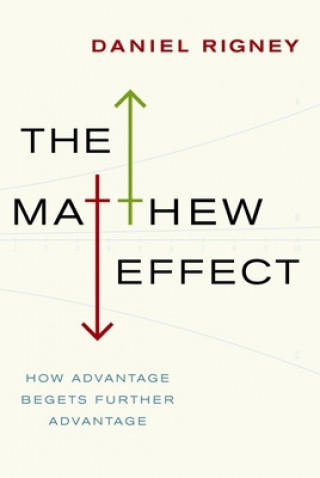
Code: 04042083
Matthew Effect
by Daniel Rigney
The old saying does often seem to hold true: the rich get richer while the poor get poorer, creating a widening gap between those who have more and those who have less. The sociologist Robert K. Merton called this phenomenon the M ... more


- Language:
 English
 - Binding: Hardback
- Number of pages: 176
Publisher: Columbia University Press, 2010
- More about this


You might also like
-

Mother Mary Comes To Me
14.42 € -17 % -

Cambridge Lower Secondary English Learner's Book 9 with Digital Access (1 Year)
31.90 € -10 % -

Forensics: What Bugs, Burns, Prints, DNA, and More Tell Us about Crime
13.51 € -24 % -

La profezia dell'armadillo. Artist edition
20.32 € -
Fascia: The Tensional Network of the Human Body
61.58 € -6 % -

MURDER ROAD
14.12 € -25 % -

Amadeus
10.87 € -24 % -

Hungry Souls
14.12 € -25 % -

Best Women's Erotica of the Year, Volume 1
17.68 € -18 % -

Alfred's Basic Piano Library Lesson 5
15.24 € -15 % -

Poems Of The Sea
13.20 € -23 % -

En Cyclo Pedia
17.78 € -17 % -

Princess and the Goblin
9.14 € -25 % -

American Indian Stories and Old Indian Legends
9.24 € -25 % -

Lustrum
10.97 € -24 % -

Art as Medicine
18.39 € -50 % -

Hey Duggee: Squirrel Club Sticker Activity Book
6.60 € -25 % -

Racing Weight Cookbook
24.79 € -9 % -

Painted Veil
11.37 € -18 % -

Become a Rock Star Real Estate Agent
11.37 € -24 % -

Girl Who Climbed Everest
25.50 € -

Grammar of Egyptian Aramaic, Second Revised Edition
44.41 € -24 % -

Hygiene, Volume I
33.84 € -

Charley's First Night
8.73 € -24 % -

Adult Coloring Book
8.43 € -

New Orleansclass Cruiser USS Astoria
21.54 € -9 % -

Star Rise
13.81 € -

Universal Love
12.09 € -25 % -

Laser Electronics
248.91 € -14 % -

In the Name of Jesus
12.09 € -20 % -

Rough Guides Slovenia: Travel Guide with eBook
17.27 € -26 % -

BABADADA, Serbian (in cyrillic script) - Kurdish Sorani (in arabic script), visual dictionary (in cyrillic script) - visual dictionary (in arabic scri
27.03 € -7 % -

Checkmate
21.84 € -

Welcome to America, Champ
16.76 € -9 % -

An English Translation Of The Sushruta Samhita Based On Original Sanskrit Text, Volume 1, Part 1
22.05 € -2 % -

Reinhold Niebuhr and His Circle of Influence
33.73 € -

Počítání soba Boba - 1. díl
7.92 € -16 % -

Intermediate Algebra
231.53 € -

Standardisierung versus Differenzierung als zentrales Entscheidungsproblem interkultureller Kommunikationspolitik
18.08 € -11 % -

Flammen über dem Silbersee, 1 DVD
19 € -

Dali
12.39 € -7 % -

Far Harbours
8.63 € -1 % -

From Growing Up Pains To The Sacred Diary
16.25 € -17 % -

I'm yours
9.75 € -7 % -

Dissertatio, De Legibus Historiae Naturalis (1696)
21.23 € -1 % -

J'y vais, j'y vais pas ?
25.10 € -

This Is Modern Art
12.80 € -24 % -

Terra Geographie 9/10. Ausgabe Thüringen Gymnasium
32.01 € -

Denslow's Mother Goose, Volume 3 (Simplified Chinese): 06 Paperback Color
32.11 € -7 % -

Canadian Annual Review of Politics and Public Affairs
174.91 € -

Blut ist Wasser. Roman in 45 Akten
9.04 € -

Impressionist Treasures
36.07 € -14 % -

La princesse Flora
8.43 € -6 % -
Youth Practices in Digital Arts and New Media: Learning in Formal and Informal Settings
59.86 € -25 % -

The Informatics Guide to Healthcare
234.68 € -

Travels in the Interior Inhabited Parts of North America
26.92 € -14 % -

Gray Whales Gray Whales
23.77 € -24 % -

Begriff Des Terrorismus Im Voelkerrecht
97.06 € -1 % -

Story of the 9th King's in France
17.98 € -14 % -

Commentaries on the Dhammapada
9.54 € -

song for you. 50 canzoni per vincere le sfide della vita
28.14 € -9 % -

La Justesse De La Langue Francoise: Ou Les Differentes Significations Des Mots Qui Passent Pour Synonimes (1718)
31.09 € -2 % -

The Old Christian Right: The Protestant Far Right from the Great Depression to the Cold War
75.61 € -
New Economy Emotion - Engaging Customer Passion with E-CRM
47.96 € -9 % -

Eclopius' Lament
13.41 € -6 % -

Pascua de Cristo
5.07 € -

SONS SORPRESA - GRRR! GRRR!
19.50 € -

Metaphorical Society
49.79 € -

Foreign Direct Investments from Emerging Markets
109.86 € -

Пенни Ореховое Сердце и "Проклятие монстрянки"
15.64 € -54 % -

Walt Whitman: Bard of the West
32.92 € -2 % -

Neue Hall- und Thon-Kunst
16.25 € -10 % -

Phenomenology and the Human Positioning in the Cosmos
155.09 € -7 % -

Deutsch typologisch
26.72 € -6 % -

Рабочая тетрадь к учебнику В.А. Самковой, Н.И. Романовой "Окружающий мир". 3 класс. В 2-х частях. Часть 1
8.02 € -12 % -

Little Wire Hanger in the Closet
14.93 € -2 % -

Meaning Of Children
145.84 €
Give this book as a present today
- Order book and choose Gift Order.
- We will send you book gift voucher at once. You can give it out to anyone.
- Book will be send to donee, nothing more to care about.
More about Matthew Effect
You get 88 loyalty points
 Book synopsis
The old saying does often seem to hold true: the rich get richer while the poor get poorer, creating a widening gap between those who have more and those who have less. The sociologist Robert K. Merton called this phenomenon the Matthew effect, named after a passage in the gospel of Matthew. Yet the more closely we examine the sociological effects of this principle, the more complicated the idea becomes. Initial advantage doesn't always lead to further advantage, and disadvantage doesn't necessarily translate into failure. Does this theory need to be revisited? Merton's arguments have significant implications for our conceptions of equality and justice, and they challenge our beliefs about culture, education, and public policy. His hypothesis has been examined across a variety of social arenas, including science, technology, politics, and schooling, to see if, in fact, advantage begets further advantage. Daniel Rigney is the first to evaluate Merton's theory of cumulative advantage extensively, considering both the conditions that uphold the Matthew effect and the circumstances that cause it to fail. He explores whether growing inequality is beyond human control or disparity is socially constructed and subject to change. Reexamining our core assumptions about society, Rigney causes us to rethink the sources of inequity.
Book details
Book category Books in English Society & social sciences Society & culture: general Social groups
36.48 €
- Full title: Matthew Effect
- Author: Daniel Rigney
- Language: English
- Binding: Hardback
- Number of pages: 176
- EAN: 9780231149488
- ISBN: 0231149484
- ID: 04042083
- Publisher: Columbia University Press
- Weight: 390 g
- Dimensions: 216 × 146 × 19 mm
- Date of publishing: 23. February 2010
Trending among others
-

Women Who Run with the Wolves
10.56 € -9 % -

Orientalism
14.32 € -18 % -

When God Was A Woman
13.10 € -29 % -

Women Who Run With The Wolves
14.93 € -30 % -

Who Cooked the Last Supper?
19.30 € -2 % -

The Second Sex
14.93 € -30 % -

Why Does He Do That?
16.86 € -27 % -

1491 (Second Edition)
15.54 € -25 % -

Freedom Writers Diary
11.58 € -29 % -

The Velvet Rage
13.91 € -29 % -

The Manipulated Man
12.09 € -24 % -

Witches, Midwives, And Nurses
12.90 € -

The Autobiography of Malcolm X
7.92 € -29 % -

Mein Kampf
8.63 € -18 % -

On Michael Jackson
11.37 € -28 % -

Hillbilly Elegy
13.81 € -29 % -

Scum Manifesto
8.93 € -21 % -

Death of Nature
14.12 € -25 % -

Atlas of Indian Nations
34.75 € -28 % -

Black Skin, White Masks
12.80 € -25 % -

Islam and the Destiny of Man
19.20 € -25 % -

Meat Market - Female flesh under capitalism
10.87 € -18 % -

Promise of Politics
13.51 € -24 % -

Lost Keys of Freemasonry
6.80 € -

Tribal Wars of the Southern Plains
25.50 € -

What I Told My Daughter
14.12 € -25 % -

Flour Babies
8.12 € -30 % -

Amazons
18.69 € -9 % -

Random Family
15.34 € -20 % -

How to Run a Traditional Jewish Household
24.59 € -17 % -

Sexually Dominant Woman
10.66 € -25 % -

Gender Transformations
75.20 € -

My Journey to Lhasa
14.83 € -25 % -

Inuit Qaujimajatuqangit
32.41 € -14 % -

Dear Madam President
16.35 € -20 % -

Weight of the World - Social Suffering in Contemporary Society
37.80 € -

Autobiography of Malcolm X
22.86 € -27 % -

Futbol, Jews, and the Making of Argentina
25.60 € -11 % -

Room of One's Own
5.78 € -

Goddesses in Everywoman
11.07 € -30 % -

Complete Persepolis
20.32 € -

How Europe Underdeveloped Africa
22.76 € -13 % -

Eros and Mysteries of Love
14.83 € -25 % -

The Mastery of Love
10.97 € -23 % -

Sister Outsider
12.09 € -19 % -

Iron John
14.83 € -25 % -

Muqaddimah
18.59 € -23 % -

Devotion
8.63 € -24 % -

Indigenous Peoples' History of the United States
13.41 € -29 %
Collection points Bratislava a 13229 dalších
Copyright ©2008-26 najlacnejsie-knihy.sk All rights reservedPrivacyCookies

 26462 collection points
 Delivery 2.99 €
 02/210 210 99 (8-15.30h)