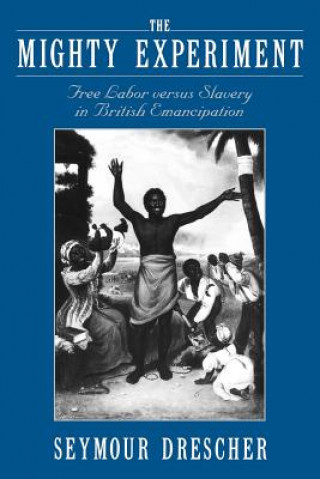
Code: 04031761
Mighty Experiment
by Seymour Drescher
By the mid-eighteenth century, the transatlantic slave trade was considered to be a necessary and stabilizing factor in the capitalist economies of Europe and the expanding Americas. Britain was the most influential power in this ... more


- Language:
 English
 - Binding: Paperback
- Number of pages: 318
Publisher: Oxford University Press Inc, 2004
- More about this


You might also like
-

Detective Stanley and the Mystery at the Museum
10.94 € -17 % -

Bearing False Witness: Debunking Centuries of Anti-Catholic History
14.79 € -25 % -

Peppa Pig: Peppa's Buried Treasure
9.01 € -11 % -

King Arthur And His Knights Of The Round Table
16 € -25 % -

Scaredy Squirrel Visits the Doctor
11.75 € -25 % -

Best Karate: V.10
13.98 € -9 % -

Knots. Step-by-Step Instructional Guide on Tying Knots For Any Purpose
8.91 € -7 % -

Jungle Lore
11.24 € -9 % -

VIVE Y DEJA MORIR JAMES BOND 007 LIBRO 2
14.99 € -9 % -
![HERCULE - Mon Histoire à Écouter [QR code ou CD] - L'histoire du film - Disney](https://media.libris.to/jacket/44619669t.jpg "HERCULE - Mon Histoire à Écouter [QR code ou CD] - L'histoire du film - Disney")
HERCULE - Mon Histoire à Écouter [QR code ou CD] - L'histoire du film - Disney
10.33 € -

Shield of Sparrows
38.91 € -

Shame Machine
19.95 € -26 % -

Borders, Human Itineraries, and All Our Relation
18.23 € -25 % -

Vocal Training for Praise Singers
27.96 € -1 % -

North Koreans in Japan
234 € -

Kursbuch Religion Elementar 5/6
50.16 € -6 % -

Mein Sextagebuch: Dein ganz persönliches Sexbuch
7.29 € -6 % -

The Davis Gang
9.82 € -6 % -

Tintin au Congo
29.58 € -

Dowsing and Science: Essays
6.27 € -

Land of Enchantment
10.94 € -17 % -

Om
21.37 € -

Klinische Angiologie
348.11 € -

Kiel im Zeitalter der Weltkriege
33.64 € -16 % -

Clinical Aspects of Neutron Capture Therapy
57.05 € -

Killy Literaturlexikon 1. A - Blu
207.75 € -1 % -

Hygiene alimentaire, moyen de combattre la goutte, le rhumatisme, l'obesite
13.06 € -1 % -

One Clear, Ice-cold January Morning at the Beginning of the 21st Century
11.85 € -24 % -

Japan's Arduous Rejuvenation as a Global Power
41.85 € -2 % -

Science of Life
32.83 € -2 % -

Be Humble, Be Blessed; The Beatitudes Series
12.35 € -7 % -

Tribute to the Memory of Washington Hunt: Containing a Memorial, Proceedings of a Citizens' Meeting, Action of the Common Council of the City of Lockp
11.85 € -25 % -

Index of Rhode Island Census in 1774
21.98 € -2 % -

Der Schatzgräber ind den literarischen und bilderischen Seltenheiten, Sonderbarkeiten
27.76 € -3 % -

Budget Justifications and Performance Information Fiscal Year 2014: Office of Insular Affairs
14.99 € -6 % -
Die Büchermarken oder Buchdrucker- und Verlegerzeichen
12.56 € -

New Testament Church
39.21 € -1 % -

Equality by Statute
67.59 € -7 % -

How NOT to Play Bridge
15.39 € -18 % -

Democracy's Schools
59.89 € -

Big Media, Big Money
66.68 € -

Universal Design
127.28 € -

Degradable Aliphatic Polyesters
226.60 € -7 % -

Nur y el gnomo irlandés
16 € -9 % -

Histoire de La Pre Sidence de M. Thiers. Livr. 1-42
26.54 € -1 % -

History and Government of the United States Volume 1
37.39 € -1 % -

CAVERN OF THE DAMNED
9.82 € -6 % -

Histoire politique du monde grec - 3e éd.
43.16 € -

I precursori di Dante
20.26 €
Give this book as a present today
- Order book and choose Gift Order.
- We will send you book gift voucher at once. You can give it out to anyone.
- Book will be send to donee, nothing more to care about.
More about Mighty Experiment
You get 113 loyalty points
 Book synopsis
By the mid-eighteenth century, the transatlantic slave trade was considered to be a necessary and stabilizing factor in the capitalist economies of Europe and the expanding Americas. Britain was the most influential power in this system which seemed to have the potential for unbounded growth. In 1833, the British empire became the first to liberate its slaves and then to become a driving force toward global emancipation. There has been endless debate over the reasons behind this decision. This has been portrayed on the one hand as a rational disinvestment in a foundering overseas system, and on the other as the most expensive per capita expenditure for colonial reform in modern history. In this work, Seymour Drescher argues that the plan to end British slavery, rather than being a timely escape from a failing system, was, on the contrary, the crucial element in the greatest humanitarian achievement of all time. The Mighty Experiment explores how politicians, colonial bureaucrats, pamphleteers, and scholars taking anti-slavery positions validated their claims through rational scientific arguments going beyond moral and polemical rhetoric, and how the infiltration of the social sciences into this political debate was designed to minimize agitation on both sides and provide common ground. Those at the inception of the social sciences, such as Adam Smith and Thomas Malthus, helped to develop these tools to create an argument that touched on issues of demography, racism, and political economy. By the time British emancipation became legislation, it was being treated as a massive social experiment, whose designs, many thought, had the potential to change the world. This study outlines the relationship of economic growth to moral issues in regard to slavery, and will appeal to scholars of British history, nineteenth century imperial history, the history of slavery, and those interested in the history of human rights.
Book details
Book category Books in English Humanities History History: specific events & topics
46.91 €
- Full title: Mighty Experiment
- Author: Seymour Drescher
- Language: English
- Binding: Paperback
- Number of pages: 318
- EAN: 9780195176292
- ISBN: 0195176294
- ID: 04031761
- Publisher: Oxford University Press Inc
- Weight: 468 g
- Dimensions: 235 × 157 × 19 mm
- Date of publishing: 23. September 2004
Trending among others
-

Man's Search for Meaning
12.86 € -1 % -

Women, Race & Class
13.27 € -13 % -

Man's Search For Meaning
8.40 € -49 % -

The Complete MAUS
20.46 € -9 % -

Black Skin, White Masks
12.25 € -17 % -

Eichmann in Jerusalem
16 € -8 % -

The Rape of Nanking
16 € -27 % -

Diary of a Young Girl
7.39 € -25 % -

Bloodlands
15.70 € -15 % -
State and Revolution
12.46 € -26 % -

Night
10.12 € -29 % -

Bitten By Witch Fever
38.50 € -8 % -

Call The Midwife
13.98 € -6 % -

How Football Explains The World
17.02 € -25 % -

Four Sisters: The Lost Lives of the Romanov Grand Duchesses
16 € -25 % -

Hungary and the Fall of Eastern Europe, 1000-1568
15.80 € -14 % -

Political Violence in the Weimar Republic, 1918-1933
21.37 € -12 % -

Light Jagdpanzer: Develment - Production - erations
35.66 € -25 % -

Golden Age
20.77 € -26 % -

Conquerors
12.86 € -26 % -

Ordinary Men
15.60 € -10 % -

Exploring the Britannic
29.79 € -19 % -

European Weapons and Armour
31.10 € -12 % -

Inside the Gas Chambers - Eight Months in the Sonderkommando of Auschwitz
12.76 € -24 % -
Titanic Calling
11.34 € -25 % -

Law of Blood
25.12 € -25 % -

Blood and Soil
33.54 € -
Drowned And The Saved
13.98 € -24 % -

Social and Cultural Dynamics
74.99 € -

Diary of Samuel Golfard and the Holocaust in Galicia
44.18 € -

Necropolis
12.05 € -24 % -

Hot Wheels Recent Years
21.98 € -26 % -

Man's Search For Meaning
17.02 € -20 % -

Monk
12.25 € -

Discourse on Colonialism
12.25 € -14 % -
More Money Than God
16.71 € -29 % -

World Football Club Crests
18.13 € -22 % -
Billion Dollar Spy
12.25 € -30 % -
Homo Deus
11.75 € -32 % -

Che Guevara
23.30 € -25 % -
Madness and Civilization
14.89 € -24 % -

Empire of Death
40.22 € -28 % -

Nuremberg Diary
16.21 € -25 % -

Alphabet Logo: Trademarks & Symbols
21.58 € -17 % -

Knight's Own Book of Chivalry
27.96 € -10 % -

Thomas Sankara Speaks
14.89 € -24 % -
Ascent of Money
14.89 € -29 % -

Night
9.72 € -29 % -

Great Cities in History
16 € -13 %
Collection points Bratislava a 13299 dalších
Copyright ©2008-26 najlacnejsie-knihy.sk All rights reservedPrivacyCookies

 26602 collection points
 Delivery 2.99 €
 02/210 210 99 (8-15.30h)