Code: 04864206
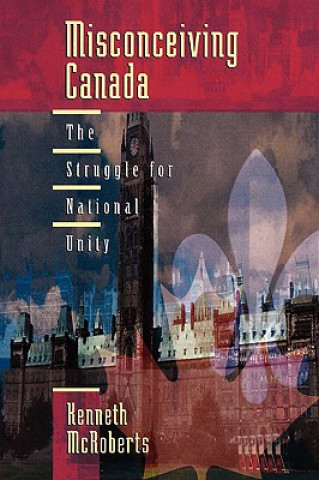
Misconceiving Canada
by Kenneth McRoberts
In the fall of 1996, the prospects for Canada looked bleak; of the many unity crises that Canada has known, this one is undoubtedly the worst. The November 1995 referendum on Quebec sovereignty produced the smallest of victories f ... more


- Language:
 English
 - Binding: Paperback
- Number of pages: 412
Publisher: Oxford University Press, Canada, 1997
- More about this


You might also like
-

Loud House #16
12.51 € -9 % -

Reading Heidegger from the Start
40.97 € -

Ils ont osé le dire
17.85 € -

Enlightenment East and West
39.65 € -

Mom and Me Knits
17.15 € -9 % -

O processo de projeto de obras publicas
49.75 € -14 % -

An Evening with Benjamin Franklin and Thomas Jefferson: Dinner, Wine, and Conversation
22.60 € -6 %
Give this book as a present today
- Order book and choose Gift Order.
- We will send you book gift voucher at once. You can give it out to anyone.
- Book will be send to donee, nothing more to care about.
More about Misconceiving Canada
You get 127 loyalty points
 Book synopsis
In the fall of 1996, the prospects for Canada looked bleak; of the many unity crises that Canada has known, this one is undoubtedly the worst. The November 1995 referendum on Quebec sovereignty produced the smallest of victories for the forces of federalism: 0.06 per cent or 54,288 votes; it could easily have gone the other way. Moreover, surveys have regularly indicated that in a new referendum the Yes vote could prevail. If there ever was a last chance for Canada this would seem to be it. This book begins by exploring the deep historical roots of the conception of Canada that Trudeau and his colleagues tried to change. The book then moves on to examine how successive governments tried to re-examine the relationship between Quebec and the rest of the country. McRoberts examines the role of the Trudeau government, official bilingualism, multiculturalism, the Mulroney era, and the failures of both the Meech Lake and the Charlottetown Accords. The final chapter of the book examines the 1995 Quebec referendum with its near victory of the Yes vote, which can only be seen as proof of the failure of the Trudeau strategy, and the current federal government's failure to deliver meaningfully on promises made during the referendum. The conclusion begins with a review of this critical reassessment of the strategy and its consequences for Canada. It then maps out some of the routes to resolving the crisis that became available once that strategy has been abandoned: formalizing asymmetry within Canadian federalism, revising language policy on a territorial basis, recasting Canada as a multinational confederation, and so on. Whether any of this can be done, however, is an open question. Yet if Quebec should opt for sovereignty it will be important to remember that Canadians and Quebecois are not naturally the worst of enemies as some have claimed, and would still have common interests that needed protection. This volume will explore ways to doing this. In the last analysis, as this book shows, a vote for sovereignty is not inevitable but would be the result of errors and miscalculations that were made, often with the best of intentions, by our political class. In particular, it would have stemmed from a national unit strategy that was based on a misconception of Canada.
Book details
Book category Books in English Society & social sciences Politics & government Political ideologies
52.57 €
- Full title: Misconceiving Canada
- Subtitle: The Struggle for National Unity
- Author: Kenneth McRoberts
- Language: English
- Binding: Paperback
- Number of pages: 412
- EAN: 9780195412338
- ISBN: 0195412338
- ID: 04864206
- Publisher: Oxford University Press, Canada
- Weight: 579 g
- Dimensions: 229 × 154 × 23 mm
- Date of publishing: 01. May 1997
Trending among others
-

The Communist Manifesto
4.33 € -11 % -

The Unabomber Manifesto
9.38 € -1 % -

Capital
6.75 € -14 % -

State and Revolution
6.55 € -

Communist Manifesto
7.26 € -24 % -

Capital
10.39 € -24 % -

Capital
17.05 € -24 % -

Rights of Man, Common Sense, and Other Political Writings
8.67 € -29 % -

Czechoslovak Arms Exports to the Middle East Volume 5
21.08 € -25 % -

Capital
16.95 € -24 % -

Reform or Revolution and Other Writings
12.71 € -25 % -

Capital
15.63 € -24 % -

Enquiry Concerning Political Justice
12.71 € -24 % -

Notes on Nationalism
3.72 € -24 % -

Anarchism and Other Essays
12 € -24 % -

Democratic Paradox
16.14 € -17 % -
Economic & Philosophic Manuscripts of 1844
12.81 € -

Communist Manifesto and Das Kapital
9.28 € -17 % -

Libertarianism
12.71 € -24 % -

Critique of the Gotha Program
14.83 € -1 % -

Nationalism
8.67 € -25 % -
Blackshirts and Reds
12.71 € -24 % -

Imperialism the Highest Stage of Capitalism
6.85 € -

The Communist Manifesto
2.11 € -5 % -
![What Is to Be Done? [Burning Questions of Our Movement]](https://media.libris.to/jacket/08800888t.jpg "What Is to Be Done? [Burning Questions of Our Movement]")
What Is to Be Done? [Burning Questions of Our Movement]
7.46 € -

Imagined Communities
17.45 € -

Grundrisse
17.15 € -26 % -

Road to Serfdom
15.43 € -25 % -
Rules for Radicals
14.83 € -24 % -

Essential Rosa Luxemburg
16.44 € -12 % -

Old Is Dying and the New Cannot Be Born
12.30 € -18 % -

Prison Notebooks
104.35 € -

For Marx
23.61 € -18 % -

Translating Anarchy - The Anarchism of Occupy Wall Street
21.39 € -17 % -

Origins and Doctrine of Fascism
67.81 € -

Anatomy of Fascism
12.51 € -28 % -

Hitler 1936-1945
20.07 € -28 % -

Hitler 1889-1936
21.39 € -24 % -

Anti-Duhring
18.86 € -25 % -

What Is Populism?
10.49 € -29 % -
Capitalism, Socialism and Democracy
12.30 € -

Economic and Philosophic Manuscripts of 1844
8.67 € -10 % -

Why Marx Was Right
13.51 € -24 % -

Fascism
6.05 € -

Inside The Third Reich
19.47 € -27 % -

Liberalism
12.81 € -12 % -
ABCs of Socialism
11.70 € -26 % -
Critique of the Gotha Program
10.28 € -2 % -

Superpatriotism
14.02 € -25 %
Collection points Bratislava a 12812 dalších
Copyright ©2008-26 najlacnejsie-knihy.sk All rights reservedPrivacyCookies

 25628 collection points
 Delivery 2.99 €
 02/210 210 99 (8-15.30h)