Code: 01915514
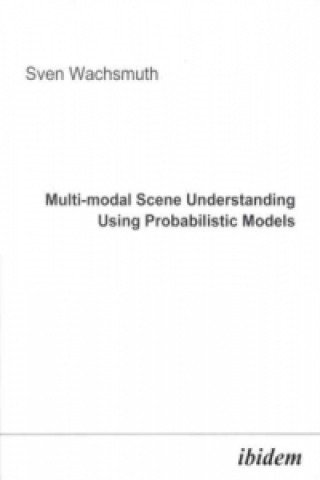
Multi-modal Scene Understanding Using Probabilistic Models
by Sven Wachsmuth
How do we explain a picture to another person? We talk about the picture, describe the colors, shapes, and objects in it, mention how different objects are related to each other. How do we explain a verbal statement? We show a pic ... more


- Language:
 English
 - Binding: Paperback
- Number of pages: 204
Publisher: ibidem, 2005
- More about this

29.18 €
RRP: 32.42 €
You save 3.24 €
Availability:
50/50 We think title might be available. Upon your order we will do our best to get it within 6 weeks.
We search the world
You might also like
-

Kurosagi Corpse Delivery Service: Book Five Omnibus
19.65 € -21 % -

TNM Supplement
50.26 € -2 % -

Grey Fairy Book
11.34 € -24 % -

Clothes To Sew For 11 1/2" Fashion Dolls, Volume 1
26.44 € -

Five Tuesdays in Winter
10.33 € -28 % -

Le favole di Esopo e Fedro
20.56 € -9 % -

My Paris Kitchen
24.62 € -26 % -

Jordan Peterson, God, and Christianity: The Search for a Meaningful Life
27.15 € -9 % -

Political Testament of Cardinal Richelieu
46.10 € -

Big Data - Using SMART Big Data, Analytics and Metrics To Make Better Decisions and Improve Performance
17.12 € -24 % -

Boy Who Could See Demons
28.27 € -

Typodarium 2015
22.39 € -

Meal in a Mug
18.13 € -9 % -

Ravensburger Puzzle 12000220 - Löwen in der Savanne - 500 Teile Puzzle für Erwachsene und Kinder ab 10 Jahren, Puzzle mit Löwen-Motiv
12.46 € -9 % -

Wróżenie z wnętrzności
9.41 € -2 % -

Love and Vandalism
9.62 € -21 % -

Kunstvermittlung für Menschen mit Demenz
25.02 € -4 % -

Average Height of Flight
14.58 € -22 % -

Miracle on Ice
9.72 € -9 % -

Southeast Asia and the Rise of China
225.08 € -

Backyard Volcano
14.68 € -17 % -

Siegen gegen Sizilianisch - die pfiffige Python
28.16 € -7 % -
Iulius Paulus: Ad edictum libri IV-XVI
267.04 € -

Innocent Blood
29.58 € -

An Introduction to Modern Variational Techniques in Mechanics and Engineering
50.66 € -9 % -

Todo lo que necesitas saber sobre Cloud Computing: Conoce todos sobre el trabajo en la Nub
9.82 € -6 % -

Law of Evidence, by Lord Chief Baron Gilbert. Considerably Enlarged by Capel Lofft, ... Volume 3 of 4
23.60 € -25 % -

Mis esploraciones y descubrimientos en la Patagonia, 1877-80. With map
19.45 € -25 % -

Album 50-lecia Klubu Kultury im. Heleny Modrzejewskiej
50.97 € -1 % -

Amtsmannvertreibungen in Baden Im Marz Und April 1848
134.58 € -4 % -

Cinders
8.71 € -10 % -

Emotional Influences on Sport Event Marketing
49.04 € -2 % -

Language: Usage and Practice, Grade 3
12.46 € -17 % -

Reunion Publique Tenue A Libourne, Le 8 Mai 1870, A l'Occasion Du Plebiscite
12.15 € -1 % -

Embedded Software and Systems
109.54 € -

Angel heart
20.06 € -

Esposa de Guardia
17.22 € -14 % -

What GOOD Administrators Do to LEAD Great Schools: Basic First Aid procedures for School Staff
8.10 € -7 % -

CARMELINA SANCHEZ CUTILLAS OBRA COMPLETA II. PROSA
71.34 € -

Constructivism and Education
124.65 € -

Four Thorns of Kilimanjaro
13.37 € -25 % -

How to Help a Monster and Learn Confidence (Bedtime story about a Boy and his Monster Learning Self Confidence, Picture Books, Preschool Books, Kids A
15.80 € -1 % -

In Life We But Wonder
16.61 € -

Ion Channels
151.30 € -9 % -

Irish Yearbook of International Law, Volume 6, 2011
186.57 € -4 % -

BRZRKR TOMO Nº 02/03
24.62 € -
RAPSODIE
66.17 € -

Clara's Clever Custard
11.34 € -

Political Economy of Regulation
110.66 € -

Kater Schnurz im Märchenland
11.04 € -15 % -

Dispute Settlement Reports 2005
252.54 € -

Broken Angels Can't Fly
22.49 € -2 % -

Sokratische Pädagogik
33.23 € -

BLEEDING ARMENIA;
37.39 € -1 % -

Divine Intervention: Is What You Need!
14.08 € -6 % -

Executive Guide to Healthcare Kaizen
265.21 € -

Shadowscent
26.44 € -

Two Years Before the Mast and Twenty-Four Years After
34.65 € -2 % -

Stem Cell Biology Basic Concepts to Frontiers Students Edition
59.07 € -7 % -

Neither Donkey nor Horse
31.71 € -

Sex After Your 32nd Anniversary
9.82 € -6 % -

Patrologiae Cursus Completus: Seu Bibliotheca Universalis, Integra, Uniformis, Commoda, Oeconomica, Omnium SS. Patrum, Doctorum Scriptorumque Eccles
32.83 € -2 % -

Biological Sequence Analysis Using the SeqAn C++ Library
293.18 € -

Kellory the Warlock
14.89 € -1 % -

More Than Petticoats: Remarkable Kentucky Women
13.98 € -9 % -

Monster Anthropology in Australasia and Beyond
106.50 € -4 % -

Legal Property Relations of Married Parties
30.09 € -2 % -

France and Ireland
62.11 € -10 % -

München Mord - Wir sind die Neuen, 1 DVD
16.31 € -
Functional Grammar in the ESL Classroom
108.53 €
Give this book as a present today
- Order book and choose Gift Order.
- We will send you book gift voucher at once. You can give it out to anyone.
- Book will be send to donee, nothing more to care about.
Availability alert
Enter your e-mail address and once book will be available,
we will send you a message. It's that simple.
More about Multi-modal Scene Understanding Using Probabilistic Models
You get 70 loyalty points
 Book synopsis
How do we explain a picture to another person? We talk about the picture, describe the colors, shapes, and objects in it, mention how different objects are related to each other. How do we explain a verbal statement? We show a picture which visualizes the content of the utterance, the objects mentioned in it and how they are related. In everyday communication people use various ways in parallel in order to transmit their intention. They point on something, put on a special face, gesticulate, or refer to the common environment of the communication partners.§They use different modalities in order to communicate. It seems to be just natural to use the same way of interaction in humancomputer-interfaces. The consequence is a paradigm shift from passive interfaces, such as mouse clicks or text typing, to an active communication partner that interprets the auditive and visual environment, draws inferences using background knowledge, and requests missing information. Subsequently, such an active human-computer-interface will be called artificial communicator. However, the automatic interpretation of signals of a separate input modality, such as speech understanding, gesture recognition, or visual object recognition are only one part of the total. In order to build systems which communicate with people in a natural way, the integration of modalities is an essential task that is not trivial. Each modality has its own vocabulary and expressiveness. Pointing defines a region or direction of interest, a special face may represent an emotional feeling, speech understanding provides qualitative facts about the world, and vision perceives and interprets analogous shapes in the world. I think it is not questionable that different formalisms are needed for processing different modalities, and, indeed, this is the the fact in the current state of the art (see Sec. 2.2,2.3). The question is, and this thesis will be an experimental study in this topic, what is the most promising formalism to integrate the results of the specialized processing components of such a multi-modal system or artificial communicator? How should the individual components of the system be connected, and how should the processing be organized? This thesis will give an innovative answer to these questions and present a realization in a particular domain.
Book details
29.18 €
- Full title: Multi-modal Scene Understanding Using Probabilistic Models
- Author: Sven Wachsmuth
- Language: English
- Binding: Paperback
- Number of pages: 204
- EAN: 9783898212717
- ID: 01915514
- Publisher: ibidem
- Weight: 280 g
- Published: 2005
Trending among others
-

Moonwalk
14.08 € -18 % -

The Score
13.77 € -12 % -

The Deal
12.35 € -21 % -

The Mistake
14.48 € -

Jujutsu Kaisen, Vol. 30
9.41 € -24 % -

Berserk Deluxe Volume 1
35.66 € -25 % -

The Goal
14.58 € -7 % -

Invincible Compendium Volume 2
55.22 € -33 % -

Berserk Deluxe Volume 2
33.13 € -31 % -

Witch Hat Atelier: Grimoire Edition 1
34.65 € -29 % -

Lord of Mysteries, Vol. 3: The Clown, Part III
14.99 € -24 % -

Murdoku
14.28 € -30 % -

Legacy
11.95 € -24 % -

Moonwalk: A Memoir
19.95 € -31 % -

Jujutsu Kaisen, Vol. 25
9.72 € -25 % -

JoJo's Bizarre Adventure: Part 7--Steel Ball Run, Vol. 7
18.23 € -25 % -

Witch Hat Atelier Manga Box Set 1
51.37 € -31 % -

Heated Rivalry
12.56 € -7 % -

White Nights
4.75 € -11 % -

Jujutsu Kaisen, Vol. 26
9.31 € -25 % -

Berserk Deluxe Volume 3
55.02 € -

Jujutsu Kaisen, Vol. 29
9.92 € -20 % -

Invincible Compendium Volume 1
48.33 € -21 % -

The Deal
13.77 € -26 % -

Invincible Compendium Volume 3
48.33 € -21 % -

Veil Volume 1
13.16 € -22 % -

The Long Game
13.06 € -4 % -

Murdoku
14.68 € -22 % -

Berserk Deluxe Volume 5
54.72 € -

Yesteryear
16 € -25 % -

Chainsaw Man, Vol. 21
9.92 € -20 % -

Jujutsu Kaisen, Vol. 28
9.72 € -25 % -

The Summer Hikaru Died, Vol. 7
12.25 € -30 % -

Boys Omnibus Vol. 1 TPB
26.34 € -38 % -

The Ballad of Falling Dragons
14.18 € -14 % -

Berserk Deluxe Volume 4
43.57 € -17 % -

Jujutsu Kaisen, Vol. 1
12.66 € -2 % -

The Mistake
13.77 € -26 % -

Project Hail Mary
10.53 € -14 % -

The Score
14.68 € -22 % -

Invincible Volume 1
10.43 € -21 % -

Lord of Mysteries, Vol. 1: The Clown, Part I
14.89 € -24 % -

Starside (Deluxe Limited Edition)
23.70 € -29 % -

The Courage To Be Disliked
10.63 € -14 % -

King of Gluttony
10.12 € -25 % -

Jojo's Bizarre Adventure: Part 7--Steel Ball Run, Vol. 1
18.33 € -24 % -

Jojo's Bizarre Adventure: Part 7--Steel Ball Run, Vol. 2
18.94 € -22 % -

Veil Volume 2
12.05 € -25 % -

The Score (Collector's Edition)
22.18 € -29 %
Collection points Bratislava a 12782 dalších
Copyright ©2008-26 najlacnejsie-knihy.sk All rights reservedPrivacyCookies

 25568 collection points
 Delivery 2.99 €
 02/210 210 99 (8-15.30h)