Code: 04914419
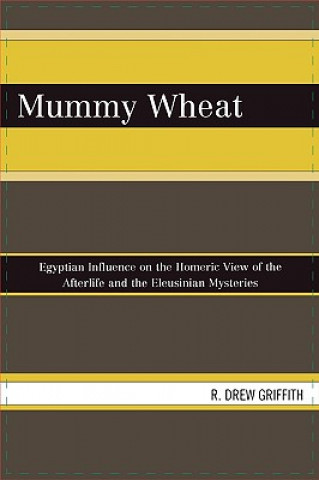
Mummy Wheat
by R. Drew Griffith
Homer presents a world-view in which death represents the end of consciousness and total annihilation of personhood. Yet in Odyssey, Book Four, he contradicts this by saying that one man at least will not die, but will be transpor ... more


- Language:
 English
 - Binding: Paperback
- Number of pages: 272
Publisher: University Press of America, 2008
- More about this


You might also like
-
Computer Science Distilled
23.71 € -2 % -

Shades of Gray
14.73 € -25 % -

Turner and Constable
33.70 € -24 % -

Alphabreaths
14.02 € -25 % -

Samolepící bločky žluté CUBO 75x75 / 400 lístků v bločku
2.21 € -32 % -

The Complete Office of Holy Week in Latin and English: According to the Roman Missal and Breviary
22.50 € -7 % -

Self in Jungian Psychology
31.88 € -2 % -

You Can't Smell a Flower With Your Ear!
5.14 € -24 % -

Jesus Christ, The True Temple of God
19.77 € -1 % -
Road that Is Not a Road and the Open City, Ritoque, Chile
40.36 € -

Femení singular
12.20 € -5 % -

Industrial Decarbonization and the Energy Transition
217.89 € -

Global Competitiveness Report 2004-2005
102.03 € -

Porfiri Ivanov, Russia's Naturalist Healer
10.28 € -2 % -

Gol 37. Un reto casi imposible
12.91 € -
Untold Mayhem
10.59 € -25 % -

Anne's House of Dreams
7.66 € -24 % -
In The Company Of Light
13.11 € -18 % -

Springfield
19.57 € -21 % -

Der Klassik(ver)führer, Wagner: Parsifal, 2 Audio-CDs
20.78 € -17 % -

Fault of Sages
11.50 € -7 % -

Planning and Transformation
88.50 € -

Lineage of the Saints
18.26 € -7 % -

How to Heal from Psychic Attack: The Problem Solvers Alphabet
18.26 € -7 % -

Anna of the Five Towns
7.36 € -7 % -

Popular Protest in the New Middle East
114.54 € -

Kolibris Und Jumbo-Jets
43.39 € -7 % -

Economic Development in the Americas since 1500
48.54 €
Give this book as a present today
- Order book and choose Gift Order.
- We will send you book gift voucher at once. You can give it out to anyone.
- Book will be send to donee, nothing more to care about.
More about Mummy Wheat
You get 184 loyalty points
 Book synopsis
Homer presents a world-view in which death represents the end of consciousness and total annihilation of personhood. Yet in Odyssey, Book Four, he contradicts this by saying that one man at least will not die, but will be transported to Elysium, where he will have a blessed existence forever. In Mummy Wheat R. Drew Griffith argues that this shocking violation of Homer's normal world-view comes from Egypt, where more than anywhere else in the ancient world people firmly believed in life after death. This Egyptian view entered Homer deeply enough that traces of it can be found in many facets of his poetic language. Finally, Griffith argues, the Elysium idea did not die with Homer, but became enshrined in one of the most influential and long-lived religious traditions of Greece: the mysteries of Demeter at Eleusis outside of Athens.
Book details
Book category Books in English Literature & literary studies Literature: history & criticism Literary studies: general
75.69 €
- Full title: Mummy Wheat
- Subtitle: Egyptian Influence on the Homeric View of the Afterlife and the Eleusinian Mysteries
- Author: R. Drew Griffith
- Language: English
- Binding: Paperback
- Number of pages: 272
- EAN: 9780761842989
- ISBN: 0761842985
- ID: 04914419
- Publisher: University Press of America
- Weight: 408 g
- Dimensions: 231 × 154 × 20 mm
- Date of publishing: 18. September 2008
Trending among others
-

How to Read a Book
14.62 € -7 % -

Moveable Feast
8.57 € -30 % -

Count of Monte Cristo
10.18 € -29 % -
Odyssey
10.18 € -23 % -

Germinal
7.16 € -25 % -
Plainwater
14.02 € -25 % -
Idiot
9.28 € -24 % -
Consolation of Philosophy
11.80 € -25 % -

Sir Gawain and The Green Knight
8.57 € -24 % -

Bleak House
9.07 € -30 % -

Selected Journals of L. M. Montgomery: Volume I: 1889-1910
31.38 € -
Complete Plays of Sophocles
6.95 € -26 % -
Mimesis
20.28 € -24 % -

David Copperfield
10.59 € -25 % -

Boyhood
10.59 € -28 % -

Mysteries of Udolpho
10.18 € -35 % -

Art of Memoir
14.02 € -25 % -

Pride and Prejudice
14.12 € -4 % -
Republic
33.80 € -

Vladimir Nabokov
60.55 € -

Our Mutual Friend
9.07 € -30 % -

Woodlanders
9.68 € -26 % -

Unimaginable Mathematics of Borges' Library of Babel
32.19 € -

Vladimir Nabokov
53.28 € -

Macrobii Ambrosii Theodosii Saturnalia
64.28 € -

Economy of the Unlost
36.32 € -2 % -
Awakening
20.78 € -
Republic
33.90 € -

Fitzgerald: The Love of the Last Tycoon
35.82 € -

Weird Realism - Lovecraft and Philosophy
18.86 € -9 % -

Apollodorus' Library and Hyginus' Fabulae
22.90 € -9 % -

Stanze of Angelo Poliziano
39.45 € -

Portable Edgar Allan Poe
15.84 € -29 % -

Pickwick Papers
9.28 € -24 % -

Love Itself - In the Letterbox
22.19 € -

Weird and the Eerie
13.41 € -

The Picture of Dorian Gray
7.16 € -29 % -
Dubliners
8.97 € -29 % -

Karamazov Brothers
9.78 € -31 % -

Zofloya or The Moor
10.39 € -24 % -
Metamorphoses
7.16 € -25 % -

Saga of Tanya the Evil, Vol. 3
12.20 € -14 % -

SEOUL University Korean 1B Workbook (QR), m. 1 Audio
34 € -
Art of Rhetoric
4.53 € -24 % -
Edda
7.86 € -24 % -
If Not, Winter: Fragments Of Sappho
18.06 € -25 % -

Iliad
15.63 € -24 % -

Simple Passion
7.46 € -30 % -

SEOUL University Korean 1B Student's Book (QR), m. 1 Audio
49.95 €
Collection points Bratislava a 12833 dalších
Copyright ©2008-26 najlacnejsie-knihy.sk All rights reservedPrivacyCookies

 25670 collection points
 Delivery 2.99 €
 02/210 210 99 (8-15.30h)