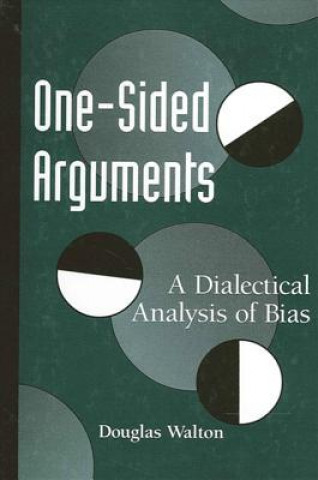
Code: 04700612
One-Sided Arguments
by Douglas N. Walton
We often feel that an argument should be doubted or held as suspicious because it has a bias. But bias isn't always wrong. It is a normal phenomenon in advocacy argumentation, and in many cases it is to be expected. Yet sometimes ... more


- Language:
 English
 - Binding: Paperback
- Number of pages: 295
Publisher: State University of New York Press, 1999
- More about this

34.27 €
Availability:
50/50 We think title might be available. Upon your order we will do our best to get it within 6 weeks.
We search the world
You might also like
-

Mengele
14.45 € -22 % -

Al Qaeda, the Islamic State, and the Global Jihadist Movement
12.73 € -24 % -

Talking and Doing Science in the Early Years
239.63 € -

From Religion to Philosophy
61.67 € -

Black Los Angeles
117.49 € -
Management Accounting for Hotels and Restaurants
254.30 € -

Conserving Living Natural Resources
164.50 € -

Landmark Cases in Property Law
146.91 € -

Reluctant Modernist
52.87 € -9 % -

Accident, Suicide, or Murder
14.85 € -24 % -

Cours d'histoire moderne
53.88 € -

Menschen der Ehe
11.72 € -10 % -

Being Haiku
13.74 € -
Development and Diffusionism
53.28 € -4 %
Give this book as a present today
- Order book and choose Gift Order.
- We will send you book gift voucher at once. You can give it out to anyone.
- Book will be send to donee, nothing more to care about.
Availability alert
Enter your e-mail address and once book will be available,
we will send you a message. It's that simple.
More about One-Sided Arguments
You get 83 loyalty points
 Book synopsis
We often feel that an argument should be doubted or held as suspicious because it has a bias. But bias isn't always wrong. It is a normal phenomenon in advocacy argumentation, and in many cases it is to be expected. Yet sometimes bias can be quite harmful in argumentation. In this book, bias is defined as one-sided advocacy of a point of view in argumentation. It is shown to be harmful, or properly subject to critical condemnation, only when the dialogue exchange is supposed to be a balanced, two-sided exchange of viewpoints.The book concedes the postmodernist premise that bias is quite normal in everyday conversational arguments, and that a finding of bias should not, by itself, constitute grounds for criticizing an argument as critically deficient or fallacious. But the book strongly disagrees with the postmodernist conclusion that no standard of rationality can be brought to bear to condemn narrowly interest-based or one-sided arguments as biased. It is argued that in some cases narrow, one-sided partisanship in an argument is justifiably a basis for negative criticism of the worth of the argument.
Book details
Book category Books in English Humanities Philosophy History of Western philosophy
34.27 €
- Full title: One-Sided Arguments
- Subtitle: A Dialectical Analysis of Bias
- Author: Douglas N. Walton
- Language: English
- Binding: Paperback
- Number of pages: 295
- EAN: 9780791442685
- ID: 04700612
- Publisher: State University of New York Press
- Weight: 426 g
- Dimensions: 228 × 151 × 17 mm
- Date of publishing: 12. August 1999
Trending among others
-

Why I Am so Clever
3.83 € -22 % -

Meditations
8.18 € -30 % -

The Myth of Sisyphus
9.90 € -14 % -
The Republic
10.30 € -22 % -
Nausea
11.62 € -26 % -

Beyond Good and Evil
10.20 € -27 % -
Letters from a Stoic
10.91 € -24 % -
Discourses and Selected Writings
11.21 € -24 % -
Thus Spoke Zarathustra: A Book for Everyone and No One
11.01 € -30 % -
Simulacra and Simulation
21.43 € -

On the Shortness of Life
7.88 € -29 % -

Aphorisms on Love and Hate
4.03 € -17 % -

Phenomenology of Spirit
17.58 € -24 % -

Fear and Trembling
11.92 € -24 % -
The Nicomachean Ethics
10.40 € -30 % -
The Symposium
8.58 € -25 % -

Either/Or
14.85 € -30 % -

The Sickness Unto Death
11.62 € -26 % -
On the Genealogy of Morals
9.70 € -34 % -

The Spell of the Sensuous
13.13 € -30 % -

Intellectual Life
16.78 € -25 % -

On the Heights of Despair
31.64 € -

Fear and Trembling and The Sickness Unto Death
11.32 € -24 % -

Critique of Pure Reason
16.17 € -25 % -
Nicomachean Ethics
11.11 € -14 % -

Leviathan
7.17 € -9 % -

Timaeus and Critias
9.90 € -25 % -

Consolations of Philosophy
12.93 € -30 % -

Meditations and Other Metaphysical Writings
13.74 € -

Candide and Other Stories
6.56 € -24 % -

Thus Spoke Zarathustra
8.99 € -14 % -

At The Existentialist Cafe
14.85 € -15 % -
Last Days of Socrates
10.61 € -25 % -

Beelzebub's Tales to His Grandson
25.07 € -25 % -

Concept of Anxiety
13.54 € -24 % -
First Philosophers
11.82 € -25 % -

How to Be a Leader
14.75 € -25 % -

Essays and Aphorisms
16.27 € -29 % -

Selected Writings
13.44 € -24 % -

Complete Works of Aristotle, Volume 2
67.74 € -11 % -

Complete Works of Aristotle, Volume 1
67.74 € -11 % -
Meno and Other Dialogues
8.58 € -24 % -
Theaetetus
12.02 € -24 % -

Leviathan
14.35 € -
Discourses, Fragments, Handbook
11.42 € -27 % -

What IS Sex?
19.91 € -19 % -
Enneads
15.46 € -25 % -
Letters on Ethics - To Lucilius
49.13 € -
Meditations on First Philosophy
7.88 € -25 %
Collection points Bratislava a 12832 dalších
Copyright ©2008-26 najlacnejsie-knihy.sk All rights reservedPrivacyCookies

 25668 collection points
 Delivery 2.99 €
 02/210 210 99 (8-15.30h)