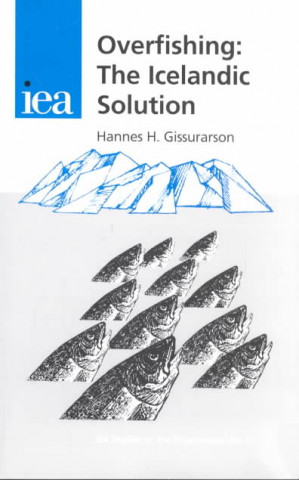
Code: 04560052
Overfishing
by Hannes H. Gissurarson
In this monograph, Professor Gissurarson explains the Icelandic model of fisheries management, Individual Transferable Share Quotas (ITQs), implemented in 1979 to reverse the decline in Icelandic fish stocks. Access to Icelandic f ... more


- Language:
 English
- Binding: Hardback
- Number of pages: 68
Publisher: Institute of Economic Affairs, 2000
- More about this

12.86 €
RRP: 14.31 €
You save 1.44 €
Availability:
50/50 We think title might be available. Upon your order we will do our best to get it within 6 weeks.
We search the world
You might also like
-

47 Ronin
15.98 € -2 % -

Friendly Approach To Complex Analysis, A
80.55 € -

Valašský král
6.23 € -5 % -

Why Victorian Literature Still Matters
91.01 € -9 % -

Bass Wisdom
14.17 € -17 % -

Il potere del linguaggio. Comunicare in modo efficace per ottenere risultati migliori
16.59 € -9 % -

Der Bro Code - Das Playbook
14.67 € -2 % -

Vicodin Thieves
16.59 € -9 % -

Banken und Kunst
16.99 € -10 % -

Thomas Aquinas on God and Evil
159.91 € -

CONTROL APLICADO CON VARIABLES DE ESTADO (2.ª EDICION) (ACCE
8.64 € -

Serious Games und Gamification in der schulischen Bildung
105.19 € -4 % -

COCINA DEL JABALÍ
14.67 € -10 % -

valigia della memoria. Ricordi di prigionia di un internato militare italiano
25.04 € -9 % -

Gestion d'entreprise agricole durable
48.67 € -14 % -

Das Recht und seine historischen Grundlagen
220.05 € -

Historical Origins of International Criminal Law
50.28 € -25 % -

Ncert Solutions Science for Class 7th
36 € -10 % -

Athera's Dawn: The White Lion Chronciles, Book 3
18.70 € -7 % -

Rudan Mi-Bheanailteach Is an Cothroman, Dain
15.08 € -2 % -

Sendero de la Verdad, Libro 9
14.67 € -1 %
Give this book as a present today
- Order book and choose Gift Order.
- We will send you book gift voucher at once. You can give it out to anyone.
- Book will be send to donee, nothing more to care about.
Availability alert
Enter your e-mail address and once book will be available,
we will send you a message. It's that simple.
More about Overfishing
You get 31 loyalty points
 Book synopsis

In this monograph, Professor Gissurarson explains the Icelandic model of fisheries management, Individual Transferable Share Quotas (ITQs), implemented in 1979 to reverse the decline in Icelandic fish stocks. Access to Icelandic fisheries was traditionally open to all. In the 1960s and 1970s excessive catches of herring and then cod led to a decline in stocks of these important species in Iceland's waters. In response, Iceland's government imposed restrictions on the number of days trawlers could put to sea to catch certain species. This led to fishing Derbies, where fishermen competed to catch as many fish as possible in the limited time available. Inevitably, catches continued to exceed sustainable levels. Starting in 1979, the Icelandic government gradually introduced a system of individual transferable share quotas (ITQs), which essentially give boat owners the right to catch a specific proportion of the total allowable catch (TAC) of certain species. If a boat owner does not wish to use all his ITQ he can sell part of it to someone else. This encourages more efficient use of the capital invested in boats and equipment. Because ITQs entitle their owners to a specific share of the future stock of fish, they create incentives to ensure that stocks are sustainable. Since the introduction of ITQs, capital invested in Icelandic fisheries (boats and equipment) has been gradually falling and catches have fallen to sustainable levels, whilst the value of catches has risen. Because of the success of the ITQ system and the wealth it has created, there is now political pressure for an imposition of a resource rent tax. But such a tax would be contrary to the interests of effective conservation of fish stocks. A more appropriate next step would be to introduce a cost-recovery charge and, as a quid pro quo, give ITQ owners greater say in the administration and enforcement of the system. Owners of ITQ would have stronger incentives to ensure that catch levels were set at the economically optimal level.
Book details
Book category Books in English Economics, finance, business & management Economics
12.86 €
- Full title: Overfishing
- Subtitle: The Icelandic Solution
- Author: Hannes H. Gissurarson
- Language: English
- Binding: Hardback
- Number of pages: 68
- EAN: 9780255364898
- ISBN: 025536489X
- ID: 04560052
- Publisher: Institute of Economic Affairs
- Weight: 124 g
- Dimensions: 219 × 137 × 6 mm
- Date of publishing: 20. October 2000
Trending among others
-

Why Nations Fail
14.37 € -17 % -

Liar's Poker
13.47 € -

Misbehaving - The Making of Behavioral Economics
12.16 € -14 % -

Phishing for Phools
15.78 € -25 % -

Irrational Exuberance
16.79 € -26 % -

Economic Facts and Fallacies
15.08 € -25 % -

(Mis)Behaviour of Markets
13.87 € -24 % -

Analysis of Karen Z. Ho's Liquidated
10.55 € -
Principles for Dealing with the Changing World Order
25.33 € -22 % -

Economics: The User's Guide
13.17 € -26 % -

Essential Mathematics for Economic Analysis
86.79 € -
Economics In One Lesson
15.08 € -25 % -

Art of Statistics
16.69 € -6 % -

Price of Inequality
11.86 € -2 % -

Hypomanic Edge
20.61 € -10 % -

Complete Guide to Starting a Paintless Dent Repair Business
33.38 € -

Freakonomics
7.13 € -29 % -

J R
22.12 € -24 % -

Capitalism, Socialism, and Democracy
15.38 € -23 % -
New World Economy: A Beginner's Guide
13.97 € -26 % -

How I Made One Million Dollars Last Year Trading Commodities
36.20 € -25 % -
Necessary but Not Sufficient
15.08 € -25 % -

Scrum - A Pocket Guide - 3rd edition
19 € -19 % -

Decision Book
13.67 € -24 % -

Econometric Analysis, Global Edition
83.67 € -14 % -

Rise of Carry: The Dangerous Consequences of Volatility Suppression and the New Financial Order of Decaying Growth and Recurring Crisis
26.24 € -24 % -

How Rich Countries Got Rich and Why Poor Countries Stay Poor
18.50 € -20 % -

Economics
336.82 € -

Further Mathematics for Economic Analysis
121.79 € -

Economic Way of Thinking, The
89.10 € -19 % -

Market as an Economic Process
11.56 € -25 % -

Future Is Asian
22.12 € -24 % -

Losing an Enemy
30.97 € -7 % -

Political Economy of Health and Healthcare
40.02 € -

Europe's Orphan
25.84 € -4 % -

Predictably Irrational
15.08 € -25 % -

Debt, 10th Anniversary Edition
25.64 € -25 % -

Misbehavior of Markets
22.72 € -

Undercover Economist Strikes Back
12.86 € -30 % -

Rational Optimist
10.75 € -29 % -

Breakthrough Copywriter
19.70 € -1 % -

Misbehaving - The Making of Behavioral Economics
25.64 € -25 % -

Economics Rules - The Rights and Wrongs of the Dismal Science
12.76 € -29 % -

Principles of Economics
14.17 € -18 % -

Home Economics
14.17 € -21 % -

Start-Up Nation
9.95 € -18 % -

Richest Man in Babylon
30.16 € -9 % -

Armchair Economist
11.76 € -24 % -

Applied Economics
44.85 €
Collection points Bratislava a 13376 dalších
Copyright ©2008-26 najlacnejsie-knihy.sk All rights reservedPrivacyCookies

 26756 collection points
 Delivery 2.99 €
 02/210 210 99 (8-15.30h)
