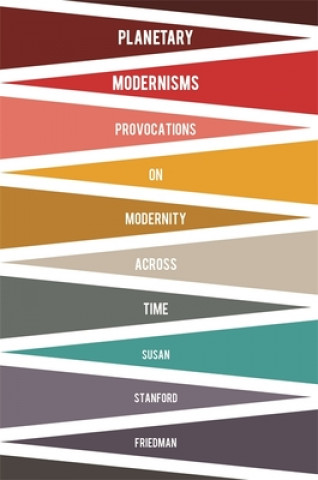
Code: 09084014
Planetary Modernisms
by Susan Stanford Friedman
Drawing on a vast archive of world history, anthropology, geography, cultural theory, postcolonial studies, gender studies, literature, and art, Susan Stanford Friedman recasts modernity as a networked, circulating, and recurrent ... more


- Language:
 English
 - Binding: Hardback
- Number of pages: 472
Publisher: Columbia University Press, 2015
- More about this


You might also like
-

Magnum Contact Sheets
55.84 € -11 % -

Warcraft: Lord of the Clans
13.35 € -15 % -

Look Inside Jobs
13.04 € -9 % -

Brzechwa dzieciom
9.30 € -21 % -

Collected Poems 1934-1952
5.15 € -30 % -

L'Impressionnisme et la sculpture
13.04 € -

My Very First Our World Book
10.11 € -29 % -

ADHD u dorosłych
8.99 € -21 % -

Tešíme sa na Vianoce
16.58 € -26 % -

B-52 Stratofortress vs SA-2 "Guideline" SAM
15.27 € -19 % -

Principles of Neurobiology
106.23 € -

Fanciful Fox Mosaic Color By Number Book
9.80 € -6 % -

Innovation
18.10 € -24 % -

Whispering Land
21.74 € -

Učíme sa násobiť a deliť
4.95 € -23 % -

For a Muse of Fire
9.10 € -25 % -

Thrift
15.77 € -9 % -

Colour Atlas of Tropical Dermatology and Venerology
151.05 € -9 % -

Grapes and Wine: A Visit to the Principal Vineyards of Spain and France: Giving A Minute Account of the Different Methods Pursued in th
30.04 € -2 % -

Unverhofft kommt oft
12.64 € -10 % -

Why We Die
14.76 € -25 % -

De la tranquillité de l'âme
11.83 € -

Quadra
24.17 € -
Philip and Rowena
14.56 € -

My Wife By God's Decree: Sixteen Assumptions About Your Marriage That Change Everything
6.87 € -6 % -

Routledge Creative Writing Coursebook
65.96 € -

Grumpy Cat's NOT-to-Dot Book
7.88 € -25 % -

Lighting the Earth
15.47 € -25 % -

Breathe
11.83 € -24 % -

Neuronal Plasticity: Building a Bridge from the Laboratory to the Clinic
102.99 € -7 % -

George Learns to Prepare for Winter
10.01 € -24 % -

Das Österreichisch-Ngarische Zoll- Und Handelsbündnis
20.43 € -

En El Origen (Edición Bilingüe) / In the Origin (Bilingual Edition)
10.61 € -25 % -

Flower Sings
21.74 € -

Histoire de France, Depuis Les Gaulois Jusqu'a La Fin de la Monarchie, Volume 8
28.02 € -

Self-tuning PID of an activated sludge process by evolution algorithm
32.06 € -14 % -

Grace Overwhelming
90.24 € -10 % -

Manual of Bone Densitometry Measurements
100.76 € -9 % -

Human Rights in International Criminal Proceedings
120.90 € -

Seven Committed Things to Do to Stay Saved
9.80 € -6 % -

Murs & Coutumes Bourgeoises: Liege Sous Le Regime Hollandais, 1820 a 1830...
18.10 € -24 % -

VMware Workstation - No Experience Necessary
42.69 € -2 % -

Memorial Edition of Thomas Bewick's Works Volume 3
28.32 € -1 % -

Misteri ed enigmi nell'archeologia e nell'arte
28.22 € -

Leadership and Authority in China
143.87 € -

Treatise of Human Nature
26.90 € -10 % -

Lie Groups and Lie Algebras - A Physicist's Perspective
110.58 € -

Kun-mkhyen Pad-ma dKar-po's Amitayus Tradition of Vajrayana Buddhist Transformative Care
40.26 € -4 % -

Structural mechanics in reactor technology, Vol.C: Fuel Elements and Assemblies
543.01 € -

The Healer Cat / Բուժող Կատուն
14.76 € -25 % -

Participatory Activist Research in the Globalised World
102.99 € -7 % -

Arthur Papers
58.57 € -

Industrial Waste Fly-Ash as a Fertilizer
55.13 € -14 % -

Leading Me
17.39 € -7 % -

Ami ou ennemi ?
19.82 € -10 % -

Cosa volete davvero per i vostri figli?
24.58 €
Give this book as a present today
- Order book and choose Gift Order.
- We will send you book gift voucher at once. You can give it out to anyone.
- Book will be send to donee, nothing more to care about.
More about Planetary Modernisms
You get 371 loyalty points
 Book synopsis
Drawing on a vast archive of world history, anthropology, geography, cultural theory, postcolonial studies, gender studies, literature, and art, Susan Stanford Friedman recasts modernity as a networked, circulating, and recurrent phenomenon producing multiple aesthetic innovations across millennia. Considering cosmopolitan as well as nomadic and oceanic worlds, she radically revises the scope of modernist critique and opens the practice to more integrated study. Friedman moves from large-scale instances of pre-1500 modernities, such as Tang Dynasty China and the Mongol Empire, to small-scale instances of modernisms, including the poetry of Du Fu and Kabir and Abbasid ceramic art. She maps the interconnected modernisms of the long twentieth century, pairing Joseph Conrad with Tayeb Salih, E. M. Forster with Arundhati Roy, Virginia Woolf with the Tagores, and Aim C saire with Theresa Hak Kyung Cha. She reads postcolonial works from Sudan and India and engages with the idea of N gritude. Rejecting the dominant modernist concepts of marginality, othering, and major/minor, Friedman instead favors rupture, mobility, speed, networks, and divergence, elevating the agencies and creative capacities of all cultures not only in the past and present but also in the century to come.
Book details
Book category Books in English Literature & literary studies Literature: history & criticism Literary theory
153.38 €
- Full title: Planetary Modernisms
- Subtitle: Provocations on Modernity Across Time
- Author: Susan Stanford Friedman
- Language: English
- Binding: Hardback
- Number of pages: 472
- EAN: 9780231170901
- ISBN: 0231170904
- ID: 09084014
- Publisher: Columbia University Press
- Weight: 814 g
- Dimensions: 165 × 236 × 36 mm
- Date of publishing: 18. August 2015
Trending among others
-

Beginning Theory
16.38 € -9 % -

Taz
9.70 € -25 % -
Sincerity and Authenticity
28.32 € -2 % -

Blindness and Insight: Essays in the Rhetoric of Contemporary
27 € -5 % -

Poetic Closure
45.12 € -

Narratology
41.98 € -

Discipline and Punish
14.05 € -25 % -

Dictionary of Critical Theory
25.39 € -

Critique of the Power of Judgment
38.84 € -25 % -

Orality and Literacy
44.81 € -18 % -

Origins of Postmodernity
16.18 € -17 % -

Analysis of Thucydides's History of the Peloponnesian War
9.91 € -
Heterologies
24.58 € -5 % -

Literary Theory: A Very Short Introduction
10.41 € -24 % -

How to Read and Why
13.14 € -29 % -

Ear of the Other
19.32 € -

Analysis of Burton G. Malkiel's A Random Walk Down Wall Street
8.99 € -5 % -
Norton Anthology of Theory and Criticism
109.67 € -

How Fiction Works
11.52 € -29 % -

Analysis of Oliver Sacks's The Man Who Mistook His Wife for a Hat and Other Clinical Tales
10.41 € -

Postmodern Condition
19.01 € -10 % -

Analysis of Gayatri Chakravorty Spivak's Can the Subaltern Speak?
10.41 € -

Analysis of Mary Douglas's Purity and Danger
8.99 € -5 % -

Theory of Literature
22.15 € -

Mirror and the Lamp
28.83 € -

Analysis of Frantz Fanon's The Wretched of the Earth
10.41 € -

Paratexts
39.25 € -

Virginia Woolf and Being-in-the-World
44.10 € -

Distant Reading
19.92 € -18 % -

Storyworlds across Media
36.21 € -

Bloomsbury Anthology of Aesthetics
52.50 € -

Introducing Semiotics
20.02 € -

Theory of Literature and Other Critical Writings
39.55 € -

Politics of Literature
23.77 € -2 % -

Desire in Language
36.31 € -

Philosophy of Literary Form
41.68 € -

Ancients and the Postmoderns
15.17 € -23 % -

Marxism and Form
44.51 € -2 % -

On Moral Fiction
23.26 € -

Heterocosmica
39.85 € -

Mythology in the Modern Novel
57.56 € -
Postmodern Narrative Theory
44.41 € -

Transmedial Narratology and Contemporary Media Culture
36.21 € -

Literary Theory - An Anthology, Third Edition
44 € -4 % -

Literary Theory: A Complete Introduction
14.76 € -25 % -

Analysis of Philip Zimbardo's The Lucifer Effect
10.41 € -

Critical Terms for Literary Study, Second Edition
40.66 € -

Analysis of Jane Jacobs's The Death and Life of Great American Cities
8.99 € -5 % -

On the Origin of Stories
30.65 € -4 %
Collection points Bratislava a 13332 dalších
Copyright ©2008-26 najlacnejsie-knihy.sk All rights reservedPrivacyCookies

 26668 collection points
 Delivery 2.99 €
 02/210 210 99 (8-15.30h)