Code: 04477165
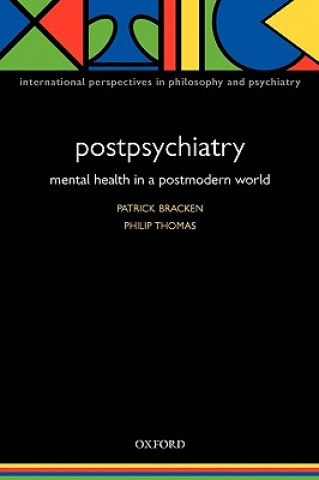
Postpsychiatry
by Bracken
How are we to make sense of madness and psychosis? For most of us the words conjure up images from television and newspapers of seemingly random, meaningless violence. It is something to be feared, something to be left to the expe ... more


- Language:
 English
 - Binding: Paperback
- Number of pages: 312
Publisher: Oxford University Press, 2005
- More about this


You might also like
-

Moonwalk
14.05 € -18 % -

The Score
12.33 € -20 % -

Berserk Deluxe Volume 1
35.89 € -25 % -

The Deal
12.33 € -9 % -

The Mistake
11.32 € -28 % -

Jujutsu Kaisen, Vol. 30
9.70 € -25 % -

Berserk Deluxe Volume 2
36.29 € -31 % -

Dancing The Dream
19.91 € -31 % -

Murdoku
14.65 € -22 % -

Berserk Deluxe Volume 3
55.30 € -

The Goal
12.93 € -16 % -

White Nights
4.54 € -14 % -

Invincible Compendium Volume 2
45.80 € -24 % -

Chainsaw Man, Vol. 21
9.90 € -20 % -

The Legacy
11.92 € -22 % -

Jujutsu Kaisen, Vol. 29
7.67 € -30 % -

Invincible Compendium Volume 3
45.80 € -24 % -

Threshing Day (Wing and Claw Collection)
17.79 € -29 % -

Lord of Mysteries, Vol. 3: The Clown, Part III
17.08 € -13 % -

Berserk Deluxe Volume 5
55 € -

Witch Hat Atelier: Grimoire Edition 1
34.98 € -29 %
Give this book as a present today
- Order book and choose Gift Order.
- We will send you book gift voucher at once. You can give it out to anyone.
- Book will be send to donee, nothing more to care about.
More about Postpsychiatry
You get 220 loyalty points
 Book synopsis
How are we to make sense of madness and psychosis? For most of us the words conjure up images from television and newspapers of seemingly random, meaningless violence. It is something to be feared, something to be left to the experts. But is madness best thought of as a medical condition? Psychiatrists and the drug industry maintain that psychoses are brain disorders amenable to treatment with drugs, but is this actually so? There is no convincing evidence that the brain is disordered in psychosis, yet governments across the world are investing huge sums of money on mental health services that take for granted the idea that psychosis is an illness to be treated with medication. Although some people who use mental health services find medication helpful, many do not, and resist the idea that their experiences are symptoms of illnesses like schizophrenia. Consequently they are forced into having treatment against their wishes. So, how do we make sense of this situation? Postpsychiatry addresses these questions.It involves an attempt to rethink some of the fundamental assumptions of mental health work, showing how recent developments in philosophy and ethics can help us to clarify some of the dilemmas and conflicts around different understandings of madness. Throughout, the authors examine the conflicting ways in which politicians, academics, and mental health professionals appear to understand madness, and contrast this with voices and experiences that are usually excluded - those of the people who use mental health services. They then examine the power of psychiatry to shape how we understand ourselves and our emotions, before considering some of the basic limitations of psychiatry as science to make madness meaningful. In the final section of the book they draw on evidence from service users and survivors, the humanities and anthropology, to point out a new direction for mental health practice. This new direction emphasises the importance of cultural contexts in understanding madness, placing ethics before technology in responding to madness, and minimising 'therapeutic' coercion.
Book details
Book category Books in English Society & social sciences Psychology Psychological theory & schools of thought
90.89 €
- Full title: Postpsychiatry
- Author: Bracken
- Language: English
- Binding: Paperback
- Number of pages: 312
- EAN: 9780198526094
- ISBN: 0198526091
- ID: 04477165
- Publisher: Oxford University Press
- Weight: 450 g
- Dimensions: 231 × 156 × 18 mm
- Date of publishing: 22. December 2005
Collection points Bratislava a 12832 dalších
Copyright ©2008-26 najlacnejsie-knihy.sk All rights reservedPrivacyCookies

 25668 collection points
 Delivery 2.99 €
 02/210 210 99 (8-15.30h)