Code: 06366035
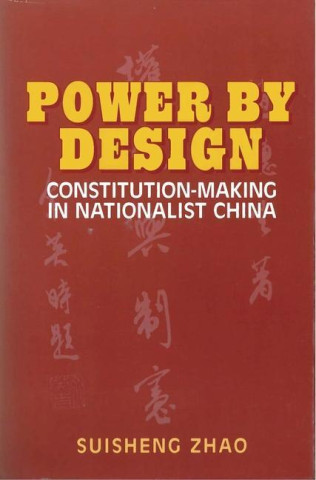
Power by Design
by Suisheng Zhao
First established as a cabinet system in Guangzhou in 1925, the Nationalist Government of China was replaced three years later by a presidential system under a unified Nationalist government in Nanjing. The cabinet government was ... more


- Language:
 English
 - Binding: Hardback
- Number of pages: 232
Publisher: University of Hawai'i Press, 1996
- More about this

33.08 €
Availability:
50/50 We think title might be available. Upon your order we will do our best to get it within 6 weeks.
We search the world
You might also like
-

Trotskyism In The United States
66.48 € -9 % -

Blue Wolf
47.15 € -

Britains Civilian Toy Figures
35.51 € -26 % -

A Journey Through the Evidence of Islam and the Holy Quran's Divine Origin
10.31 € -2 % -
L'Art de la ponctuation. Le point, la virgule et autres signes fort utiles
9.60 € -

Teacher Educators in the Twenty-first Century
39.15 € -

Risk Worth Taking, A
12.54 € -9 %
Give this book as a present today
- Order book and choose Gift Order.
- We will send you book gift voucher at once. You can give it out to anyone.
- Book will be send to donee, nothing more to care about.
Availability alert
Enter your e-mail address and once book will be available,
we will send you a message. It's that simple.
More about Power by Design
You get 80 loyalty points
 Book synopsis
First established as a cabinet system in Guangzhou in 1925, the Nationalist Government of China was replaced three years later by a presidential system under a unified Nationalist government in Nanjing. The cabinet government was restored in 1931 and existed until the presidential system was again installed by the 1936 constitution. Why did presidential and cabinet systems exist alternately during this formative period of the Nationalist government? Why was the presidential system finally adopted in 1936? Suisheng Zhao answers these and other questions fundamental to understanding authoritarian regimes in this pioneering study of the design of the Nationalist Government of China from 1925 to 1937. Borrowing ideas from public choice theory, Zhao proposes that political actors who design governmental institutions are driven by power-maximization strategies just as business firms are driven by wealth-maximization strategies. Constitution-making reflects the underlying distribution of power among authoritarian leaders, who attempt to design political institutions that will consolidate their personal power and position. Thus, Zhao argues, if political actors possess more power resources than their rivals and anticipate themselves becoming dominant, they will choose the singular leadership of the presidential system. If they are in a weaker position and do not anticipate becoming dominant, they will prefer the collective leadership of the cabinet form of government.
Book details
Book category Books in English Society & social sciences Politics & government Political structure & processes
33.08 €
- Full title: Power by Design
- Subtitle: Constitution-making in Nationalist China
- Author: Suisheng Zhao
- Language: English
- Binding: Hardback
- Number of pages: 232
- EAN: 9780824817213
- ISBN: 9780824817213
- ID: 06366035
- Publisher: University of Hawai'i Press
- Weight: 380 g
- Dimensions: 217 × 147 × 19 mm
- Date of publishing: 31. December 1996
Trending among others
-

The Prince
10.11 € -29 % -

The Prince
4.65 € -23 % -
Republic
7.88 € -24 % -

Democracy in America: The Complete and Unabridged Volumes I and II
6.47 € -29 % -

How Democracies Die
7.88 € -29 % -

How Democracies Die
14.26 € -27 % -

Likewar: The Weaponization of Social Media
14.76 € -25 % -

Theodore Rex
16.99 € -27 % -

Russia Hoax
16.18 € -17 % -

National Populism
12.23 € -20 % -

D'Annunzio
69.92 € -

Stalin, Vol. II
18.71 € -27 % -

Leadership in Turbulent Times
13.04 € -27 % -

Against Empire
14.76 € -25 % -

Red Notice: How I Become Putins No 1 Enemy
15.07 € -2 % -
Signal and the Noise
14.66 € -28 % -

Constitution of the United States
4.24 € -30 % -

The Road to Unfreedom
11.43 € -34 % -

Hitler
19.02 € -29 % -

Prince
16.28 € -29 % -

Stalin, Vol. I
17.09 € -33 % -

Democracy for Realists
18.21 € -25 % -

How to Run a Country
10.41 € -50 % -

Tyranny of Merit
13.85 € -10 % -

Twilight of Democracy
13.55 € -22 % -

Zeit der Oligarchen
11.93 € -15 % -

Thomas Jefferson: The Art of Power
18.91 € -25 % -

Listening to Grasshoppers
12.94 € -30 % -

Obama: An Intimate Portrait
34.80 € -34 % -

Suicide of the West: How the Rebirth of Tribalism, Nationalism, and Socialism Is Destroying American Democracy
14.76 € -28 % -

America's Constitution
18.31 € -24 % -

Life of Mahatma Gandhi
15.98 € -25 % -

My Way
25.09 € -4 % -

Quotable Jefferson Davis
13.96 € -1 % -

Stalin
18.31 € -24 % -

Campbell-Bannerman
13.96 € -24 % -

Wellington
14.87 € -30 % -

Lloyd George
13.96 € -24 % -

Legislative Lobbying in Context
71.94 € -
Constitutionalism & the Separation of Powers, 2nd Edition
29.24 € -9 % -

Civil War in Syria
36.42 € -

Asquith
13.96 € -24 % -

Ramsay Macdonald
14.87 € -15 % -

Baldwin
14.87 € -15 % -

Anarchy, State, and Utopia
25.39 € -

Democracy in America
12.03 € -25 % -

How to Stand Up to a Dictator
15.17 € -28 % -

Prince
6.77 € -14 % -
Republic and The Laws
9.71 € -25 %
Collection points Bratislava a 12837 dalších
Copyright ©2008-26 najlacnejsie-knihy.sk All rights reservedPrivacyCookies

 25678 collection points
 Delivery 2.99 €
 02/210 210 99 (8-15.30h)