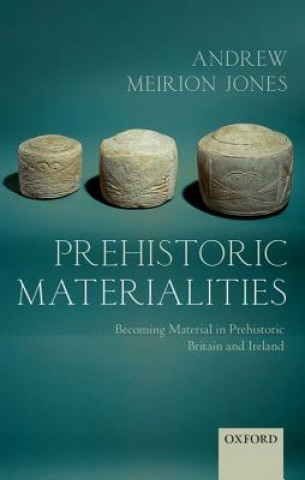
Code: 01323412
Prehistoric Materialities
by AndrewMeirion Jones
Humans occupy a material environment that is constantly changing. Yet in the twentieth century archaeologists studying British prehistory have overlooked this fact in their search for past systems of order and pattern. Artefacts a ... more


- Language:
 English
 - Binding: Hardback
- Number of pages: 256
Publisher: Oxford University Press, 2012
- More about this


You might also like
-

That Time I Got Reincarnated as a Slime, Vol. 11 (light novel)
11.32 € -25 % -
Euclidean Geometry
27.81 € -25 % -

360 Degrees of the Zodiac
19.31 € -2 % -

Define the Relationship 03
16.28 € -10 % -

Mathematical Paradise: Getting to Know Fibonacci Numbers
14.86 € -7 % -

Todo sobre Pitagoras
10 € -6 % -

spirit of masonry in moral and elucidatory lectures. By Wm Hutchinson ...
26.29 € -2 % -

Shakespeare Lexicon, Vol. 1
46.32 € -2 % -

Practice of Pure Awareness
55.93 € -26 % -

Nearest East
31.75 € -9 % -

Helvetica forever, deutsche Ausgabe
38.73 € -

Experiencing Film Music
58.26 € -

Ruckfalle
8.18 € -9 % -

Cuando Acabe La Musica
17.59 € -24 % -

Retailing in the Twenty-First Century 2nd Edition
54.41 € -

Where Zebras Go
8.69 € -25 % -

When Bunnies Go Bad
24.17 € -9 % -

Control of the Cardiovascular and Respiratory Systems in Health and Disease
98.11 € -

Old American Houses And How To Restore Them - 1700-1850
31.55 € -10 % -

30 budowli, które musisz znać
3.94 € -20 % -

Unleash The Voices Within
39.14 € -1 %
Give this book as a present today
- Order book and choose Gift Order.
- We will send you book gift voucher at once. You can give it out to anyone.
- Book will be send to donee, nothing more to care about.
More about Prehistoric Materialities
You get 460 loyalty points
 Book synopsis
Humans occupy a material environment that is constantly changing. Yet in the twentieth century archaeologists studying British prehistory have overlooked this fact in their search for past systems of order and pattern. Artefacts and monuments were treated as inert materials which were the outcomes of social ideas and processes. As a result materials were variously characterized as stable entities such as artefact categories, styles or symbols in an attempt to comprehend them. In this book Jones argues that, on the contrary, materials are vital, mutable, and creative, and archaeologists need to attend to the changing character of materials if they are to understand how past people and materials intersected to produce prehistoric societies. Rather than considering materials and societies as given, he argues that we need to understand how these entities are performed. Jones analyses the various aspects of materials, including their scale, colour, fragmentation, and assembly, in a wide-ranging discussion that covers the pottery, metalwork, rock art, passage tombs, barrows, causewayed enclosures, and settlements of Neolithic and Early Bronze Age Britain and Ireland.
Book details
Book category Books in English Humanities History Regional & national history
190.06 €
- Full title: Prehistoric Materialities
- Author: AndrewMeirion Jones
- Language: English
- Binding: Hardback
- Number of pages: 256
- EAN: 9780199556427
- ISBN: 0199556423
- ID: 01323412
- Publisher: Oxford University Press
- Weight: 424 g
- Dimensions: 149 × 216 × 19 mm
- Date of publishing: 19. July 2012
Trending among others
-

Ethnic Cleansing of Palestine
14.35 € -17 % -

The Fourth Turning
20.12 € -11 % -
Line in the Sand
10.41 € -30 % -

Ataturk
14.96 € -29 % -

On China
16.88 € -34 % -

Illustrated Encyclopedia of Uniforms of the American War of Independence
21.23 € -25 % -

'Tis
11.83 € -25 % -

Arabs
22.24 € -12 % -

Easy Company Soldier
14.76 € -28 % -

Civil War
9.30 € -24 % -

Reconstruction of Nations
28.31 € -

Rosicrucian Enlightenment
24.77 € -7 % -

Ancien Regime and the Revolution
13.85 € -26 % -

Hungarian and Bulgarian Aces of World War 2
20.52 € -14 % -

Roman Legionary Fortresses 27 BC-AD 378
18.10 € -15 % -

Battle That Stopped Rome
14.05 € -25 % -

History of the Middle East
18.50 € -23 % -

Washington
17.59 € -24 % -

Athene Palace
24.17 € -

Modern Ireland 1600-1972
18.60 € -25 % -

Balloon-busting Aces of World War 1
20.52 € -14 % -

Penguin Historical Atlas of Ancient Egypt
16.48 € -26 % -

Polish Saber
55.83 € -
Civil War
12.84 € -14 % -

Vanished Kingdoms
17.89 € -29 % -

American Civil War
14.15 € -29 % -

Romanian Aces of World War 2
20.52 € -14 % -

Irish Freedom
18.10 € -25 % -

Molotov Remembers
24.17 € -
Inanna, Lady of Largest Heart
30.54 € -9 % -

Elizabeth's Women
18.10 € -25 % -

Croatian Aces of World War 2
20.52 € -14 % -

Ottoman Age of Exploration
31.15 € -

Nations and Nationalism since 1780
15.47 € -25 % -

Vivid Faces
16.07 € -24 % -

Great Departure
16.07 € -21 % -

Concise History of Albania
34.48 € -

Israel-Palestine Conflict
39.74 € -

Ireland Since the Famine
19.41 € -20 % -

Spanish Army of the Napoleonic Wars (1)
15.77 € -15 % -
Empires and Barbarians
30.64 € -24 % -

Knights Templar
8.69 € -25 % -

German Army 1939-45 (3)
15.77 € -15 % -

Henry VI
27.40 € -20 % -

Brief History of the Martial Arts
19.92 € -19 % -

Japan After Japan
41.16 € -

Sophia
16.07 € -24 % -

Britain After Rome
16.07 € -24 % -

London
31.65 € -24 %
Collection points Bratislava a 12441 dalších
Copyright ©2008-26 najlacnejsie-knihy.sk All rights reservedPrivacyCookies

 24886 collection points
 Delivery 2.99 €
 02/210 210 99 (8-15.30h)